

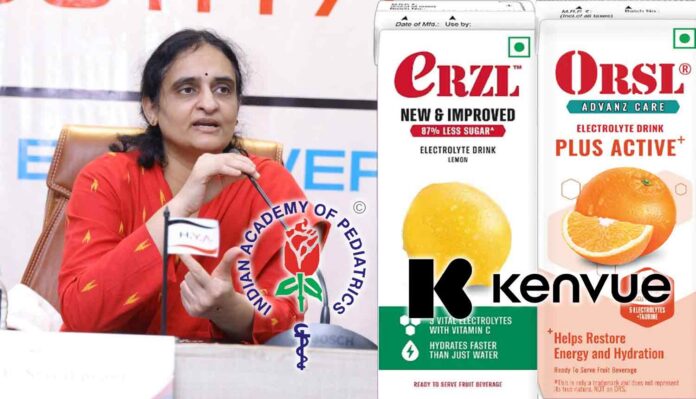
Dr Sivaranjani Santosh, a Hyderabad-based paediatrician, has resigned from the Indian Academy of Paediatrics (IAP) after saying that the body did not support her long fight against misleading labelling of certain beverage products as ORS. Her decision comes after years of raising concerns about how some companies marketed fruit-based drinks in a way that could confuse consumers into believing they were genuine Oral Rehydration Solutions.
Explaining her decision, Dr Santosh told The Indian Express, “After I raised the issue about the new branding of the Kenvue drink resembling the old one, thereby confusing people into believing that it was an ORS, the company issued a statement in which it mentioned that all their drinks have a scientific basis and they also presented it at Pedicon, which is a conference organised by IAP.”
She questioned the claim, saying, “First, putting up a stall at a conference does not mean presenting it; it just means that the company funded it.” She further alleged that when she approached the IAP for support, the response was disappointing. “I reached out to the IAP, asking them to condemn this statement as well as the notice against me by Kenvue. Instead, the IAP leadership asked other members not to speak about it until they looked into it and later issued a confusing position statement.”
Dr Santosh also expressed concern over the wording of the IAP’s statement. She said, “The statement did not talk about all non-nutritive sweeteners… It specifically talked about sucralose used by Kenvue in its new product… This position paper can now be used by the company if they file a defamation suit against me.”
Notably, FSSAI last year banned the use of ‘ORS’ labelling on beverage products that do not conform to the World Health Organisation’s (WHO) approved formulation for Oral Rehydration Solution. ORSL marketed by Kenvue was one of the major brands impacted by this order. In response to the order, Kenvue changed the brand to eRZL, but Dr Sivaranjani Santosh alleges that the styling of the package still resembles ORS, and consumers may get misled by this.
Kenvue has already sent a legal notice to the doctor over her objections to the new brand.
Concerns over sweeteners and child health
Dr Santosh has consistently warned about the health risks of such beverages, especially for children. She pointed out that products labelled or marketed like ORS but not following proper medical standards can be dangerous.
According to her, excess sugar in such drinks can worsen dehydration. “The problem is that excess sugar pulls more water to the gut and can lead to severe dehydration and diarrhoea in already sick children,” she explained, adding that in serious cases, it could even become life-threatening without timely treatment.
She also raised concerns about artificial sweeteners like sucralose. Even though marketed as a healthier alternative, she said these can also draw water into the gut and worsen diarrhoea in sick children. For healthy children, she advised that regular consumption of such non-nutritive sweeteners should not be encouraged.
A report by the World Health Organisation (WHO) has also highlighted risks linked to such sweeteners, noting increased chances of type-2 diabetes and cardiovascular disease with higher intake.
Background: ORS labelling controversy
The controversy began when India’s apex food regulator restricted companies from using the term ORS for products that do not meet the WHO-recommended formulation. Despite this, one company, Kenvue, rebranded its product as an “everyday hydration solution” under a new name, eRZL.
Dr Santosh raised objections, saying the new product looked almost identical to the earlier one. According to her, the packaging used a similar four-letter name, the same colour scheme, font style, and even the same fruit image, which could easily confuse customers and retailers.
She formally challenged this by filing a trademark opposition earlier this year. “No child should end up in a coma after a bout of diarrhoea because the parents mistook a product to be genuine ORS,” she said, stressing the seriousness of the issue.
She explained that while the company’s WHO-approved ORS product, sold under the name ORS, was appropriate for medical use, the newer versions of eRZL were not meant for treating dehydration caused by diarrhoea. One version contains significantly less sugar but includes sucralose, which she believes still carries risks.
Company’s response
Responding to the controversy, Kenvue, formerly part of Johnson & Johnson, said it has been transparent about its products. In an earlier statement, the company said, “ORSL is now the exclusive brand name of our WHO ORS drug portfolio… whereas eRZL is our new and improved electrolyte drink portfolio designed for everyday hydration.”
The company added that it always recommends its WHO-approved ORS product for cases of diarrhoeal dehydration and has maintained clear communication with healthcare professionals and consumers.
