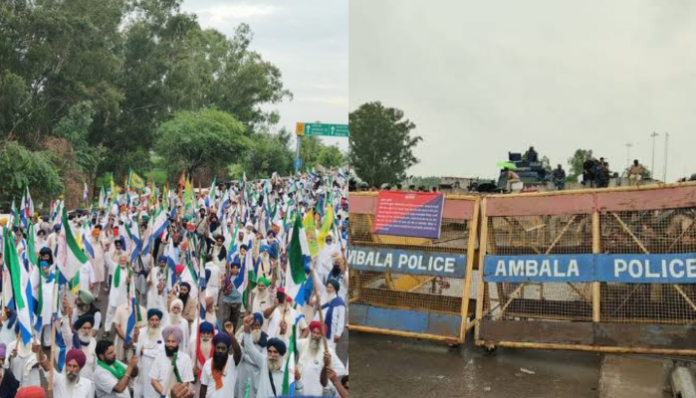
On 21st July (Tuesday), a protest is scheduled to take place at Delhi’s Kisan Ghat. It was announced by the Desh Bachao Morcha against the proposed trade deal between United States and India. According to the organisers, nearly 550 unions of farmers and social groups would attend the event from all over the nation.
However, the Haryana government has sealed the Shambhu border ahead of this gathering which triggered an agitation on the location which has a heavy police presence. Barricades were built and cement blocks were positioned at the bridge over the Ghaggar River.
The farmers charged both Punjab and Haryana governments with obstructing their march to the purported “Kisan Mahapanchayat.” They charged that the Haryana police erected roadblocks on Punjab’s territory, but the latter did nothing to stop them. Buses were set to transport farmers from various parts of the border state to the national capital.
#WATCH | A large number of farmers reach Shambhu Border (Punjab-Haryana border) ahead of their scheduled march to Delhi today. Visuals from Patiala (Punjab) side. pic.twitter.com/dJtdEt0qti
— ANI (@ANI) July 21, 2026
On 16th July (Thursday) morning, convoy carrying around 1000 farmers departed from Gurdwara Sri Fatehgarh Sahib and reached Madhopur close to Sirhind on the Grand Trunk (GT) Road. Afterwards, they started their journey to Shambhu border.
Gurnam Singh Charuni, the head of the Bharatiya Kisan Union (Charuni) was reportedly arrested by police in Kurukshetra on his way to Delhi for the Mahapanchayat, a day earlier. Prince Waraich, the organisation’s spokesperson, had stated that many of its members were being held by the cops in an effort to prevent them from participating in the demonstration.
The farmers from Haryana made their way from Ambala, Kurukshetra and other places to reach their destination. Sarwan Singh Pandher, a representative of the Kisan Mazdoor Sangharsh Committee (KMSC) stated that people from his outfit, Kisan Mazdoor Morcha (Punjab Chapter), Azaad Kisan Morcha (AKM) and Bharti Kisan Union (BKU) Ekta Sangharsh had proceeded from multiple areas of Punjab.
VIDEO | Haryana Police put concrete barricades at Shambhu border as farmers prepare to head to Delhi for a planned 'mahapanchayat' to protest against the proposed Indo-US trade deal.
— Press Trust of India (@PTI_News) July 21, 2026
(Full video available on PTI Videos – https://t.co/n147TvrpG7) pic.twitter.com/kfjwDQXnEW
Pandher accused the centre of not involving any “stakeholders” regarding US-India Free Trade Agreement (FTA) which he claimed was being inked signing “in a secret way as the government tells us nothing about it.” He insisted, “All that we get to know is from the US side through their press releases,” remarking that they are going to Delhi to ask Prime Minister Narendra Modi about it.
Pandher added, “People from Haryana, Rajasthan, Himachal Pradesh, Maharashtra, Uttar Pradesh and Uttarakhand are also coming for this one-day rally.” He declared that they wished for the deal to be completely scrapped.
Pandher highlighted that the two nations in a February joint release agreed to work towards drafting the first tranche of a mutually beneficial, multi-sector bilateral trade agreement (BTA) by fall. He expressed that this suggested the deal could even extend to include agriculture, dairy, industry, digital trade, e-commerce, government procurement, intellectual property rights and services.
He stated that prior US trade paperwork and yearly related reports have continuously advocated enhanced market access in India’s dairy and agricultural industries. These documents have pushed for lower tariffs on soybeans, corn (maize), cotton, ethanol, apples, almonds, and other agricultural commodities alongside more market access for its dairy products, poultry, fruits, fisheries products, coconuts and other commodities in India.
#WATCH | Amritsar, Punjab | Kisan Mazdoor Sangharsh Committee leader & coordinator for Desh Bachao Morcha, Sarwan Singh Pandher, along with farmers, to leave for Delhi today for a one-day rally to protest against India-US FTA
— ANI (@ANI) July 20, 2026
He says, "Desh Bachao Morcha has called for a one-day… pic.twitter.com/odIbzFZwz7
Germanjit Singh Bandala, the leader of the Kisan Mazdoor Sangharsh Committee Punjab, claimed that the agreement will negatively impact Indian labourers, farmers, small merchants and the general public. He asserted that it disregarded the interests of India’s small and marginal cultivators in favour of American businesses and farmers.
According to Bandala, US agriculture is conducted on a considerably greater scale, with farms spanning thousands of acres and receiving significant government subsidies. On the other hand, the majority of Indian farmers receive much less financial assistance and only possess two to two and a half acres of land. He argued that the low-income community would find it difficult to compete if the arrangement allowed cheaper agricultural imports from the US to enter the country’s market which would prompt a dramatic drop in their earnings.
Bandala stressed that New Delhi was proceeding with the pact under pressure from Washington while previous governments shielded the agricultural sector from undue foreign interference, mentioning that the repercussions could hamper small businesses and employment opportunities in other industries as well.
Farmer groups conveyed that approval of cheaper agricultural imports under the deal would badly affect farmers, workers, livestock rearers, small traders, micro industries and the agricultural sector. Bandala described the demonstration as “only the beginning” and threatened escalation if their demands were not met.
The Desh Bachao Morcha pressed the government to refrain from accepting any contracts without conducting thorough discussions with farmers, workers, dairy producers, small traders and other stakeholders. They also wanted all documents pertaining to the planned FTA to be made public.
The authenticity of the claims
It is important to realise that India-US FTA has not yet been ratified despite the uproar, supposed vulnerabilities and agitations to protect the interests of farmers. Union Minister Piyush Goyal recently informed that negotiations are underway to achieve a “good deal” that satisfies both nations. However, the charges seem to be based more on insinuations, suspicions and doubts rather than on the facts that clearly point to strict protections for Indian sensitive farming sectors.
The government has already explained that the pact “fully safeguards India’s agricultural interests, particularly those of the farm and dairy sectors.” Union Minister Shivraj Singh Chouhan outlined that “no sudden or disruptive entry of foreign products will take place in the Indian market.” He emphasised that all important crops, food grains, fruits and dairy products remain secure and no market segment has been opened in a manner that could hurt Indian farmers.
The centre assured that the deal would put pressure on domestic farmers and the protections for significant agricultural commodities continue to be in place in relation to contention about greater availability of American farm products in local markets.
Furthermore, the statement issued by India and US in February addressed the removal and reduction of tariffs on Dried Distillers Grains, red sorghum for animal feed, tree nuts, fresh and processed fruits, soybean oil, wine, spirits and similar other products. India already imports them to fulfill domestic demand gaps.
However, it did not mention any major staple crops such as rice, wheat or maize. The reductions are specifically aimed at industrial and supplementary goods that do not compete with the core agricultural products of Indian farmers. Hence, any claims to the contrary are incorrect.
Last year, US Commerce Secretary Howard Lutnick even lashed out, “India brags that they have 1.4 billion people, then why wouldn’t they buy one bushel of corn from us? Doesn’t that rub you the wrong way. That they sell everything to us, and they won’t buy our corn. They put tariffs on everything,” in an interview. His comment exuded frustration, but it also underscored the government’s refusal to succumb to pressure while maintaining the welfare of its farmers at the forefront.
Notably, PM Modi echoed the same sentiment when he stated, “For us, the interest of our farmers is our top priority. India will never compromise on the interests of farmers, fishermen and dairy farmers. I know we will have to pay a heavy price for it, and I am ready for it. India is ready for it.” He has consistently provided these reassurances to alleviate authentic concerns.
Washington is indeed interested in gaining wider access to Indian markets, yet New Delhi has repeatedly turned down their demands, prioritising its own farmers and other sectors associated with the industry. This has contributed to the delay in finalising the agreement.
However, how can facts be permitted to impede propaganda? Thus, a similar situation has taken shape in yet another demonstration in the name of farmers, featuring emotional appeals, anger and allegations that bear no relation to the reality. Of course, they are also not concerned with the disruption of public life or the inconvenience caused to commuters.
Farmers or self-interest groups
These entities, created under the guise of upholding interests of farmers have surfaced as their biggest opponents as evidenced during the agitation against the three farm laws. The ordinance, which had the potential to transform the agricultural sector, was ultimately repealed due to the unyielding protests and violence instigated by these organisations.
The laws would have enabled the farmers to bypass the state-controlled Agricultural Produce Marketing Committee (APMC) mandis and sell directly to private buyers, corporations and supermarkets as well as ended the role of traditional middlemen who dominated this system and dictated lower prices to them. This would have also prevented crop loss and low-price wastage by facilitating direct sales to private players, contract farming and improved private storage.
However, a massive agitation was launched to mislead the unsuspecting public by asserting that the government intends to seize the land of farmers and transfer it to industrialists, who would then dominate the sector, ultimately destroying the livelihoods of those associated with it. These outfits were fighting to keep the middlemen in mandis who are infamous for their exploitative practices against farmers.
They ruined a crucial opportunity that could have revolutionised the agricultural sector and improved the lives of farmers instead of participating in a dialogue and pursuing a mutually agreeable solution. Moreover, their violent antics at the Lal Qila, brutal assault on cops and the associated loss of life and property were apparent to everyone.
Now, as India stands on the brink of a major advancement with the FTA, they have once again awakened from their slumber to halt yet another progressive and advantageous move for the country.
These groups appear to be solely focused on aggressive actions aimed at compelling the government to yield to their demands, driven by their egos and ulterior motives under the pretext of representing farmers. Otherwise, they would have opted for dialogue instead of repeatedly taking to the streets and fostering confrontational scenarios. In essence, they function like pressure cartels, pursuing their own financial and political gains while masquerading as champions of farmers and their interests to deceive the masses.
The objective has remained consistent, from rejecting the critical farm laws to protesting against the trade deal, which is still under negotiation and has yet to reach a final agreement.