

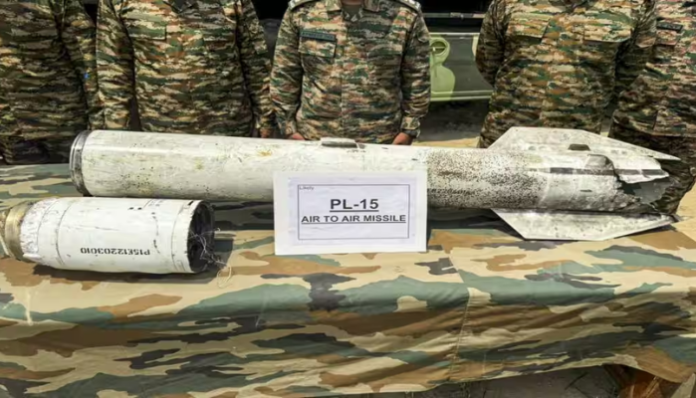
In a significant development for India’s military capabilities, the Defence Research and Development Organisation (DRDO) is set to give its homegrown Astra missile a major technological upgrade, a report in Hindustan Times stated. This move comes after Indian forces recovered an almost intact Chinese PL-15 missile on 9th May that had been fired by a Pakistani jet during Operation Sindoor, which was India’s military response to the tragic Pahalgam terror attack that killed 26 civilians.
The PL-15 was found in a relatively undamaged condition in Punjab’s Hoshiarpur.
During the operation, a Pakistani Air Force fighter, believed to be either a JF-17 or a J-10C, launched the Chinese-made PL-15 missile. However, the rocket failed to hit its target and landed unexploded in a field near Hoshiarpur, Punjab, roughly 100 kilometres inside Indian territory. For Indian defence scientists, this was a rare intelligence opportunity. This export version of the missile, with a range of 145 kilometres, lacks a self-destruct mechanism, a feature that is standard in all Indian air-to-air missiles.
After a thorough analysis, DRDO scientists discovered several features in the Chinese weapon that could be useful. As per the HT reports, the PL-15 is equipped with a miniature Active Electronically Scanned Array (AESA) radar, which is essentially a very powerful and smart mini-radar for guiding the missile. It also has an advanced engine that allows it to maintain incredible speeds of over Mach 5 and sophisticated anti-jamming capabilities to prevent it from being thrown.
The DRDO has now decided to incorporate these key technologies, especially the AESA radar, into its own indigenous Astra Mark-2 missile development programme, giving it a significant edge.
Earlier, there were reports that several foreign powers, including the Five Eye nations led by the USA and South Korea, Japan, and France were interested to study the PL 15 missile recovered by Indian forces.
It is notable here that recovery of an almost intact missile was considered a rare opportunity and multiple nations had shown interest in it. Military history from around the world is replete with examples where recovered, or captured weapons from a rival power were used t develop and upgrade existing designs.
How captured equipment from rival powers are used to upgrade and develop advanced weapons
During and after World War II, the USA obtained V-2 rockets from the Germans and brought dozens of them to its research facilities. They reverse-engineered the rockets and made the PGM-11 Redstone IRBM. The same technology then laid the groundwork for the Saturn V rockets, catapulting US capabilities in the space race.
The Soviets, in a similar manner, extensively studied the B-29 Superfortress bombers that had forced landed in Vladivostok. They eventually developed the Tupolev Tu-4, with upgraded radar and engines.
China itself has developed its J-20 stealth fighters by basing them on the F-117 Nighthawk, a wreckage of which they obtained from Serbia, as per multiple reports. Iran’s Shahed drones are said to be based on the RQ-170 Sentinel drone, after managing to land a hacked drone inside their territory.
It is notable here that no country officially acknowledged that they ‘based’ their weapons upgradation on a rival power’s captured technology. But it is common knowledge all over the world that when an advanced weapon, even a wreckage of it, lands in the territory of a rival power, it is treated as a prime piece of intelligence and studied extensively.
Lessons from combat
Operation Sindoor and its aftermath have kicked off a new round of strategic planning in the region. According to reports, Pakistan is now looking to further enhance its arsenal. They are reportedly seeking to buy even longer-range PL-17 missiles from China, 2,000 YIHA of kamikaze drones from Turkey, and have also submitted a list of high-tech weapon requirements to the United States.
India, in response, is not standing still. While its own weapons like the BrahMos, Rampage, and SCALP missiles performed very well during Operation Sindoor, defence planners are taking no chances. India is moving to acquire more Meteor missiles for its Rafale fighters and is also developing a next-generation BrahMos missile with a massive 800-kilometre range.
This is part of a new strategy where Indian fighters will operate from a safe distance, outside the range of Pakistan’s Chinese HQ-9 air defence systems, while launching long-range supersonic missiles.
Indian security officials have also expressed concern over ceasefire violations. They noted that even after a ceasefire was formally declared at 5 pm on 10th May, Pakistan continued its attacks by firing armed kamikaze drones and rockets into the Jammu and Rajasthan sectors. While India did not retaliate at the time, New Delhi has made it clear that it will not be as forgiving in any future incidents.
