

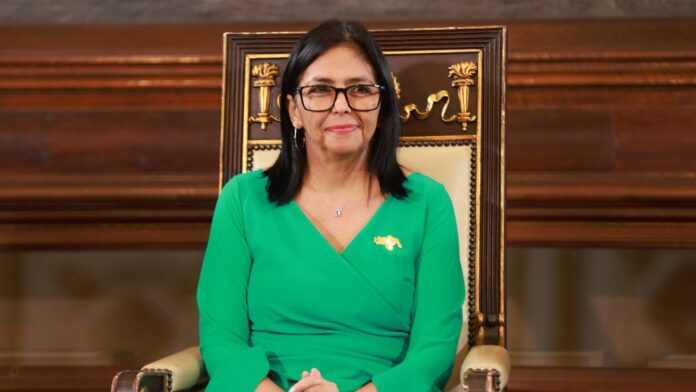
Venezuela’s interim President Delcy Rodríguez delivered a forceful rebuttal to recent U.S. assertions about her country, dismissing Washington’s accusations on drugs, democracy, and human rights as pretexts for a deeper strategic aim centred on Venezuela’s oil resources.
Speaking to the Venezuelan National Assembly, Rodríguez argued that these narratives have long been deployed not to address real issues, but to justify foreign interference aimed at controlling the nation’s rich energy reserves, the largest in the world.
Rodríguez said Venezuela’s status as an “energy powerhouse” has made it a target for what she described as the “energy greed of the North.” She challenged the legitimacy of U.S. claims on narcotics and human rights, saying those issues have repeatedly been used to mask the true objective: securing unfettered access to Venezuelan oil.
“We are an energy powerhouse…. Claims about drugs, democracy, and human rights have been used as excuses for one real goal: control of our oil,” Rodriguez said.
Venezuela’s Acting President Delcy Rodríguez:
— Clash Report (@clashreport) January 8, 2026
Venezuela is an energy powerhouse, and that reality has brought serious challenges.
Claims about drugs, democracy, and human rights have been used as excuses for one real goal: control of our oil. pic.twitter.com/sQ1ABleGCB
Her remarks followed a high-profile statement by U.S. President Donald Trump, who claimed that Venezuela’s interim government was offering “full cooperation” and suggested that the United States would oversee Venezuelan oil production and sales for years to come. Trump’s comments came amid a broader U.S. campaign that includes military pressure and the seizure of sanctioned tankers linked to Venezuelan crude.
At the same time, Rodríguez sought to frame her government’s position as pragmatic rather than confrontational. She emphasised that Caracas is willing to enter into energy partnerships and commercial contracts that benefit all parties involved, provided those agreements are transparent, defined by clear economic terms, and rooted in international law. This, she said, reflects Venezuela’s desire to diversify its energy relationships rather than cede control to one external power.
Rodríguez also defended Venezuela’s recent stance toward the United States, saying that while past attempts to remove her predecessor, Nicolás Maduro, have strained bilateral ties, engaging in lawful trade — including in energy — is neither unusual nor inappropriate. Her comments highlighted a consistent theme: Venezuela’s willingness to negotiate commercially while rejecting what she portrays as coercive or illegitimate interference.
Against this backdrop, the U.S. government has taken steps to seize Venezuelan oil assets and tankers, asserting control over future sales and export revenue. Washington says this effort is part of a broader strategy to restructure Venezuela’s energy sector and ensure that its immense oil wealth contributes to regional stability and economic recovery, even as critics argue it amounts to economic dominance under the guise of cooperation.
