

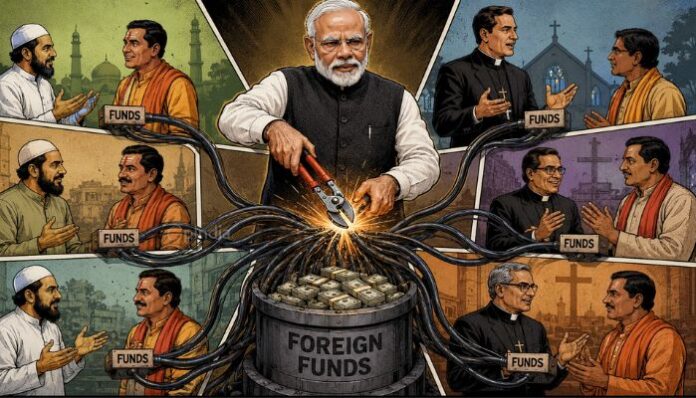
On 22nd June, the Government of India issued a Gazette notification tightening the FCRA Rules. According to the amendments, the government has explicitly kept proselytisation, or religious conversion, outside several faith-based activities for which foreign contributions can be received.
Under the Foreign Contribution (Regulation) Amendment Rules, 2026, organisations seeking FCRA registration will have to select their activities from a predefined list and disclose the states or Union Territories where the foreign-funded work will be carried out.
The new schedule permits foreign funding for religious education, sermons, satsangs, meditation retreats and the preservation of indigenous and tribal faith practices. However, these activities cannot include religious conversion.
The amendment assumes significance as organisations will no longer be able to obtain FCRA registration under a broad religious category without identifying the exact nature of their work. The approved purposes and geographical areas will also be mentioned on their registration certificates.
Conversion excluded from foreign-funded religious activities
The schedule introduced under the amended rules identifies 16 religious purposes for which an organisation may seek permission to receive foreign contributions.
These include the construction, renovation and maintenance of temples, mosques, churches, gurudwaras, monasteries and other places of worship. Foreign funds may also be received for printing and translating sacred texts, maintaining pilgrim facilities, running dharamshalas and community kitchens, promoting devotional music and preserving religious heritage.
Religious organisations can also receive foreign money for conducting religious education, moral instruction, satsangs, discourses and meditation retreats. However, conversion has been specifically excluded from these activities.
The same restriction applies to institutions working on religious philosophy, theology and religious history. Such institutions may receive foreign contributions for studying, documenting and preserving religious traditions, but not for carrying out conversion-related work.
The government has also excluded conversion from foreign-funded projects meant to document, preserve or revive indigenous and tribal faith practices, rituals and systems of worship.
In practical terms, an organisation cannot seek FCRA approval in the name of preserving tribal or indigenous traditions and then use the foreign contribution to convert members of those communities.
Similarly, an association receiving foreign funds to conduct religious education or sermons cannot use the same programme as a conversion campaign. The money must be spent only on the activity and purpose declared before the government.
The rules continue to allow foreign funding for religious publications, faith-based research, interfaith dialogue, religious museums and libraries, de-addiction centres, counselling programmes and the protection of sacred places and relics.
Rules regulate foreign funding, not conversion in general
The amendment does not create a general nationwide prohibition on religious conversion. It deals specifically with the receipt and use of foreign contributions under the FCRA. The development is important as funds are often pumped in under the guise of contributions to NGOs and are then used to convert vulnerable individuals, including members of poor Hindu families. There have been countless instances in which both Christian and Islamic NGOs have received foreign funding to push conversion activities.
The latest amendments keep conversion outside the approved scope of specified foreign-funded religious activities. An organisation may conduct the religious and charitable work listed in the schedule, but it cannot obtain or use foreign money under those categories for conversion.
The changes will also make it easier for the government to examine whether an organisation has used foreign funds for the declared purpose. Since the registration certificate will mention the approved activities and operating areas, any diversion of funds can be checked against the organisation’s stated scope.
The notification further clarifies that foreign contributions must be used only for activities carried out in India, in accordance with the organisation’s declared objectives and the purpose for which the money was received.
NGOs must declare exact purpose and operating area
Every organisation applying for FCRA registration will now have to choose its purpose from the schedule attached to the rules. The schedule divides eligible activities into religious, cultural, economic, educational and social categories. Each category contains a detailed list of activities rather than a single broad description.
Applicants must also identify every state or Union Territory in which they propose to use the foreign contribution. Both the purpose and the geographical area will be recorded on the FCRA registration certificate.
Associations already registered before the introduction of the 2026 rules have been given one year to inform the Centre about the purposes and states or Union Territories for which they want to retain their registration.
An organisation seeking to add or remove a purpose, state or Union Territory will have to apply to the government before changing the scope of its work. The application must be supported by a resolution of its governing body.
The Centre may approve or reject the request after conducting an inquiry.
The existing application fee will cover one purpose and operation in one state or Union Territory. An additional fee of Rs 300 will be charged for every additional purpose and every additional state or Union Territory.
Foreign nationals as key functionaries face restrictions
The amended rules have widened the definition of a “key functionary” in an organisation. It will now include company directors, partners in firms, trustees, the Karta of a Hindu Undivided Family, members of governing bodies and managing committees, and any other person responsible for controlling or managing the organisation’s affairs.
An association having foreign nationals, other than persons of Indian origin, as its key functionaries will ordinarily not be considered eligible for FCRA registration or prior permission.
The Centre may, however, issue a separate order identifying the cases in which foreign nationals can be permitted to serve as key functionaries and the conditions that such organisations must fulfil.
Spending and field verification requirements tightened
The government has also introduced a financial threshold for determining whether an association has carried out reasonable activity in its selected field.
For renewal or cancellation proceedings, an organisation will be deemed to have undertaken reasonable activity for the benefit of society if it has spent at least Rs 10 lakh in foreign contributions on its chosen purpose during the previous two financial years.
The activity counted for this purpose must have been carried out using foreign contributions received in accordance with the FCRA. Organisations receiving foreign money in instalments under prior permission will face additional checks.
The second or any subsequent instalment will be released only after at least 75 per cent of the foreign contribution received in the previous instalment has been used. The government will also conduct a field inquiry to verify the utilisation before allowing the next instalment.
The organisation must apply through the newly introduced Form FC-3BB and submit a Chartered Accountant-certified utilisation statement, relevant bank statements and a report on the activities carried out. Photographs and other supporting documents may also be sought.
Social media, donors and publications to be disclosed
Organisations applying for registration or filing annual returns will now have to disclose their official websites and social media accounts.
The rules also seek greater transparency where money is routed through Donor Advised Funds or other intermediary remittance vehicles. In such cases, the organisation will have to disclose the identity, address and email details of the ultimate donor, along with the amount received.
Annual returns will have to contain detailed, project-wise and location-wise activity reports explaining how foreign contributions were used. Organisations must separately disclose spending on activities, new assets and administrative expenditure.
They will also have to provide details of books, magazine articles, newspaper articles or other publications brought out by the association or its key functionaries during the year.
The form reiterates that an association covered by the relevant FCRA restriction cannot engage in the production or broadcast of news or current affairs through any form of mass communication.
Overall, the amendments replace broad declarations with purpose-specific and state-specific approvals. In the religious category, the most significant change is the clear separation between permissible faith-based work and religious conversion funded through foreign contributions.
US lawmakers had expressed concerns over FCRA amendments allowing seizure of NGO assets
Just 10 days before the latest amendments came into effect, US lawmakers had expressed concerns over the changes the Indian government has made to the FCRA rules in recent times. In a statement, they claimed that the proposed changes to the FCRA could “adversely impact civil society groups”, including Christian organisations.
Senator James Risch, head of the Senate Foreign Relations Committee, called the proposed changes “deeply concerning”. Speaking to Hindustan Times, he said, “India’s Foreign Contribution Regulation Act imposes onerous and opaque constraints on non-governmental organizations and groups that receive foreign funding, making their daily operations nearly impossible. Any efforts to use FCRA as an excuse to expand persecution or harassment of US-linked Christian ministries by seizing their funds or property would be deeply concerning.”
He further asserted that the US would not hesitate to “call out countries who violate the internationally recognised human rights of Christians and other religious groups around the world”. He expressed concerns over the government’s proposal to take over the assets of NGOs under the FCRA Rules.
