

HomeSpecialsBusting the big myth: Why data centres aren't the water villains they're made out...

Busting the big myth: Why data centres aren’t the water villains they’re made out to be

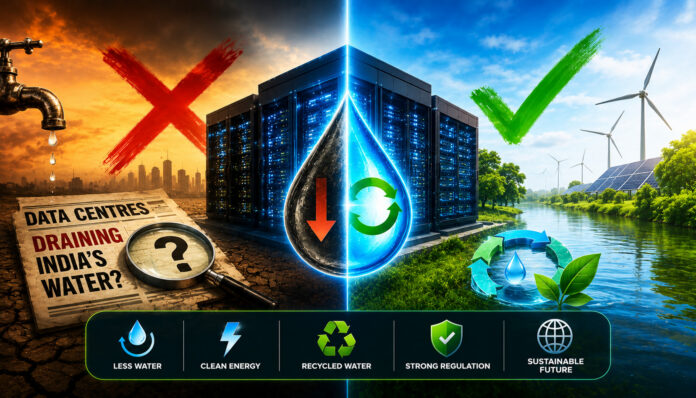
Between 0.02 and 0.03 percent of India's total water demand is accounted for by data centres.

Residents near a proposed technology campus on the outskirts of Visakhapatnam learned in the spring of 2025 that a big data centre complex, part of a joint venture comprising global technology interests, would be developed in their neighbourhood. Concerns arose within weeks on local channels and in regional media. Water was the concern, not employment or land as Visakhapatnam already faces severe seasonal shortages. People questioned how such a large facility would obtain water from a community that is already unable to consistently supply its own homes.

Andhra Pradesh was not the only state experiencing this concern. Technology experts have warned about data centres competing with civilians for water in Bengaluru, where tanker trucks travel the streets every day due to an unreliable water supply. Environmental researchers and community groups have voiced similar concerns in Chennai and Hyderabad. In short, the data centre business has earned a reputation in some circles as a silent and voracious consumer of India’s most contentious resource, water, one that takes from the city to supply the company while leaving ordinary citizens with less.

The worries are reasonable. In India, water is already a highly politicised resource, so any new large-scale industrial claim on it should be carefully investigated. The following is an attempt to offer precisely that scrutiny, without downplaying or exaggerating the issues beyond what the evidence warrants.

The prevailing narrative

Two primary sources provide the numbers that are most frequently used in critical reports on India’s data centre water use. India’s data centres might need almost 150 billion litres of water a year in 2025, according to Mordor Intelligence’s 2025 market research. This amount is predicted to increase significantly as the industry grows. Another piece of information that garnered a lot of attention was included in a November 2025 BBC report. According to S&P Global research, between 60 and 80 percent of India’s future data centre capacity may be situated in high water stress zones, which are areas where freshwater demand already approaches or surpasses available supply.

The total litres of water quoted is often compared to household consumption estimates in internet conversations and local news coverage. According to a widely distributed narrative, one huge facility uses as much water as thousands of domestic houses put together. The underlying message is one of diversion water meant for fields and taps is being diverted to chill servers that cater to businesses and their global clients.  

The language of crisis

The narrative is very powerful since it combines a number of different issues into one frightening image. The terms ‘water use,’ ‘water diversion,’ and ‘water pollution’ are frequently used interchangeably to refer to the same issue. A data centre that releases badly treated wastewater, uses water for cooling, or is situated in a water-stressed area is all indirectly portrayed as posing the same kind of harm. The terms guzzling and draining imply an endless and harmful appetite, which is reinforced by parallels to cities that are already obviously struggling with their water supplies.

Though technically incorrect, this confusion has emotional resonance. The evidence will demonstrate that this inaccuracy has a significant impact.   

Testing the claims against the evidence

The Council on Energy, Environment, and Water’s 2026 report, which thoroughly analysed data centre water infrastructure in India, provides the most notable correction to the mainstream narrative. Its conclusion should be put simply between 0.02 and 0.03 percent of India’s total water demand is accounted for by data centres. It reflects the true magnitude of India’s water economy.

Approximately 78-80% of India’s freshwater is used for agriculture. The majority of the remaining amount comes from domestic and industrial supply combined. By all reasonable measures, a sector that accounts for 0.02 to 0.03 percent of the country’s demand is a minor claimant in that situation rather than a dominating one. The estimate of 150 billion litres is close to accurate. However, it becomes almost insignificant when compared to the hundreds of trillions of litres that India’s agricultural sector withdraws each year.

Withdrawal is not consumption

This is the debate’s most significant logical part, which is rarely fully addressed by the media. Critics usually refer to water withdrawal, or the total amount of water that enters a data center’s cooling system, when they quote numbers of how much litres of water will be required. The amount of water that is permanently extracted from the local water cycle is not being measured. The single biggest source of misconception in the water discussion is confusing these variables, which are fundamentally different.

Data centre cooling towers function by evaporating some of their flowing water, as was described in the preceding article in this series. Somewhere in the larger water cycle, the evaporated water finally returns to Earth as rainfall after rising into the atmosphere as water vapour, which is pure, mineral-free, and chemically neutral. It neither vanishes nor gets polluted. It returns to the water cycle in the same way that it would have if it had evaporated from an irrigated field or a lake. The remaining water loss, known as blowdown, is drained in regulated amounts from the cooling basin, treated to eliminate concentrated minerals and leftover chemicals, and then either treated on site prior to any environmental release or released to municipal wastewater systems under regulatory supervision.

In the end, a large portion of the water that enters a data center’s cooling circuit is evaporated and returned to the atmosphere, another portion is recycled through regulated wastewater treatment, and a very small portion is captured by modern drift eliminators before it can escape due to drift, or the tiny droplets carried by fans. The headline of billions of litres thus measures something closer to cooling system throughput than real depletion of India’s water sources. The amount of water that is actually and permanently taken from the local water cycle is known as the real consumption figure, and it is significantly lower than the figure that is usually reported.

What the regulations already require

The current regulatory framework does not align with the image of data centres as uncontrolled consumers, free to extract from aquifers without repercussions. Discharge standards for industrial facilities have long been upheld by the Central Pollution Control Board, and state groundwater authorities must provide No Objection Certificates to data centres that use groundwater. Water efficiency requirements are now explicitly included in state level data centre policies. For instance, Rajasthan’s 2025 data centre policy mandates wastewater recycling and, for some classes, zero liquid discharge, which means that treated water must be reused inside the facility instead of being dumped into public drains.

According to a March 2026 Press Information Bureau release, the Indian government’s official stance on this issue is reserved. MeitY verified that groundwater extraction limits and CPCB discharge standards already apply to these facilities and stated that it has not received many complaints about the data centre sector’s unsustainable water use at the central level. That does not imply that there are no issues somewhere. In contrast to activist reports, it is an acknowledgement from the regulatory body in charge of monitoring the industry and has more weight as evidence.

What technology can do?

India is not the first nation to struggle with the issue of where to locate data centres when freshwater is limited. Other regions’ experiences provide valuable precedence.

One of the world’s most water stressed nations, Singapore, has developed a sizeable and globally important data centre industry. Highly treated recycled municipal wastewater, or NEWater, is increasingly being used by its operators as the main cooling system source. The city state’s officials have demonstrated that a regulatory framework may effectively reroute industrial water demand away from freshwater sources without sacrificing sector growth by making access to recycled water a requirement for data centre permits. 

Major operators, including Microsoft, have converted facilities to use recycled water, significantly lowering freshwater withdrawal while preserving cooling performance in parts of the American Southwest, particularly Arizona and California, where water stress is politically and legally significant. Microsoft has made a public pledge to become water positive by 2030, which means that throughout all of its international operations, it would replenish more freshwater than it uses. With a combination of closed loop cooling, hybrid systems, and recycled water sourcing, Equinix, which runs data centres in water constrained areas from California to the Middle East, has reported that in its most advanced facilities, Water Usage Effectiveness figures, litres of water consumed per kilowatt-hour of IT energy, are approaching or below 1.0.

These methods are already being incorporated into facility designs by a number of Indian operators and new foreign competitors. In locations where freshwater use is very sensitive due to the local water risk profile, air cooled and hybrid chiller systems are being used to reduce or eliminate evaporative water loss at the expense of slightly greater energy consumption. Even though it only applies to specific types of facilities, Rajasthan’s zero liquid discharge requirement indicates the direction of state regulation. There is technology available as well as the intent to regulate is developing. Whether deployment proceeds fast enough to outpace expansion is the question.

The argument nobody is making

The actions of data centre operators are not the most under reported issue in this discussion. It is a description of how the numbers behave. Water withdrawal, or the volume passing through cooling systems, is measured by billions of litres and is expected to increase. They are not indicators of net water loss from India’s hydrological cycle. Every litre that leaves a cooling tower and evaporates is released back into the atmosphere. Evaporated water from urban industrial sources is not fundamentally different from evaporated water from a reservoir or an irrigated paddy field in a nation with a monsoon climate, where atmospheric moisture is a significant driver of precipitation. It takes part in the same extensive moisture cycle that replenishes the subcontinent with water through rains.

In contrast, flood irrigation, which is still a common practice in India’s agricultural sector, sends large amounts of water into deep percolation and fruitless evaporation, which is lost to the larger system rather than returning as local rainfall. In this analysis, data centres do not appear to be worse water cycle actors. Compared to the dispersed, frequently unmonitored water losses of large scale irrigation, they may be better in some ways, with measured inputs, traceable outputs, and more regulated outflow.

The energy-water nexus

The connection between water use and energy generation is a second point that has been largely ignored in the data centre water dispute. Large amounts of freshwater is used by India’s thermal power sector, which includes nuclear, coal, and gas facilities, for its own cooling systems. According to data from the World Resources Institute and the International Energy Agency, one of the biggest industrial uses of freshwater worldwide is thermoelectric power generation, and India’s coal based structure is no different. A coal or gas plant needs freshwater cooling for each unit of electricity it produces.

Data centres are increasingly big buyers of renewable energy, solar, wind, and hybrid systems that use almost no water to generate. A long term power purchase agreement between a data centre company and a wind farm in Tamil Nadu or a solar developer in Rajasthan is more than just purchasing renewable energy. Demand that would normally be satisfied by a thermal plant that draws from a river or reservoir somewhere in the grid is being displaced. Any honest accounting of data centers’ relationship to India’s water supply must take into account the water saved in power generation by that displacement. No one is counting this credit at the moment.

Conclusion

In India, worries regarding water and data centres are not new. In many of the cities where these facilities are being constructed, water is actually under stress, so it makes sense and is good to be wary of new industrial claimants on that resource. However, scrutiny works best when it is accurate. When the evidence is closely reviewed, it reveals a sector that contributes very little to the country’s water demand, operates under an increasingly strong regulatory framework, and has access to and is starting to implement technology that can significantly reduce reliance on freshwater. Therefore, the more important questions are not whether data centres should be constructed, but rather whether the regulations governing them are strict enough, whether they use recycled or alternative water sources when available, and whether the measurement frameworks used to report their water use, differentiating withdrawal from consumption and accounting for the water implications of their energy choices, are honest enough to support a truly informed public debate.India has the opportunity to define what a water efficient data centre looks like in a tropical, monsoon climate. Engineering data and regulatory accuracy will better define that definition than headline figures that measure the incorrect thing.

Join OpIndia's official WhatsApp channel

  Support Us  

For likes of 'The Wire' who consider 'nationalism' a bad word, there is never paucity of funds. They have a well-oiled international ecosystem that keeps their business running. We need your support to fight them. Please contribute whatever you can afford

Divyansh Tiwari
Divyansh Tiwari
Transforming legal conundrums and global affairs into riveting prose where scholarly research meets real world significance.

Related Articles

Trending now

Shipbuilding for the future world: India’s navigation path

Rajendra Chola was not targeting the top-10 global position. He read the winds of change; he saw the ocean as a highway, and he projected power with all he had. He built his ships strong enough to accomplish his goals. If India is going to reclaim any part of that thousand-year-old legacy, we need to build ships that will accomplish ours.

CJP appoints former AAP functionaries to its National Working Committee: Know who they are

The CJP indirectly formalised itself as probably the ‘youth wing’ of the Aam Aadmi Party by inducting maximum present or former AAP functionaries into its National Working Committee.
- Advertisement -

