

Ever wondered why data centres guzzle so much water? Here’s the story in plain terms.
Walk into a big data centre and the first thing that hits you isn’t the tech, it’s the noise. Thousands of servers, packed into towering racks, running non-stop and throwing off heat like commercial ovens. Keeping all that hardware from melting down is basically the second most important job in the building, right after keeping the power on.
The trick engineers use is surprisingly elegant: hot air and cold air are kept strictly separate in ‘hot’ and ‘cold’ aisles, and units called CRAHs blow chilled air across the cold side using coils full of cold water. But where does that cold water come from? That’s where things get interesting, there are actually two separate water loops. One circulates cold water indoors between chillers and those air handlers. The other carries the heat outside to cooling towers, and it’s only in this outdoor loop that water actually gets used up for good. Cooling towers work exactly like the desert coolers common in Indian homes, just industrial sized. Hot water trickles over a wet surface, fans pull air through it, and as some water evaporates, it drags heat away with it, the same reason sweat cools your skin. Most of what’s called water consumption (as opposed to just withdrawal) happens through this evaporation. A smaller portion is deliberately drained off as “blow down” to stop mineral buildup, and treated properly before disposal. Only a tiny fraction, under 0.01%, escapes as stray droplets called drift.
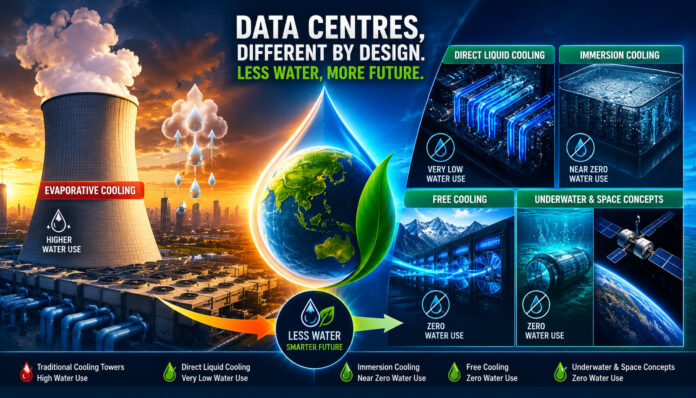
Now here’s the twist, AI is upending all of this. A single rack of AI chips can draw as much power as 100 Indian homes, and plain air just can’t carry that much heat away anymore. That’s pushing the industry toward newer, far less thirsty methods, Direct Liquid Cooling (piping coolant straight onto chips), full on immersion cooling (dunking servers in non-conductive fluid), and even free cooling that just uses naturally cool outside air. Microsoft has even tested underwater and orbital data centres to sidestep the water problem entirely.
For India, hot, water-stressed, and racing to build AI infrastructure, this isn’t academic. States like Rajasthan are already mandating recycled water and zero-waste discharge for new facilities.
The full article can be read in Chapter One Mag.


