

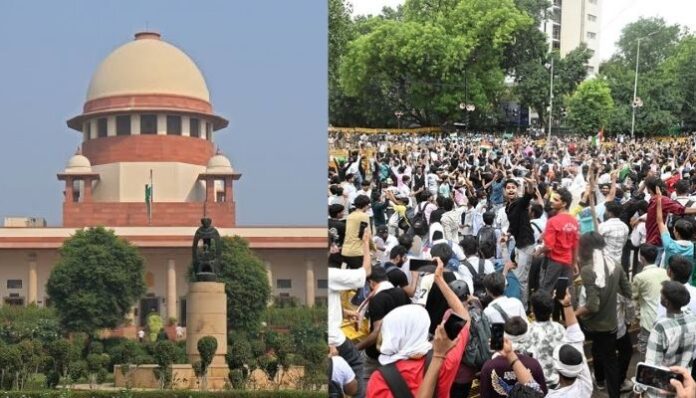
The Supreme Court on Tuesday, 1st September, quashed FIRs registered against protesters in connection with the 20th July Cockroach Janata Party (CJP) protests, but kept an important exception. The Delhi Police will remain free to take action against 2,873 people who were identified as having serious criminal antecedents, subject to the conditions laid down by the court.
The court said the Centre and Delhi Police can register fresh FIRs against these 2,873 people if an investigation establishes their involvement in serious offences such as causing bodily harm or damaging property during the protests. The court made it clear that this would not be a blanket exception covering everyone who attended the protest.
Why 2,873 protesters are an exception
The Delhi Police had earlier sought permission to register a fresh FIR against the 2,873 people, who were identified using facial recognition technology and were said to have serious criminal records. Solicitor General Tushar Mehta told the court that any fresh action would depend on an investigation establishing their involvement in offences committed during the protests.
CJP chief spokesperson Saurav Das said the group had no objection to action against anyone who had actually committed serious crimes. “If these 2,800 hardened criminals were indeed present, the first question was why they were roaming freely in society in the first place,” Das told media personnel.
Delhi: Cockroach Janta Party (CJP) chief spokesperson Saurav Das says, "Through your medium, I want to declare that we are calling off our peaceful protest march scheduled for September 5 from India Gate to the new Police Headquarters because the government has accepted all our… pic.twitter.com/sJv8SQQK7S
— IANS (@ians_india) September 1, 2026
He added that if such people were actually involved in crimes such as rape, murder or other heinous offences, they should be investigated and prosecuted.
FIRs against other protesters quashed
Apart from this exception, the Supreme Court directed that FIRs filed against protesters between 20th and 25th July in connection with the protests would stand quashed across states and Union Territories. The decision came after the Centre and several states assured the court that the cases would be withdrawn and no fresh FIRs would be registered over the same protest-related events.
The Centre, Delhi Police and the governments of Bihar, Assam, West Bengal and Maharashtra had filed applications seeking the quashing of the FIRs. Mehta said the applications were submitted to honour the assurance given by the Centre to CJP leaders on 25th July.
The bench headed by Chief Justice of India Surya Kant said the matter could be resolved through discussions based on trust. Mehta responded, “We are not enemies,” while saying that both sides had approached the issue constructively.
CJP calls off 5th September march
Following the Supreme Court’s order and the Centre’s assurances, the CJP withdrew its planned 5th September protest in Delhi. The organisation had called for the march alleging that the government had not fulfilled its commitments regarding FIRs against students.
Das told the court that the group had decided to withdraw the protest following the government’s response and the court’s order.
“In view of the positive assurances of the Government of India and the judicial sanctity bestowed upon them today, and in view of the order being passed by this Court, the CJP deems it appropriate to withdraw the call for the march on September 5 and looks forward to compliance with today’s order,” he said.
Court orders compensation mechanism
The Supreme Court also directed the Centre to work out a pan-India compensation mechanism in consultation with states and Union Territories. The government was specifically directed to finalise the modalities within three months for cases involving suicides linked to NEET 2026.
The court said the mechanism should also be developed as a regular framework for providing compensation in similar circumstances.
The Supreme Court invoked its extraordinary powers under Article 142 of the Constitution to quash all the FIRs registered against the protesters who caused a ruckus and engaged in violence at the protest site during the CJP protest.
