

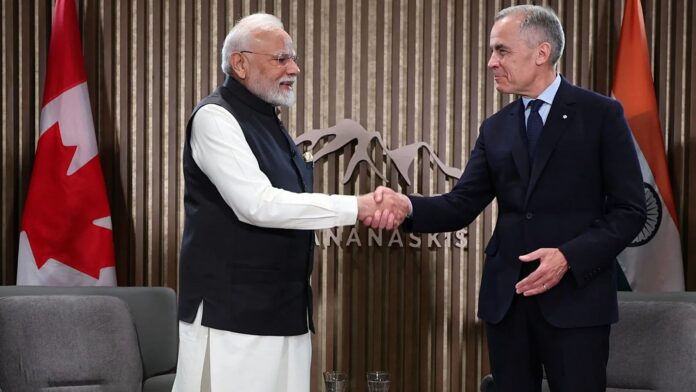
The participation of India and other emerging powers at the 52nd G7 Summit in Evian, France, has become a powerful symbol of the changing nature of global governance. Canadian Prime Minister Mark Carney has contended that the inclusion of countries beyond the traditional G7 membership reflects an important reality: the world can no longer be shaped by a small group of advanced economies alone. His remarks underscore a broader transformation in international relations, where emerging nations are increasingly influencing global decision-making.
G7 adapts to a multipolar world
Speaking during an event at Trinity College Dublin as part of his six-day European visit, Carney emphasised that the G7 has recognised the need to expand its engagement with influential countries outside its core membership. According to him, the challenges facing the international community today are too complex to be addressed solely by the world’s largest industrialised democracies.
Carney stated that if the G7 ever held a dominant position in global affairs, it no longer does. He suggested that the group’s willingness to invite countries such as India demonstrates an acknowledgement that global leadership must be shared among a wider range of nations.
India’s growing global significance
India’s invitation to the summit highlights its increasing importance in international politics and economics. As one of the world’s fastest-growing major economies and a key player in global trade, technology, and diplomacy, India is seen as an essential partner in addressing issues that affect the international community.
Carney noted that outreach partners such as India, Brazil, Egypt, Kenya, and several Gulf nations bring valuable perspectives and practical solutions to discussions. Their participation broadens the scope of debate and helps ensure that decisions reflect the interests of a more diverse global population.
Shaping a new international order
The Canadian leader suggested that the Evian summit could help define the contours of a new world order. His comments echo ideas he previously expressed at the World Economic Forum in Davos, where he encouraged middle powers and emerging economies to work together in response to growing geopolitical uncertainty.
The expanded participation at the summit reflects an evolving international landscape in which cooperation between established and emerging powers is becoming increasingly necessary. As economic influence and strategic importance spread across different regions, global institutions are under pressure to become more inclusive and representative.
Key issues on the summit agenda
Leaders attending the summit are expected to focus on several pressing global challenges, including economic stability, energy security, healthcare resilience, and ongoing conflicts in Ukraine and the Middle East. Another major topic will be the governance of artificial intelligence (AI), an area where rapid technological advancement has outpaced international regulation.
Carney warned that AI remains largely unregulated worldwide and stressed the importance of developing common standards and safeguards. Discussions at the summit are expected to explore ways of balancing innovation with responsible oversight, ensuring that emerging technologies benefit societies while minimising risks.
Diverse participation at Evian
The G7 consists of Canada, France, Germany, Italy, Japan, the United Kingdom, the United States, and the European Union. This year’s gathering includes several prominent world leaders, among them U.S. President Donald Trump, British Prime Minister Keir Starmer, German Chancellor Friedrich Merz, Italian Prime Minister Giorgia Meloni, Japanese Prime Minister Sanae Takaichi, and Canadian Prime Minister Mark Carney.
French President Emmanuel Macron has also invited leaders from a number of non-G7 countries, including Indian Prime Minister Narendra Modi, Brazilian President Luiz Inácio Lula da Silva, Egyptian President Abdel Fattah el-Sisi, South Korean President Lee Jae-myung, and Kenyan President William Ruto. Their participation highlights the summit’s broader objective of fostering dialogue among a wider group of influential nations.
Mark Carney’s remarks reflect a growing recognition that global leadership is evolving beyond traditional power structures. India’s participation in the G7 Summit serves as evidence of a world increasingly defined by cooperation among both established and emerging powers. As international challenges become more interconnected, forums such as the G7 are adapting to include a broader range of voices, potentially laying the foundation for a more inclusive and multipolar global order.
