

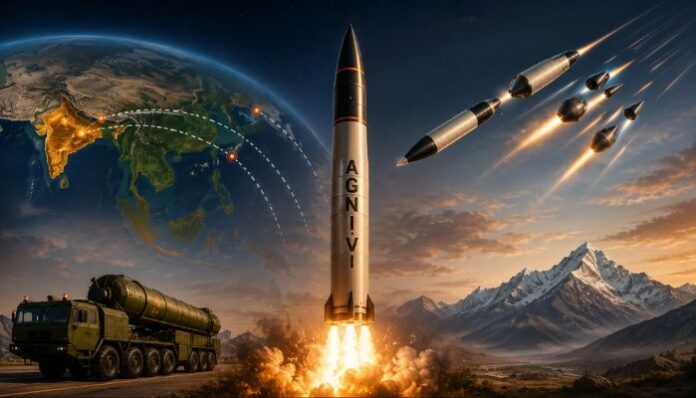
The discussion around India’s proposed Agni-VI missile has gained momentum after Defence Research and Development Organisation (DRDO) Chairman Samir V Kamat stated that the organisation is fully prepared to move ahead with the programme once it receives government approval.
While India already possesses the Agni-V missile, which can strike targets around 5,000 km away, the planned Agni-VI is expected to represent a major leap in the country’s strategic missile capability. Reports suggest it could have a range of more than 10,000 km and carry multiple nuclear warheads, making it one of India’s most advanced missile projects.
What Is Agni-VI missile?
Agni-VI is expected to be a long-range Intercontinental Ballistic Missile (ICBM), a category of missiles designed to travel more than 5,000 km. If developed and inducted, it would place India among a small group of countries possessing true intercontinental strike capability.
Unlike cruise missiles, which remain inside the atmosphere and use engines throughout their flight, ballistic missiles follow a different path. They are launched at very high speed, leave the Earth’s atmosphere, travel through space for a large part of their journey and then return to the atmosphere before striking their targets.
The missile is expected to use a canister-based launch system similar to Agni-V, allowing it to be stored, transported and launched quickly from mobile platforms. This improves survivability and reduces launch preparation time during emergencies.
How does an ICBM work?
An ICBM generally completes its mission in three stages. During the boost phase, powerful rocket motors push the missile upward at extremely high speed. At this stage, it works like a rocket used in space missions. Once it reaches the designated altitude, the missile enters the midcourse phase, where it travels through space along a ballistic path. Finally, in the terminal phase, the warhead re-enters the atmosphere and heads toward its target at extremely high speeds.
One of the most important characteristics of an ICBM is that it provides strategic reach across continents and ensures a country’s ability to retaliate during a nuclear conflict.
Understanding hypersonic speed and Mach numbers
Missile speeds are often measured using Mach numbers. Mach 1 is equal to the speed of sound, which is roughly 1,235 km/h under normal conditions. Mach 5 means five times the speed of sound, while Mach 10 means ten times the speed of sound.
Ballistic missile warheads often travel at hypersonic speeds during their descent toward targets. Because they move so fast and give defenders very little reaction time, intercepting them becomes extremely difficult.
India has already demonstrated progress in this field. The country recently tested a Long Range Anti-Ship Hypersonic Missile (LR-AShM), which is reported to reach speeds close to Mach 10. This reflects a broader shift toward fast and survivable weapons systems.
The importance of MIRV capability
One of the most talked-about features of Agni-VI is its expected MIRV capability.
MIRV stands for Multiple Independently Targetable Re-entry Vehicle. In a traditional ballistic missile, a single missile carries one warhead aimed at one target. A MIRV-equipped missile changes that model completely.
A single missile can carry several nuclear or conventional warheads. After the missile enters the midcourse phase, these warheads separate and travel independently toward different targets. In practical terms, one missile launched from India could strike multiple locations hundreds of kilometres apart.
This offers several strategic advantages. A single missile can threaten multiple targets, missile defence systems become harder to manage, fewer launch platforms are needed, and the overall survivability of a country’s nuclear deterrent improves.
The United States, Russia and China have long deployed MIRV-equipped missiles. India also demonstrated MIRV technology through Mission Divyastra, linked to the Agni missile family. Agni-VI is expected to carry a more advanced version of this capability.
How Agni-VI fits into the Agni family
India’s Agni missile programme has evolved step by step over the years.
Agni-I was mainly designed for deterrence against Pakistan. Agni-II and Agni-III expanded India’s reach deeper into China. Agni-IV improved mobility and survivability, while Agni-V introduced longer range and canister-launch technology.
Agni-VI is expected to build upon these achievements by combining greater range, improved survivability, mobile launch capability and advanced MIRV technology in a single platform.
Why India may still need Agni-VI
Many experts point out that Pakistan is already within range of shorter-range Agni missiles and that Agni-V can cover large parts of China from secure locations inside India.
However, the Agni-VI missile is not simply about reaching farther distances. The main objective is to strengthen survivability and ensure assured retaliation even after a potential first strike by an adversary.
China has been expanding its missile infrastructure through silo-based systems, road-mobile launchers and increasingly advanced missile defence networks. In such a situation, a longer-range missile allows India to base launch assets deeper inside its own territory, making them harder to locate and destroy.
The missile’s expected MIRV capability would further strengthen deterrence by complicating enemy interception efforts. Instead of dealing with a single incoming warhead, missile defence systems would have to respond to multiple warheads arriving simultaneously.
Agni-VI is more than just a weapon
Agni-VI is also important from a strategic and geopolitical perspective. Possessing a true long-range ICBM is often viewed as a sign of advanced technological and military capability.
Although India continues to follow its doctrine of “credible minimum deterrence” and maintains a no-first-use nuclear policy, the development of more capable missile systems signals growing confidence in its strategic capabilities.
Military planners also look decades ahead. Future security challenges may include stronger missile defence systems, increased Chinese naval activity, improved space-based surveillance and new technologies that could affect deterrence. Long-range and survivable missiles provide flexibility against such future uncertainties.
Lessons from Iran & US conflicts
Recent tensions involving Iran and the United States have once again highlighted the role of missiles in modern warfare.
Iran does not possess operational long-range ICBMs like those used by the United States, Russia or China. Instead, it relies on a combination of ballistic missiles, cruise missiles, drones and large-scale saturation attacks designed to overwhelm enemy air defences.
India’s security environment is different because its nuclear deterrence is primarily focused on China and Pakistan. However, modern conflicts continue to demonstrate that missile capability remains central to deterrence and that even advanced air defence systems can face challenges under sustained attacks.
The bigger picture
The debate around Agni-VI highlights an important reality: missile strength is no longer measured by range alone.
Modern strategic capability depends on several factors, including accuracy, mobility, survivability, launch readiness and the ability to operate effectively under wartime conditions. A missile that can survive an enemy attack and guarantee retaliation may be more valuable than one that simply travels farther.
The political messaging surrounding Agni-VI also suggests that India may be becoming more open about showcasing its strategic capabilities. While the country has traditionally maintained ambiguity around such programmes, recent statements indicate a desire to demonstrate that its missile technology is advancing rapidly.
Ultimately, Agni-VI is not just about crossing the 10,000-km mark. It is about ensuring that India’s nuclear deterrent remains credible and effective in an era shaped by missile defences, hypersonic weapons and growing strategic competition.


