

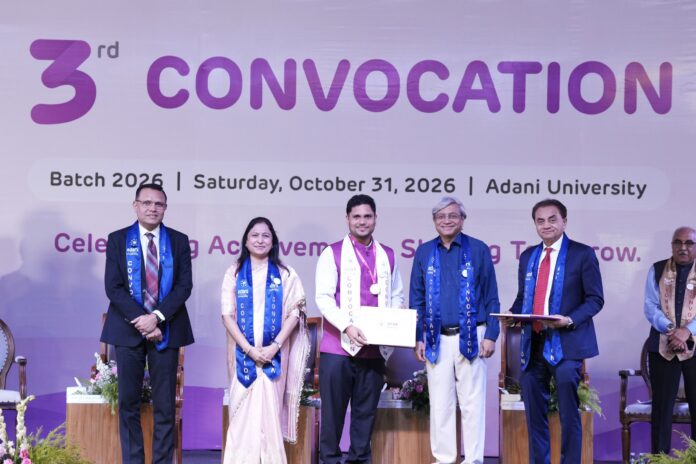
Artificial intelligence could transform education, accelerate scientific discoveries and help solve some of the world’s most complex problems. However, its growing influence also presents serious challenges, particularly concerning the erosion of truth, trust and human relationships, Indian Institute of Science (IISc) Director Prof. Govindan Rangarajan cautioned during Adani University’s third convocation ceremony in Ahmedabad on Saturday.
Addressing the graduating students as the Chief Guest, Prof. Rangarajan highlighted the immense possibilities offered by AI while urging society to remain conscious of the consequences of increasingly sophisticated technologies.
He pointed out that AI-generated images, videos and information are becoming so convincing that distinguishing between authentic and fabricated content could become increasingly difficult.
“AI offers tremendous possibilities in education and research. It can help us solve complex problems and accelerate scientific discovery. But we must also be mindful of its consequences,” he said.
Raising concerns about the wider social implications of technological advancement, Prof. Rangarajan also questioned whether increased digital connectivity was coming at the expense of meaningful human relationships.
“While technology is bringing us closer digitally, are we becoming more distant from one another? We must embrace what AI can do, but also think carefully about what we stand to lose,” he added.
The convocation saw Adani University confer degrees on 374 students belonging to the Class of 2026. Ten students were also recognised for outstanding academic performance, receiving five gold, three silver and two bronze medals.
Industry-Academia collaboration key to India’s next growth phase
Dr Priti Adani, President of Adani University, presided over the ceremony and welcomed Prof. Rangarajan, describing his contributions to mathematics, scientific research and academic leadership as an inspiration for the graduating students.
She expressed the university’s ambition to emerge as a leading research-driven institution and emphasised the importance of developing stronger connections between academia and industry.
Highlighting how collaboration between the two sectors could create opportunities for innovation, Dr Adani said that industry should not merely dictate the subjects universities research. Instead, real-world challenges and exposure to practical conditions should help both sectors identify questions and develop solutions that might otherwise remain unexplored.
“The promise is not that industry will simply tell a university what to study. It is that exposure to demanding real-world conditions can bring up questions that neither industry nor academia would have framed alone,” she said.
Dr Adani also underlined India’s achievements in infrastructure development, arguing that the country’s next major challenge would be to replicate that scale of progress in innovation and entrepreneurship.
“India has built infrastructure on a remarkable scale. Now we must learn to innovate and incubate at scale,” she said.
She urged the graduating students to pursue breakthroughs that extend beyond commercial success and address the needs of marginalised communities. Emphasising the importance of inclusive development, she encouraged them to develop solutions capable of creating a meaningful impact across different sections of society.
University outlines research and academic expansion plans
Presenting the university’s annual report, Provost Prof. (Dr.) Dhaval Pujara highlighted the contributions of its faculty, staff, students and industry partners in strengthening its academic and research ecosystem.
He outlined the institution’s efforts to consolidate its academic foundations, expand research capabilities and deepen engagement with industry and society.
Established in 2022, Adani University has positioned itself around industry-relevant education, experiential learning and interdisciplinary research. Its academic and research focus spans infrastructure, energy, technology and digital healthcare.
The university currently offers undergraduate and postgraduate programmes in engineering, technology and business management, including B.Tech, M.Tech and MBA degrees. It also provides integrated B.Tech-MBA and B.Tech-M.Tech programmes aligned with the National Education Policy (NEP), alongside interdisciplinary doctoral programmes.
With a student population of over 1,800, the institution aims to develop a multidisciplinary ecosystem that extends beyond conventional classroom education. Its broader framework encompasses skill development, entrepreneurship, innovation, product development, intellectual property creation, professional training and collaborative research with industry and international institutions.
Adani University is also the first university in Gujarat to receive ISO 21001:2018 certification, a management systems standard specifically designed for educational organisations.
As 374 students embarked on the next phase of their academic and professional journeys, the convocation brought into focus a larger question confronting the next generation: how to harness emerging technologies such as artificial intelligence while ensuring that innovation remains grounded in human values, social responsibility and the pursuit of knowledge.
