

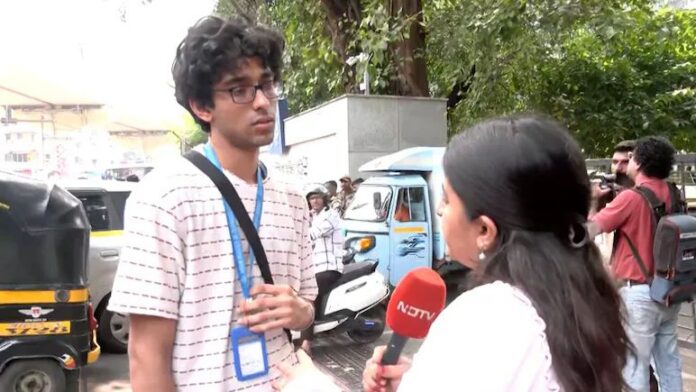
A close friend of IIT Bombay student Sahil Ravindra Wakode, whose death has triggered protests on the campus and allegations of caste-based discrimination, has disputed claims that casteism played a role in the incident.
Speaking to NDTV, Wakode’s friend Yatish Kumar said he had never observed anything that suggested his friend was facing caste-based discrimination. He recalled meeting Wakode just four or five days before the examination and said he appeared to be his usual self, “fun”, “cool” and happy.
Wakode, a second-year BTech student, was found dead in his hostel room on Friday, shortly after an incident during a mid-semester examination in which he was allegedly caught using a mobile phone and ChatGPT. According to his friend, a professor took Wakode out of the examination room after he was caught. He said he was subsequently told that the institute’s Disciplinary Action Committee (DAC) had not been imposed on him, although he did not know what happened afterwards.
Friend says casteism was ‘not an issue’
Wakode’s family has alleged institutional harassment and caste-based discrimination, and has filed a case under the Scheduled Castes and Scheduled Tribes (Prevention of Atrocities) Act, 1989. The allegations have become a central part of the controversy surrounding his death.
His friend, however, offered a different account based on his own experience of campus life.
“I don’t think casteism was an issue. I mean I have never experienced it,” Kumar told NDTV. He also stressed that he did not have complete information about everything that happened to Wakode because they were from different departments.
‘Cheating is bad, but while punishing…’
Kumar said the episode also needs to be viewed against the intense pressure faced by students at institutions such as IIT Bombay. While acknowledging that cheating is wrong, he questioned whether the circumstances and mental state of a student should also be considered when disciplinary action is taken.
“Cheating is bad. But while punishing you have to know the mental state of the student and talk,” he said.
He remembered Wakode as one of his first friends on campus. The two had lived in adjoining rooms during their first year and had played badminton together.
“He was one of my first friends,” Kumar recalled, adding that the loss had deeply affected students across the campus.
IIT Bombay apologises amid protests
The controversy has also led to protests by students, with demonstrators raising several demands concerning the institute’s handling of student welfare and disciplinary processes.
IIT Bombay subsequently apologised for statements made in an earlier communication concerning the circumstances surrounding Wakode’s death. The institute also denied reports that its Director, Shirish Kedar, would resign.
The IIT Bombay Faculty Forum, meanwhile, expressed solidarity with exam invigilator Suryanarayana Doolla, who has since been removed as dean of students welfare. The forum said Doolla had been following institutional protocol after discovering Wakode in “unauthorised possession and use of a smartphone.”
Protesting students have submitted 18 demands, including student representation on academic committees, an independent investigation into four cases of death by suicide on campus, and mental-health workshops for professors.
Allegations require investigation
The competing accounts have added another layer to the controversy. Wakode’s family has alleged caste-based discrimination and institutional harassment, while his friend says he never saw casteism as an issue and points instead to the circumstances surrounding the examination and the broader pressures faced by students.
The exact sequence of events following the examination incident, as well as the circumstances surrounding Wakode’s death, remain matters for investigation. The allegations made by his family and the account provided by his friend should therefore be considered separately until the relevant authorities establish the facts.
