

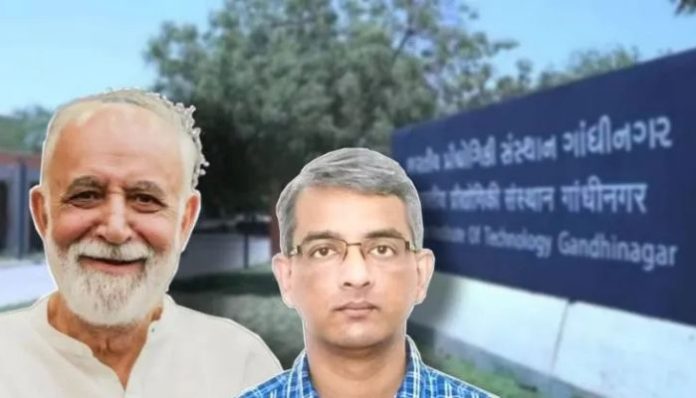
For the second time in less than a month, the Indian Institute of Technology (IIT) Gandhinagar finds itself at the centre of a major controversy. This time, an appointment to the faculty that social media users say was secretive has come under fire. Several posts online said IIT Gandhinagar appointed actor-theatre personality M. Raina-who had signed a mercy petition in support of 1993 Mumbai blasts convict Yakub Memon.
Online claims suggest that Raina was appointed to the post in September 2025 and that his name does not figure anywhere on IIT Gandhinagar’s official website. Critics further say that the institute kept the appointment of Raina under wraps deliberately to avoid public scrutiny.
Do you want a job at an IIT but you are 77 years old, have no qualifications and afraid nobody will just give you taxpayer money?
— Eminent Intellectual (@total_woke_) November 6, 2025
Worry not, just write a mercy petition for a terrorist who has killed atleast a 100 Hindus, have standards guys, and IIT Gandhinagar will give you a… pic.twitter.com/e1l5ZRSjG7
MK Raina and mercy petition for Yakub Memon
Social media users have accused IIT Gandhinagar of hiring individuals with questionable political leanings and even links to anti-national views. Several posts and documents being shared online suggest that Raina’s political background and past actions have made his appointment controversial.
Many online users pointed out that Raina was one of over 300 signatories who appealed to the President of India in 2015 for clemency for Yakub Memon, the terrorist convicted for his role in the 1993 Mumbai serial bomb blasts that killed hundreds. The petition had argued that capital punishment was “unfair, arbitrary, and excessive.” Images of this mercy petition, along with Raina’s signature, have resurfaced on social media, with users accusing him of supporting a convicted terrorist.
The controversy now has taken a political turn, with several netizens asking IIT Gandhinagar to explain why a person with such a background was selected for a position at a premier government institution.
Political remarks against Modi government
Adding to the backlash, social media users have highlighted Raina’s previous remarks against the Modi government. In an earlier interview, Raina had accused the government of suppressing dissent and weakening institutions. “This government wants us to be brain-dead,” he had said, suggesting that freedom of speech and expression had come under threat.
“[Modi] government wants to make us braindead.”
— Harshil (હર્ષિલ) (@MehHarshil) November 6, 2025
77 y/o artist faculty of IIT Gandhinagar- MK Raina.
Using our tax money, IITGn appointed him in September.
IITGn didn’t make his brilliant credentials public. But let me do so.
He wrote mercy petitions for Yakub Menon. He also… pic.twitter.com/zyN7zYKXg3
These statements, which were critial of the government’s handling of artistic and academic freedom, are now being circulated online as evidence of his alleged political bias. Many have questioned why a person who has repeatedly criticised the Indian government and supported controversial figures should be associated with an IIT.
Concerns over transparency in IIT Gandhinagar appointments
Critics have also questioned the transparency of IIT Gandhinagar’s recruitment policies. They say that the appointment process lacks accountability and that individuals with ideological or political leanings are being given academic positions without proper qualifications or public notice.
Several online users compared Raina’s appointment with other recent recruitments made by the institute, including filmmaker Don Chacko Palathara, suggesting that there is a pattern of hiring individuals with left-leaning or controversial backgrounds.
Some have demanded that IIT Gandhinagar disclose its selection criteria and explain how an artist, rather than an academic or scientist, was given a faculty post at a technical institute. They also questioned why the institute failed to publish Raina’s appointment details on its official portal, calling it an attempt to “hide information from the public.”
Fresh row over objection to ‘Vande Mataram’
Meanwhile, another controversy has erupted involving a faculty member of IIT Gandhinagar. A social media post claimed that one of the institute’s professors, identified as Arup Chakraborty, objected to the singing of the patriotic song “Vande Mataram.”
IIT Gandhinagar professor Arup Chakraborty is now opposing our National Song ‘Vande Matram’ openly.
— Harshil (હર્ષિલ) (@MehHarshil) November 7, 2025
He objects Bharat Mata being referred as त्वं ही दुर्गा दशप्रहरणधारिणीम्.
He says it is in Raag Desh so not to be sung by commoners. ? @EduMinOfIndia @dpradhanbjp @blsanthosh… https://t.co/ickZCPr2pY pic.twitter.com/1OCQRD6kau
According to screenshots of an internal email circulating online, Professor Chakraborty reportedly expressed discomfort with certain verses of the song, particularly those referring to “Bharat Mata” (Mother India). The post claims that he argued such references were inappropriate and divisive.
The email, which has gone viral, also reportedly suggested that the song should not be performed publicly, citing “sensitivities in a diverse society.” These claims have not yet been officially verified, but they have intensified anger on social media, where many users are calling for strict government action against the professor and the institute.
