

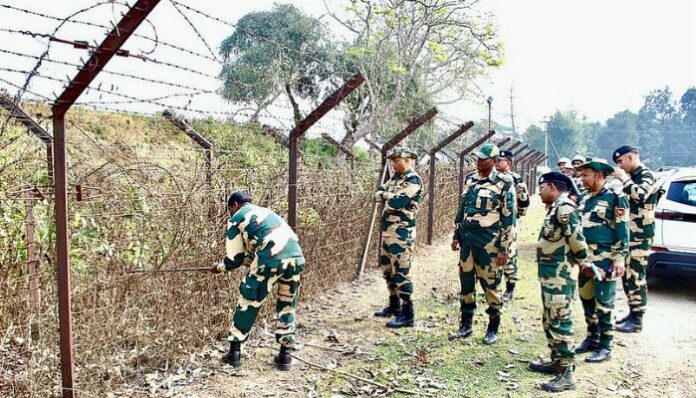
The Special Intensive Revision and the fall of the Mamata Banerjee-led Trinamool Congress (TMC) government have brought the massive underground network facilitating illegal border crossings between India and Bangladesh to a complete halt.
The revelations were made in a report published by the Anandabazar Patrika on Tuesday (16th June).
Following the recent implementation of a stringent “Detect, Delete, Deport” policy by the newly formed BJP government and a removal of ineligible voters via the Special Intensive Revision (SIR) process, the cross-border infiltration (locally called Dhur Parapar) by Bangladeshis has collapsed.
This has led to mass surrenders of illegal immigrants at border checkposts like Hakimpur and has forced syndicate operators to find alternate ways of livelihood.
An insider from the Swarupnagar border area, anonymously, told Anandabazar Patrika how infiltration is being carried out. The syndicate operated across a vast network of “ghats” along the Sonai and Ichamati rivers, which stretched from the Bangaon subdivision to the Sundarbans.
They relied on precise coordination between handlers on both sides. Bangladeshi handlers monitored border security and gathered illegal immigrants (dhurs) near the border. On the Indian side, the linemen hid in paddy and jute fields and tracked Border Security Force (BSF) patrols. Once a clear signal was given, the ghat party facilitated the cross-border infiltration.
Communication relied on cross-border SIM cards, while financial transactions were executed via mobile banking apps like bKash. The financial scale of the operation was staggering. Infiltrators paid approximately 15,000 Bangladeshi Taka to enter Indian territory. From this, Indian brokers received around 3,000 per person, which was split among local handlers, linemen, and guides.
Guides were tasked to escort the illegal immigrants to transport hubs like Sealdah or Howrah. In Hakimpur, an average of 30 to 35 people used to cross daily, and it generated roughly 6 lakh per ghat monthly. During peak years, across West Bengal’s 1,000 historical crossing points, the illegal immigration trade brought ₹70 to ₹80 crore per month. It totaled to about ₹800 to ₹900 crore annually.
The Bangladesh Border Guard (BGB) facilitated the trade while BSF enforcement tightened significantly over the last 5 years. Anandabazar Patrika found that the syndicate’s survival depended heavily on local administrative complicity to assimilate infiltrators into Indian society. Corrupt local panchayat leaders and block-level officials manufactured fraudulent identity documents, such as fake birth certificates, voter cards, and Aadhaar cards.
In one bizarre case revealed by law enforcement, a former gram panchayat head in Swarupnagar used sophisticated forgery techniques to deceive authorities. To backdate a fake birth certificate, the official manually stained the paper using an aluminium bowl and aged it inside a rice sack for days to mimic paper from 1986. The document successfully bypassed rigorous security checks.
The introduction of the SIR process, which successfully removed approximately 9 million duplicate or undocumented entries from West Bengal’s electoral rolls, combined with aggressive state policy enforcement and proactive police crackdowns has completely dismantled the illegal immigration syndicate
