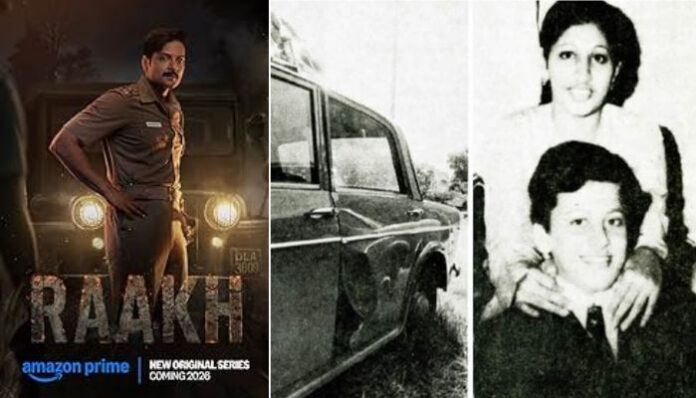
Over the recent years, Amazon Prime Video and several other OTT platforms have routinely exploited creative liberty to inject anti-Hindu and divisive ideological spins into Indian stories. Giving Bollywood’s conventional approach of depicting ‘upper-caste’, Tilak-wearing, and pious Hindu men as villains, OTT shows reframe real events through distorted lenses of Dalit victimhood, Muslim virtue and derision of upper caste Hindus. A new Amazon Prime Video original, Raakh, is facing backlash for inserting fake caste oppression narratives into the 1978 Geeta and Sanjay Chopra kidnapping and murder case, widely remembered as the Ranga-Billa case.
Caste and religions of key characters changed from upper-caste Hindus to Dalits and Muslims, the real Sikh Ranga-Billa turned into Hindu Rajjo and Babu
Officially released on 12th June 2026, Raakh is an 8-episode crime thriller headlined by actor Ali Fazal, who celebrated anti-CAA violence in 2020, Sonali Bendre, Aamir Bashir, and Rakesh Bedi. The web series has been marketed as inspired by the real 1978 Ranga-Billa kidnapping and murder case.
However, the show has rewritten the castes, religions, and the team dynamics of actual police officers and journalists to force-fit the ‘Bhim-Meem’ narrative.
The Prime Video series manufactured a narrative of systemic caste oppression, ‘Muslims are honest, Brahmin Hindus are bad’ bogey, none of which existed in the records of the actual case.
In the show, actor Ali Fazal played the character of Sub-Inspector Jayprakash Jatav, a Dalit officer, whose house features portraits of Jyotiba Phule and B.R. Ambedkar. Absolutely irrelevant to the Ranga-Billa case or the real SI from that time, SI Jayprakash Jatav, shown as facing caste prejudice in the police force, and his retired hawaldar father also faced caste discrimination. Jatav’s father is also shown chanting ‘Jai Bhim’ slogans.
Amusingly, the show features a Muslim officer, Javed Murtaza, as Jatav’s main assistant, who, in spirit, reminds one of the ‘iman ka pakka’ Rahim Chacha from Sholey.
Several social media users pointed out that the Amazon Prime Video original, Raakh, features a lazy or inefficient hawaldar who is coded as Mishra Brahmin.
Unsurprisingly, the ‘honest’ and ‘fearless’ journalist is depicted as a Muslim woman.
While in the real incident, a man named Babulal attempted to save the kidnapped siblings, in the show, Babulal’s character was shown as Salim.
And, the main villains have been given a Hindu identity and named Babu and Rajjo. One of them is shown as a Haryanvi and the other as a Maharashtrian. In reality, the killers were Sikh men Kuljeet Singh and Jasbir Singh.
The real story of the 1978 Sanjay and Geeta Chopra kidnapping and murder, which is widely known as the Ranga-Billa case
Before delving into how the viewers have reacted to the subtle caste and Bhim-Meem bonhomie depiction, it is important to apprise the readers with the real Ranga Billa case, the Amazon Prime Video web series ‘loosely inspired’ by.
On 26th August 1978 in Delhi, siblings Geeta Chopra and Sanjay Chopra, the children of Navy officer Madan Mohan Chopra, disappeared after accepting a lift in heavy rain while on their way to All India Radio office on Sansad Marg to participate in a radio program, Yuva Vani. 16-year-old Geeta and 13-year-old Sanjay left their homes at around 6:15 PM for the 8 PM show.
The duo was spotted at the Dhaula Kuan roundabout by one Kula Nand. Since it was drizzling, one M S Nanda gave a lift to the children to Gole Dak Khana from Dhaula Kuan. At around 6:30 PM, one Bhagwan Das noticed that sound is coming from the mustard yellow Fiat car next to him. Das stopped his scooter and approached the car. He noticed that Geeta Chopra was pulling the driver’s hair, and another Sanjay was trying to fight off the man sitting in the passenger seat. However, the car sped away.
Later, a person named Babulal tried to stop the car, but it sped away. Meanwhile, Bhagwan Das informed the local police about what he saw.
While the siblings struggled for their lives, the police control room committed a massive mistake. The police wrote down the wrong number of the car. Instead of HRK 8930, the operator noted it as MRK 8930.
Meanwhile, a person named Inderjeet Singh saw the Fiat car and the Chopra siblings struggle with their kidnappers, the driver and the man next to him. Singh followed the car, and Sanjay even showed his bleeding shoulder to him. Sanjay cried for help, and Singh followed. However, Inderjeet Singh lost the Fiat car as the kidnappers jumped a signal. Singh reached the police station and informed the correct car number.
Sadly, while Geeta and Sanjay were struggling for their life and crying for help, their parents, Madan Mohan Chopra and Roma Chopra, were unaware of the horror that had befallen their children.
Eager to hear their kids on the AIR program, Madan Mohan and his wife tuned in to the radio. However, they were shocked to hear the voice of another girl, who was given the slot. Later, Madan Mohan Chopra reached the All India Radio office to pick up his children, only to find out they had never arrived. Chopra called up home and his relatives to see if they had gone there.
While the Chopra couple desperately searched for their children, Ranga-Billa played every trick to keep themselves away from the police’s hands.
Two days later, the dead bodies of Geeta and Sanjay Chopra were discovered by a cowherd, Dhani Ram, who informed the police. Later, the parents of the Chopra siblings were called to identify the corpses. It was confirmed that the deceased were Geeta and Sanjay.
The police suspected that the duo faked their names and identity at the Wellington Hospital, who might have been Sanjay and Geeta’s kidnappers. The police’s suspicion was right, as it was indeed Ranga and Billa who went to the hospital for treatment of their wounds caused during the struggle with the Chopra siblings.
A national outrage and a massive manhunt followed. During the investigation, the police found the Fiat car used in Sanjay and Geeta’s kidnapping, abandoned with another name plate on 31st August, 1978, at Majlis Park, Delhi.
In the Prime Video show Raakh, Dalit officer Jayprakash Jatav tracks Rajjo-Babu’s trail to Agra, leading to a high-pressure race to stop them before they can escape on a train. However, in reality, Ranga and Billa were not caught by a lone heroic Dalit officer.
The real criminals were caught when alert army personnel, including Lance Naik Gurtej Singh and AV Shetty, spotted the duo on the Kalka Mail train near Agra. Ranga and Billa had mistakenly entered the compartment reserved for military personnel. The army officers questioned the duo, and despite mounting suspicion, waited for the train to reach Delhi. Meanwhile, Gurtej Singh noticed the pictures of the most-wanted criminals in a Hindi newspaper. With the identities of Ranga and Billa confirmed, the army officers kept a close watch on the duo.
The alert army officers handed over Ranga and Billa to the Delhi Police on 8th September 1978, leading to the end of a week-long manhunt.
Jasbir Singh, aka Billa, and Kuljeet Singh, aka Ranga, were convicted and sentenced to death. They were hanged to death in Tihar Jail.
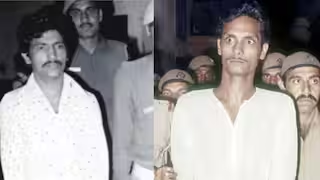
Geeta Chopra was allegedly sexually assaulted, as per the statements of the convicts. However, due to advanced decomposition of the dead body, the same could not be confirmed in the postmortem.
Raakh on Prime Video may be a captivating crime thriller, but the audience cannot help but call out the dishonest insertion of the ‘caste angle’
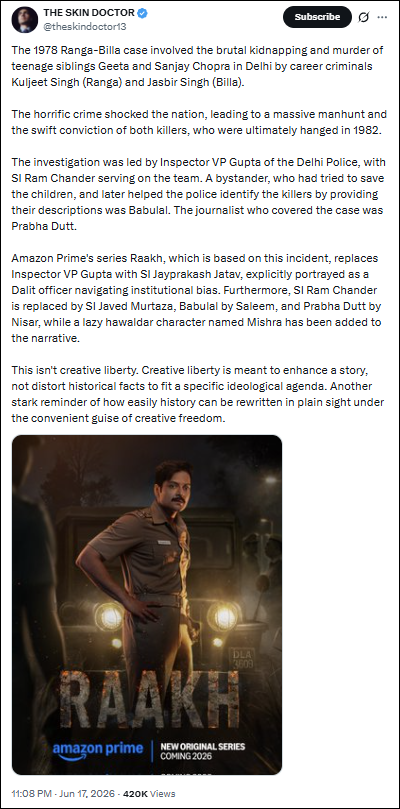
While the Amazon Prime Video show, Raakh, featured a Dalit SI Jayprakash Jatav as the protagonist, the investigation in reality was led by Inspector VP Gupta of the Delhi Police, with SI Ram Chander being his main aide on the team. The show replaced SI Ram Chander with SI Javed Murtaza.
The bystander who attempted to save Geeta and Sanjay Chopra was Babulal, a Hindu man, but the show replaced Babulal with a Muslim character named Salim.
The journalist who diligently covered the real Ranga-Billa case was a Hindu woman named Prabha Dutt. However, the Prime Video web series showed a Muslim journalist named Nisar.
Netizens have noticed the caste-religion-based ideological spin given to a real events-inspired story.
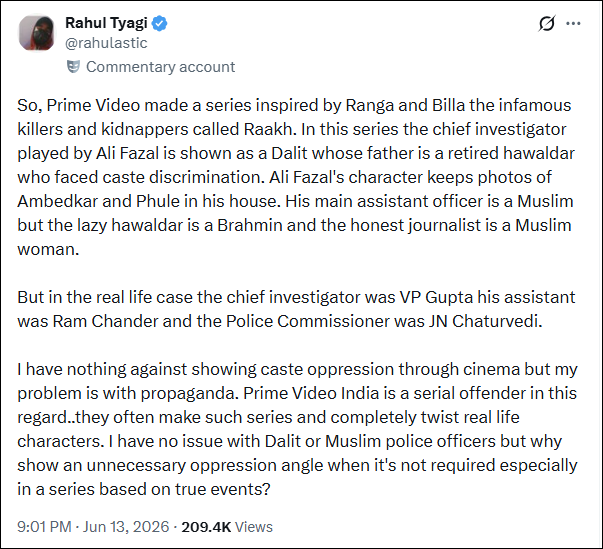
Calling out the misuse of creative freedom to peddle an agenda villainising certain Hindu caste groups, Rahul Tyagi wrote, “So, Prime Video made a series inspired by Ranga and Billa the infamous killers and kidnappers called Raakh. In this series the chief investigator, played by Ali Fazal, is shown as a Dalit whose father is a retired hawaldar who faced caste discrimination. Ali Fazal’s character keeps photos of Ambedkar and Phule in his house. His main assistant officer is a Muslim but the lazy hawaldar is a Brahmin and the honest journalist is a Muslim woman. But in the real life case the chief investigator was VP Gupta his assistant was Ram Chander and the Police Commissioner was JN Chaturvedi. I have nothing against showing caste oppression through cinema but my problem is with propaganda. Prime Video India is a serial offender in this regard..they often make such series and completely twist real life characters. I have no issue with Dalit or Muslim police officers but why show an unnecessary oppression angle when it’s not required especially in a series based on true events?”
Popular X user Skin Doctor wrote, “…This isn’t creative liberty. Creative liberty is meant to enhance a story, not distort historical facts to fit a specific ideological agenda. Another stark reminder of how easily history can be rewritten in plain sight under the convenient guise of creative freedom.”
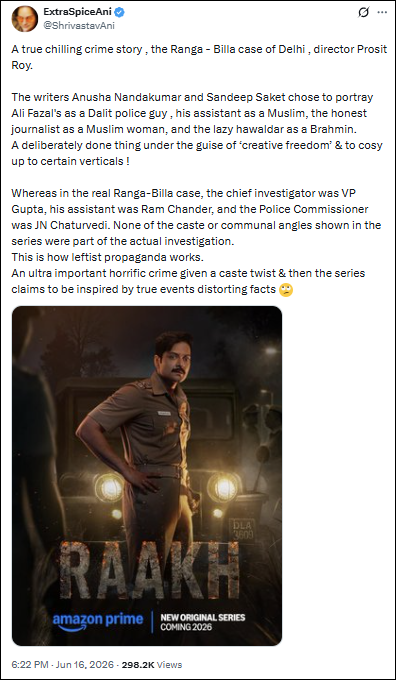
Another X user called out the writers of Raakh, Anusha Nandakumar and Sandeep Saket, for giving a “caste twist” to a horrifying kidnapping and murder case.
“The writers Anusha Nandakumar and Sandeep Saket chose to portray Ali Fazal’s as a Dalit police guy , his assistant as a Muslim, the honest journalist as a Muslim woman, and the lazy hawaldar as a Brahmin. A deliberately done thing under the guise of ‘creative freedom’ & to cosy up to certain verticals! Whereas in the real Ranga-Billa case, the chief investigator was VP Gupta, his assistant was Ram Chander, and the Police Commissioner was JN Chaturvedi. None of the caste or communal angles shown in the series were part of the actual investigation. This is how leftist propaganda works. An ultra important horrific crime given a caste twist & then the series claims to be inspired by true events distorting facts,” the X user wrote.
Meant to entertain, Prime Video is platforming Islamo-leftist activism against Hindus
Amazon Prime Video has been a repeat offender. The online streaming platform has consistently allowed writers, directors, and actors with documented biases toward anti-upper caste narratives to use its platform to soft-peddle their ideologically aligned propaganda. Raakh is not the only Amazon Prime Video show wherein unnecessary caste or religion-based victimhood arcs have been inserted. This is also not the first time that swapped identities to force-fit oppressor-oppressed binaries, and gaslight Hindus, particularly, so-called upper caste Hindus like Brahmins, Thakurs, and Baniyas.
Be it Prime Video, Netflix, or other major OTT platforms, most of them are rolling out content riddled with anti-Hindu bias, forced Muslim victimhood, and Bhim-Meem narratives, with varied intensity.
Over the years, OpIndia has highlighted how Amazon India has been giving space for ultra-left radicals and Islamist elements, who are known for their anti-Hindu agenda.
Back in 2020, Prosit Roy, who directed Raakh, had partly directed Prime Video’s Paatal Lok. This show, produced by Bollywood actor Anushka Sharma, was blatantly Hinduphobic and showed Sikhs in a poor light. The web series included instances of how Sikhs oppress Dalits and backward castes. There are also objectionable scenes regarding the Sikh Community involving rapes.
In this show, actor Jaideep Ahlawat plays Inspector Hathiram Chaudhary, posted in the Outer Jamuna Paar police station. While there were several instances, in the final episode, Inspector Chaudhary, while running, ends up in a play about devotee Prahlad, being held at a fair. Goons are chasing him, and while fleeing from them, he climbs onto the stage. Coincidentally, at that very moment, Lord Vishnu’s incarnation, Narasimha, appears before the demon Hiranyakashipu, tearing through the pillar. Inspector Chaudhary pushes the fleeing character of Narasimha away, landing him directly on Hiranyakashipu.
The show revolved around a Muslim, a Dalit, a Hindu, and a transgender—a cocktail of four criminals. Offering a dramatised version of “Burhan Wani- headmaster’s son”, the show’s makers highlighted the “humane sides” of the criminals, portraying them as helpless only because they are being “framed” in cases involving ISI and Pakistan.
The Muslim criminal Kabir hides his religious identity. Kabir’s father tells Hathiram that his eldest son was killed because he belonged to a particular religion. In that scene, Hindu extremists carrying saffron flags are seen carrying out the massacre. Kabir’s father says that for this reason, he didn’t even allow his second son to become a Muslim, but you people turned him into a terrorist.
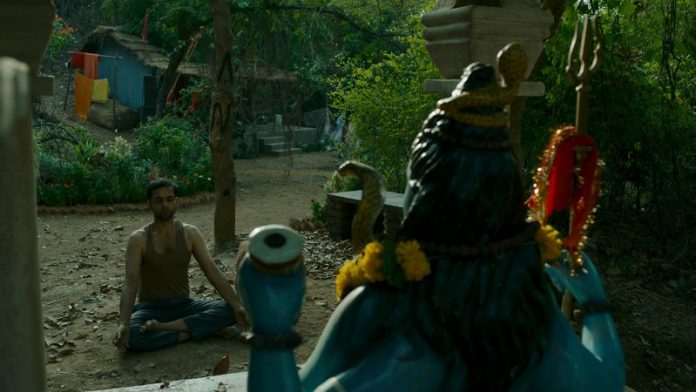
The show’s villain, “Tyagi”, is depicted as an ardent devotee of Mahadev.
In 2021, Prime Video released a show named Mumbai Diaries 26/11. The show was centred on the hardships of the frontline workers – doctors, nurses, ward boys, security guards, police personnel, journalists, among others, during the Pakistani-orchestrated Islamic terror attack.
The show, however, went overboard on secularism. Back then, many viewers had praised the performances but pointed out how Mumbai Diaries glorified the Muslim character, Dr Ahaan Mirza, as tolerant, while a Hindu male nurse, Samarth, was depicted as a hateful bigot.
Pushing the ‘bad Hindu, good Muslim’ narrative, Mumbai Diaries showed how Mirza is so emotional and nice that he even enters the morgue and offers prayers for the deliverance of the nurses’ souls. On the other hand, there is the Maharashtrian male nurse, Samarth, who is suspicious of Mirza’s actions. Samarth is unkind, intolerant, and overtly communal. He even roughs up the poor Muslim doctor on a couple of occasions.
In fact, the character of Mansi, a journalist, appears as a mouthpiece of the show’s director, and offers a soliloquy in the final episode to whitewash the Islamic Jihadist drivers of the 26/11 attacks. She says, “Jihad toh insaan ke antarman ki ladayi hoti hai na jo woh apni khamiyon se ladta hai. Humari aankhon ke samne jo hua woh jihad nahi ho sakta” (Jihad is man’s internal struggle with the negative elements of his own soul, what we saw today can never be jihad).
In 2021, Prime Video released another Hinduphobic show, Tandav. The show was directed by Ali Abbas Zafar.
Released on 14th January 2021, Amazon’s original web series Tandav attracted criticism for its anti-Hindu content and scenes mocking Hindu gods. A series of FIRs were registered in different states, including Uttar Pradesh, against Amazon India, the director, producer and actors of the series.
Starring Saif Ali Khan and notorious Islamo-leftist Mohammad Zeeshan Ayyub in the lead roles, the show’s first episode depicted Ayyub apparently playing the character of Lord Shiva and holding Trishul in his hand at a college theatre festival. The host facetiously talked about the character’s social media following and how he should post a tweet or upload pictures to increase his followers. This is followed by the infamous ‘Azaadi’ slogans by the audience.
This show was also riddled with a caste-bias narrative. In one of the episodes, the character played by actor Dino Morea berates the character played by actor Sandhya Mridul for dating a man from a lower caste. In the video, Mridul, who is married to Dino Morea, asks her husband to sign their divorce papers so that she could tie the knot with the character played by actor Anup Soni. Soni is portrayed as a man belonging to a lower caste, while Mridul and Morea are both apparently from the higher caste. Morea’s character is shown fuming over his estranged wife wanting to marry a ‘lower-caste’ man.
In another instance, the web series insinuates that is easy for police to kill Muslims and casts aspersions on the integrity of the law enforcement officials by alluding that many Muslim youths are branded as terrorists to justify their killings.
Prime Video’s super-hit series Mirzapur distorted the whole relationship dynamics between father-in-law and daughter-in-law, sister-in-law and brother-in-law. In fact, it was reported in October 2020 that a Muslim man named Tauseef, who was harassing and forcing a Hindu girl, Nikita, in Mewat, to convert to Islam, decided to kill her after watching the web series ‘Mirzapur’.
In 2023, Amazon Prime Video released Sonakshi Sinha, Gulshan Devaiah, Vijay Verma and Waris Ahmed Zaidi starrer web series Dahaad. In this crime thriller, two stories run in parallel in the series. The first story is about an upper-caste Hindu girl, Rajni, who eloped with a Muslim boy named Altaf, and the second story is about a serial killer based on Cyanide Mohan. In what amounts to a mockery of the countless victims of love and rape jihad, the show subtly denied the existence of the documented pattern of Muslim men weaponising love and sex as a means to target Hindu girls for conversion to Islam and insulting the Hindu faith.
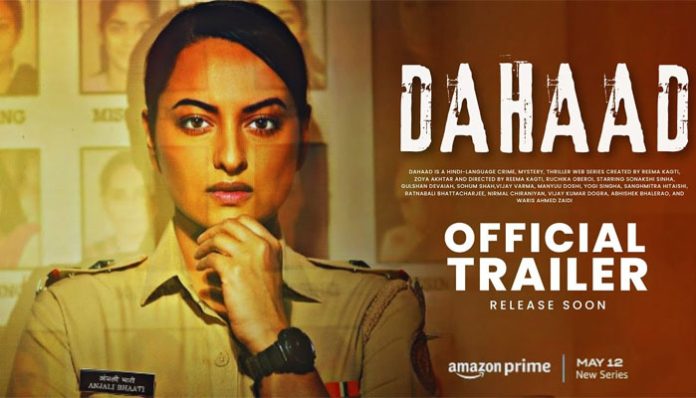
An OpIndia review highlighted back then, how Rajputs were shown as gundas, Hindu organisations (hinting towards Bajrang Dal and likes) are shown in a bad light, love jihad was whitewashed, fake caste discrimination subplots were inserted, and the main villain was carefully picked as upper caste Hindu man.
Earlier, Prime Video released a show named Sherni. The web series starring Vidya Balan was based on real events. However, just as in Raakh, in Sherni, a Hindu IFS officer, K Abharna, was shown as a Christian character, Vincent, played by Vidya Balan. While real-life hunter Asghar Ali Khan was replaced by kalawa-wearing Ranjan Rajhans.

It must also be recalled how, in 2020, the then creative head of Amazon Prime, Aparna Purohit, was called out by netizens for her left-wing bias. Her social media pages were riddled with anti-Hindu propaganda, hatred against PM Modi and the BJP.
There is a clear pattern of anti-Hindu bias, and a subtle but consistent attempt at pushing Islamo-leftist ideology through shows either entirely fictional or inspired by real events. Changing caste and religious identities of real-life-based characters as per the convenience of the narrative, weaving stories that portray Hindus, especially upper-caste Hindus as outright villains, following regressive and discriminatory practices against Dalits and Muslims, mocking Hindu deities for ‘dramatic effect’, to peddling Muslim victimhood, OTT platforms like Amazon Prime Video are exhibiting bias against Hindus.
These OTT platforms are turning entertainment into brainwashing tools, subtly gaslighting Hindus, and pushing a divisive agenda.
Raakh is a continuation of Prime Video’s approach of prioritising ideological signalling over factual fidelity.