

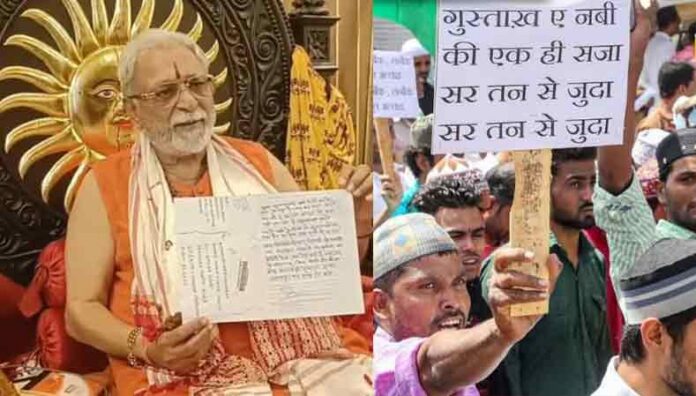
The head of the Mauni Tirth Peeth in Ujjain and Mahamandleshwar of the Niranjani Akhara, Dr Sumananand Giri Maharaj, has once again received a death threat from Islamists, triggering concern among his followers and prompting fresh demands for enhanced security. The latest threat came on Monday, 15th June, through a handwritten letter delivered to the Ganga Ghat Shri Moni Tirth Peeth Ashram on Mangalnath Road in Ujjain.
'कन्हैया लाल दर्जी का वीडियो देख, अब तेरी बारी', उज्जैन के बड़े संत को जान से मारने की मिली धमकी….see more https://t.co/T59uEp2K4f#ujjainnews#madhyapradesh#crimenews pic.twitter.com/t9Jg3hmxC5
— Patrika Madhya Pradesh (@patrika_mp) June 17, 2026
According to the ashram administration, the suspicious letter reached the premises on Monday and was opened the following day. What followed was alarming. The letter contained direct threats to the life of the Mahamandleshwar and referred to the brutal murder of Udaipur tailor Kanhaiya Lal and a recent murder in Delhi. The sender warned him that “now it is your turn” and claimed that no one would be able to save him.
The threatening letter reportedly accused Sumananand Giri Maharaj of repeatedly insulting Prophet Muhammad and used inflammatory language while invoking the slogan often associated with Islamist extremism. One part of the letter read, “Ab pani sir ke upar ja raha hai. Baar-baar mana karne par bhi tu apni aadat se baaz nahi aa raha hai. Musalsal hamare pyare Nabi ki shaan mein gustakhi kar raha hai. Kanhaiya Lal ke qatl ka video dekh… ab teri baari hai. Jahannum mein jayega tu. Tera Modi aur Mohan koi bacha nahi payega. Inshallah, bach sako to bacho.”
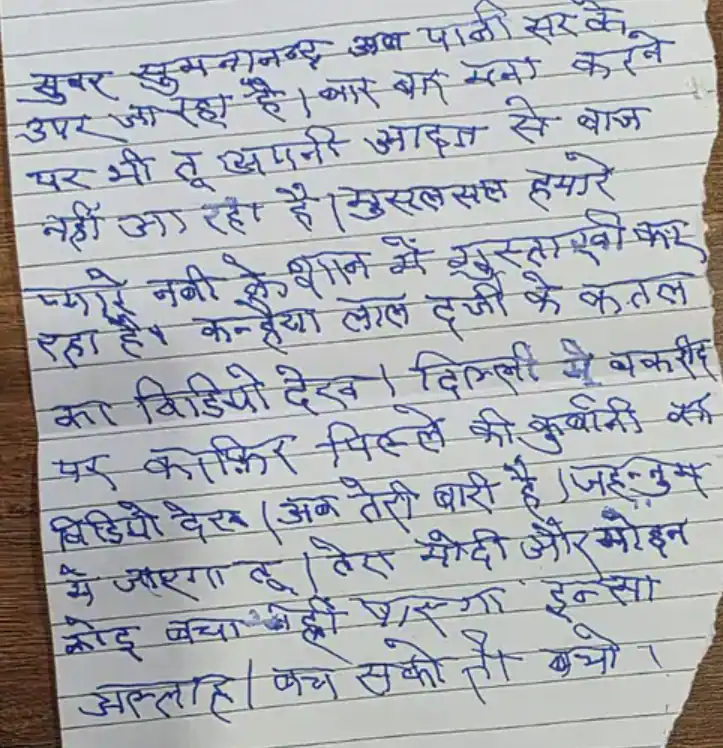
Following the threat, the ashram immediately informed the police. Authorities have seized the letter and launched an investigation to identify the sender and establish the motive behind the threat. Security agencies have also become involved due to the seriousness of the contents and the repeated nature of such threats against the religious leader.
Speaking to the media, Sumananand Giri Maharaj said that this was not an isolated incident. He revealed that he has been receiving threatening messages and letters for several years. According to him, similar threats were received in 2023 and again in 2025. He has now urged the administration to provide permanent security cover, arguing that the repeated threats should not be dismissed as mere intimidation.
Ujjain, Madhya Pradesh: On requesting security after receiving a death threat letter, Mahamandaleshwar Swami Sumananand Giri Maharaj says, "… I initially thought it might be from someone known or perhaps some ordinary letter… The letter says: '…The water has gone above your… pic.twitter.com/nzwFVyCoc9
— IANS (@ians_india) June 16, 2026
A Hindu Religious Leader under constant attack by Islamists
The latest letter is only the newest episode in what has become a long pattern of threats directed at Sumananand Giri Maharaj.
The Mahamandleshwar has often been in the spotlight for his religious activities, including ghar wapsi programmes and facilitating the conversion of individuals to Sanatan Dharma. He has also conducted Hindu marriages for people who chose to leave Islam and embrace Hinduism. These activities have frequently attracted criticism and hostility from radical elements.
According to the Mahamandleshwar, he has faced threats for three to four years continuously. He has claimed that there were even attempts to attack him physically in the past. In one instance, individuals stopped his vehicle and threatened to open fire. In another case, suspicious persons reportedly entered his ashram, creating security concerns.
Despite repeated complaints to local police stations, district authorities and state officials, he says permanent security arrangements have not yet been provided.
“Sanatan ke liye kaam karenge to aisi dhamkiyan milti hain,” he remarked while speaking about the threats. He maintained that helping individuals voluntarily embrace Sanatan Dharma was part of his duty as a religious leader and that he would continue his work despite intimidation.
‘Sar Tan Se Juda’ threat sent from Prayagraj in 2024
For the past three to four years, he has been under constant attack, bearing the brunt of radical fury simply for carrying out his religious duties. He has openly stated that his dedication to Sanatan Dharma, specifically his involvement in “ghar wapsi” (reconversion) and his efforts to bring Muslim women into the Sanatan fold and marry them according to Vedic rituals, has placed a massive target on his back. One of the most serious threats received by Sumananand Giri Maharaj emerged in December 2024 when he received a letter explicitly invoking the slogan “Sar Tan Se Juda.”
Mahamandaleshwar Dr. Sumananand Giri Ji of Niranjani Akhara Ujjain, @drsumanandgiri receives death threat
— Sanatan Prabhat (@SanatanPrabhat) December 20, 2024
This is a ploy to eliminate Hindu saints and mahants to render Hindus directionless.
Effective Hindu unity is necessary to counter this
महामंडलेश्वर डॉ. सुमनानंद गिरि I… pic.twitter.com/ZEL0aBQaK2
The letter, written in Urdu and sent by a person identified as Sagir Ahmed from Nawabnagar in Kareli, Prayagraj, warned the Mahamandleshwar that he was repeatedly insulting Prophet Muhammad and that “the only punishment for this is Sar-Tan-Se-Juda.”
The threat went beyond a simple warning. The sender also wrote, “We are fully capable of protecting our religion and faith. One day, Azaan will be given in the Shriram Temple.”
The Mahamandleshwar responded defiantly. “I have been working for Sanatan and will continue to do so,” he said.
Even before the December 2024 threat, he had reportedly received an anonymous Urdu letter in 2023 during an Akhara Parishad meeting. The pattern of threats suggests a sustained campaign of intimidation targeting him because of his religious activities and public statements.
The origins of ‘Sar Tan Se Juda’
The slogan “Sar Tan Se Juda” has become one of the most disturbing expressions associated with radical Islamist mobilisations in recent years. The phrase comes from the slogan: “Gustakh-e-Rasool ki ek hi saza, Sar Tan Se Juda, Sar Tan Se Juda,” which translates to, “There is only one punishment for insulting the Prophet, separation of the head from the body (beheading).”
Although the slogan has become familiar during protests and threats in India, its origins lie in Pakistan. The phrase gained prominence after the 2011 assassination of Punjab Governor Salman Taseer in Pakistan. Taseer was murdered by his own bodyguard, Mumtaz Qadri, because he opposed Pakistan’s controversial blasphemy laws and supported reforms.
Instead of universally condemning the murder, several radical Islamist groups celebrated Qadri as a hero. Among them was the extremist organisation Tehreek-e-Labbaik Pakistan (TLP), led by Khadim Hussain Rizvi. During large public gatherings organised in support of Qadri, crowds repeatedly chanted, “Gustakh-e-Rasool ki ek hi saza, Sar Tan Se Juda.” Rizvi used the phrase to radicalise and recruit youth during mass rallies.
The TLP subsequently digitised and globalised the radical slogan by embedding it into YouTube videos, often overlaid with dramatic sound effects of clashing swords to expand its online reach.
Over time, the slogan became a rallying cry for radical Islamist groups demanding violence against those accused of blasphemy. Pakistan has witnessed numerous cases where allegations of blasphemy have resulted in mob attacks, killings and persecution of minorities, particularly Hindus and Christians.
Soon, the slogan crossed international borders and began appearing during various communal flashpoints in India. It was heavily chanted by radical elements demanding the beheading of figures like Kamlesh Tiwari and Nupur Sharma. It has increasingly appeared during protests and online campaigns in India. The slogan has contributed to an atmosphere where threats of violence are normalised against individuals accused of offending religious sentiments.
How the ‘Sar Tan Se Juda’ narrative entered Indian public discourse
Tragically, this imported radical outcry did not stay confined behind Pakistan’s borders. It bled into India, where radical Muslims and their enablers have successfully normalised it on Indian streets. The slogan gained unprecedented visibility in India during the controversy surrounding former BJP spokesperson Nupur Sharma in 2022.
The controversy began after comments made by Sharma during a television debate concerning the Gyanvapi dispute. Soon afterwards, Alt News co-founder Mohammed Zubair shared edited clips from the debate on social media and accused Sharma of making inflammatory remarks.
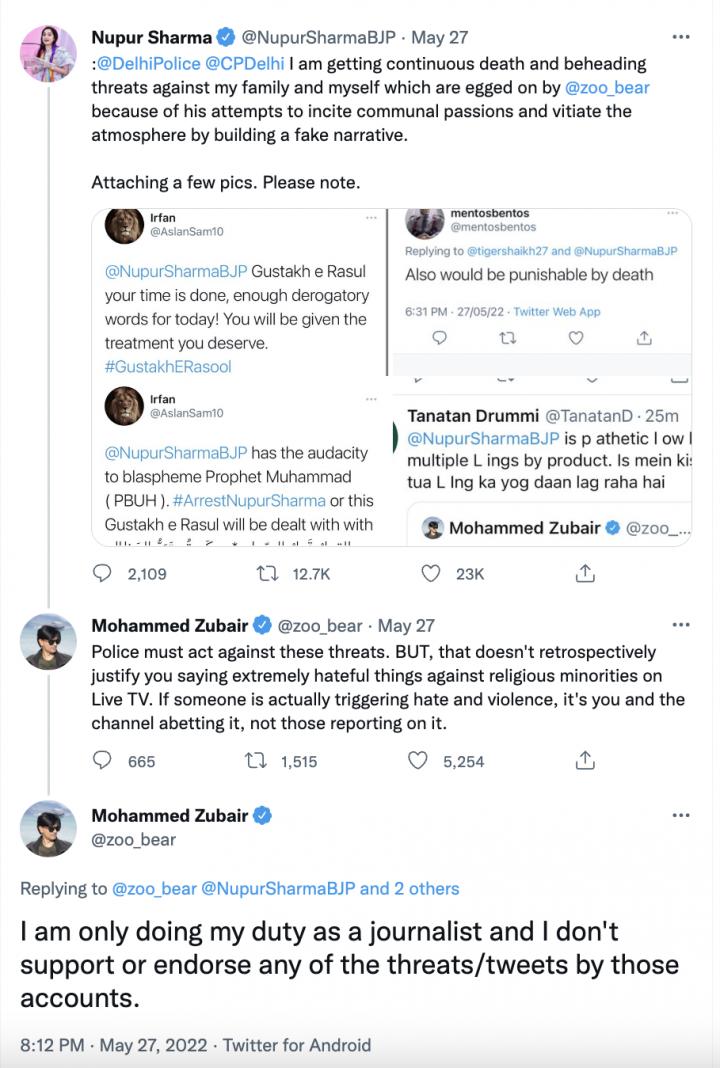
On 27th May, 2022, Zubair posted tweets targeting Sharma and described her as a “rabid communal hatemonger.” He also demanded police action against her and accused her of inciting communal tensions.

Supporters of Sharma later argued that the clips shared online lacked the full context of the debate and omitted comments made by other panellists that had triggered the exchange.
Within hours of the controversy gaining traction online, Sharma began receiving death threats, rape threats and also beheading threats. Social media was flooded with messages invoking “Gustakh-e-Rasool” and “Sar Tan Se Juda.”
Sharma herself publicly accused Zubair of creating a hostile environment through selective amplification of her remarks. She wrote to the Delhi Police, stating that she and her family were receiving continuous death and beheading threats.
:@DelhiPolice @CPDelhi I am getting continuous death and beheading threats against my family and myself which are egged on by @zoo_bear because of his attempts to incite communal passions and vitiate the atmosphere by building a fake narrative.
— Nupur Sharma (@NupurSharmaBJP) May 27, 2022
Attaching a few pics. Please note. pic.twitter.com/QmgA2uRCrS
What began as a social media controversy soon spilt into the streets. Protests erupted across multiple cities, with demonstrators openly chanting “Sar Tan Se Juda.” The slogan became a recurring feature of demonstrations organised in response to the controversy.
The episode marked a turning point, bringing a slogan once largely associated with Pakistan’s blasphemy politics into India’s public discourse.
The Kamlesh Tiwari murder in broad daylight
Long before the Nupur Sharma controversy, India had already witnessed violence linked to allegations of blasphemy.
One of the most prominent cases was the murder of former Hindu Mahasabha leader and Hindu Samaj Party founder Kamlesh Tiwari in October 2019. Tiwari was attacked at his office in Lucknow by assailants who had arrived posing as visitors. According to investigators, the attackers concealed weapons inside a box of sweets before launching their assault. He was shot, and his throat was slit in broad daylight.
According to the reports, the post-mortem report has revealed that Kamlesh Tiwari was stabbed 15 times. The Islamists had stabbed him in the upper part of the body from jaws to the chest. The wounds were inflicted within 10 cm of each another. The post-mortem report suggests that there were two deep cut marks on the neck points to attempt to slit his throat.
The attackers had also shot him once to make sure that he dies in the attack. The bullet was fired in his face. The doctors conducting a post-mortem on Kamlesh Tiwari’s body found a point 32 bullet on the backside of the skull.
The murder shocked the country because Tiwari had been facing threats since 2015, when he made controversial remarks about Prophet Muhammad.
Those remarks triggered widespread protests and riots. In Kaliachak in West Bengal’s Malda district, massive violence erupted. Shops were looted, buses were burnt, and a police station was attacked by rioters. Tiwari spent more than a year in jail after the National Security Act was invoked against him. Although he was later released following court intervention, threats against him continued.
The Kanhaiya Lal Murder case
If Kamlesh Tiwari’s murder was a warning, the horrific slaughter of Kanhaiya Lal was the ultimate realisation of the “Sar Tan Se Juda” terror on Indian soil. The explicit mention of Kanhaiya Lal in the recent threat letter to Mahamandleshwar Dr Suman Anand Giri is what makes the situation so utterly terrifying.
In June 2022, the digital dog-whistling initiated by Mohammed Zubair against Nupur Sharma claimed the life of an innocent Hindu tailor in Udaipur. Kanhaiya Lal’s only “crime” was that an 8-year-old child, his son, was playing a video game on his mobile phone and accidentally shared a social media post in support of Nupur Sharma. Within two days, two radicalised Islamists, Mohammed Riyaz Akhtar and Mohammed Gos, stormed his tailor shop. When they confronted him, Kanhaiya innocently explained that he barely knew how to operate the smartphone and that his young son had made the post by mistake. The men seemingly accepted the excuse, deleted the post themselves, and warned him.
Soon afterwards, local individuals identified him and circulated his details. Complaints were filed against him, and he reportedly began receiving threats. Fearing for his life, Kanhaiya Lal approached the police and sought protection. However, despite his repeated concerns, adequate security was not provided.
On 28th June, 2022, Mohammed Riyaz Attari and Ghaus Muhammad entered his shop posing as customers, and in a deeply disturbing act of barbarism that they filmed for the world to see, they brutally hacked Kanhaiya Lal to death, fulfilling the “Sar Tan Se Juda” promise. The murder sent shockwaves across India and became one of the most cited examples of violence carried out in the name of perceived blasphemy.
The case became a symbol of the dangers posed by extremist narratives that encourage violence against individuals accused of insulting religious figures.
The fresh threat against Mahamandleshwar Dr Sumananand Giri has once again brought attention to the growing number of threats invoking the “Sar Tan Se Juda” slogan.
From the assassination of Salman Taseer in Pakistan to the murders of Kamlesh Tiwari and Kanhaiya Lal in India, the slogan has become associated with a dangerous form of vigilantism where individuals accused of blasphemy are threatened with violence.
For Sumananand Giri Maharaj, the latest letter is not merely another anonymous threat. It comes after years of intimidation, repeated warnings and attack attempts. The references to previous murders, including the Kanhaiya Lal case, have only heightened concerns.


