

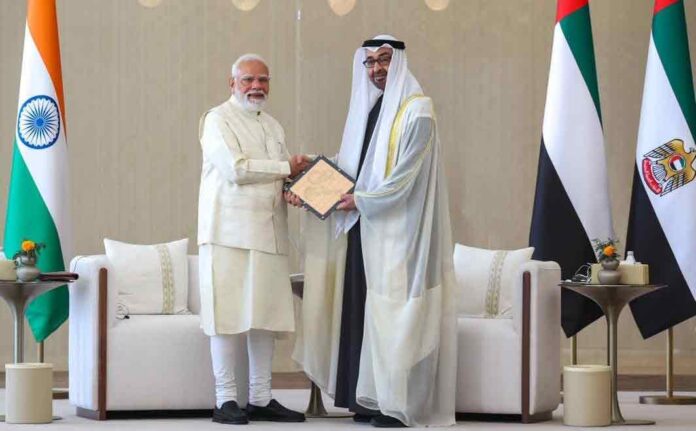
Prime Minister Narendra Modi’s visit to the UAE on 15 May 2026 has produced a series of landmark outcomes that promise to deepen strategic, economic and technological ties between India and the United Arab Emirates. Several agreements and investment announcements were finalised in Abu Dhabi, reflecting growing ties between the two nations in critical sectors ranging from energy security to defence and artificial intelligence.
كما شهدت هذه الزيارة إلى دولة الإمارات إبرام اتفاقيات محورية في قطاعات حيوية، مثل الطاقة والدفاع والبنية التحتية والشحن والتقنيات المتقدمة؛ مما منح دفعة جديدة للشراكة الاستراتيجية الشاملة بين الهند والإمارات. وفي تطور مهم آخر، أعلنت دولة الإمارات عن استثمارات بقيمة 5 مليارات… pic.twitter.com/RKQMFTUdY6
— Narendra Modi (@narendramodi) May 15, 2026
In the crucial energy domain amid the West Asia crisis, a significant Memorandum of Understanding was signed between the Indian Strategic Petroleum Reserves Limited and the Abu Dhabi National Oil Company for strategic collaboration. Under this pact, up to 30 million barrels of ADNOC crude will be stored in India’s strategic petroleum reserves, including participation in facilities at Vishakhapatnam in Andhra Pradesh and the development of new reserve infrastructure at Chandikol in Odisha.
It also opens the door for reciprocal crude storage in Fujairah in the UAE as part of India’s reserves and explores joint development of liquid natural gas and liquid petroleum gas storage facilities on Indian soil.
Complementing this, the Indian Oil Corporation Limited and ADNOC entered into a strategic collaboration agreement focused on Liquefied Petroleum Gas supplies. The two sides will explore long-term sale and purchase arrangements, including a potential comprehensive LPG supply deal between ADNOC Gas Limited and IOCL, thereby reinforcing India’s energy security architecture with reliable Gulf supplies.
On the defence and security front, India and the UAE have formalised a comprehensive Framework for Strategic Defence Partnership. This landmark understanding covers defence industrial collaboration, innovation in advanced technologies, joint training and exercises, special operations, interoperability, maritime security, cyber defence as well as secure communications and information exchange, signalling a new era of military-to-military cooperation.
Maritime development received a major fillip with two separate MoUs involving Cochin Shipyard Limited. The first, signed with Drydocks World of the UAE, provides for the establishment of a state-of-the-art Ship Repair Cluster at Vadinar under the Government of India’s Maritime Development Fund Scheme, encompassing offshore fabrication capabilities.
The second tripartite agreement, involving Cochin Shipyard Limited, Drydocks World and the Centre of Excellence in Maritime and Shipbuilding, aims at large-scale skill development and employment generation in ship repair. It seeks to build a skilled Indian maritime workforce and position the country as a global hub for shipbuilding and ship-repair professionals.
In the emerging technology sector, a term sheet was exchanged for setting up an 8 Exaflop Super Computing Cluster through a partnership between the Centre for Development of Advanced Computing in India and G-42 of the UAE. This initiative will form a key component of India’s national AI Mission and is expected to accelerate high-performance computing capabilities for both nations.
The PM’s visit also witnessed substantial investment commitments from UAE entities into the Indian economy. The Abu Dhabi Investment Authority and India’s National Infrastructure and Investment Fund agreed to explore opportunities worth up to one billion US dollars in the country’s infrastructure sector. Emirates NBD announced an investment of three billion US dollars in RBL Bank, while the International Holding Company committed one billion US dollars in Sammaan Capital, underscoring the confidence of UAE investors in India’s growth story.
Taken together, these outcomes not only strengthen the already robust India-UAE Comprehensive Strategic Partnership but also open new avenues for mutual prosperity and regional stability. The agreements are expected to generate employment, enhance technological self-reliance and secure India’s long-term energy needs while fostering greater people-to-people and business linkages between the two friendly nations.
