

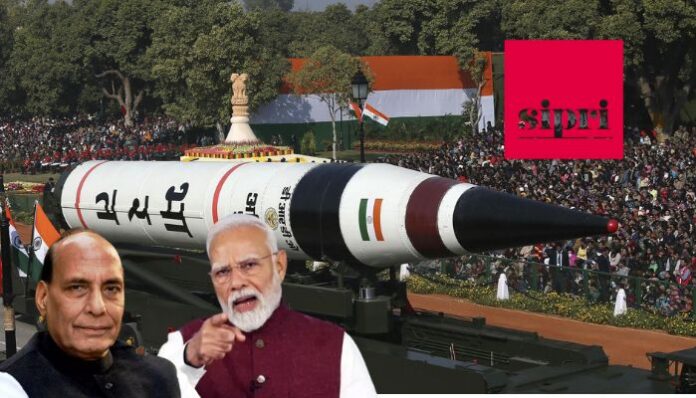
In a major shift in nuclear weapons policy, India has reportedly deployed 12 nuclear warheads. The claim has been made in the latest report of the Stockholm International Peace Research Institute (SIPRI).
The report released on 8th June states that while India has deployed zero nuclear warheads in 2025, by 2026, 12 warheads are deployed at various locations. The world’s top arms-tracking organisation, SIPRI, linked the nuclear warhead deployment with delivery systems to the post-Operation Sindoor shift in policy.
The SIPRI report says that the deployment of nuclear warheads by India is a significant departure from the decades-old policy of storing nuclear warheads and delivery systems separately.
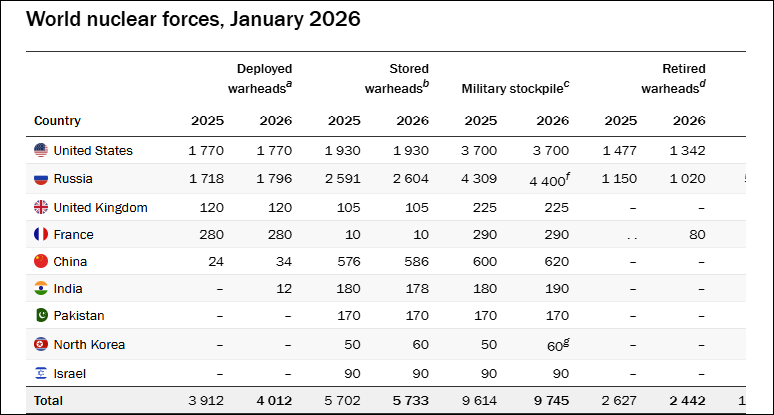
Moreover, the SIPRI analysis indicates a slight increase in India’s nuclear weapons stockpile last year. India deployed a small number of warheads on a ballistic missile submarine (SSBN) and conducted deterrence patrols.
India was estimated to have a growing stockpile of about 190 nuclear weapons as of January 2026, a small increase from the previous year. These weapons were assigned to a maturing nuclear triad of aircraft, land-based missiles and SSBNs,” the SIPRI report states.
“It has long been assumed that India stores its nuclear warheads separate from its deployed launchers during peacetime. However, the country’s recent moves towards placing missiles in canisters and conducting sea-based deterrence patrols suggest that India could be shifting in the direction of mating some of its warheads with their launchers in peacetime,” it adds.
The SIPRI report says that India is expanding its nuclear arsenal to tackle threats from both China and Pakistan.
“India is believed to have once again slightly expanded its nuclear arsenal in 2025 and continued development of new types of nuclear delivery systems. The modernisation programme is increasingly focused on developing long-range weapons capable of reaching targets throughout China, although planning also continues to be focused on India’s long-standing rivalry with Pakistan,” the report reads.
Regarding the possibility of an increase in Pakistan’s nuclear arsenal, the SIPRI analysis says, “Pakistan continued to develop new delivery systems and accumulate fissile material in 2025, suggesting that its nuclear arsenal might expand over the coming decade. The brief armed conflict between India and Pakistan in May 2025 saw India attacking Pakistani air- and missile bases that are likely to have nuclear-related roles, but both sides took steps to avoid escalation.”
India follows a “no-first use” nuclear policy, although Defence Minister Rajnath Singh has earlier emphasised that the policy depends on circumstances.
