

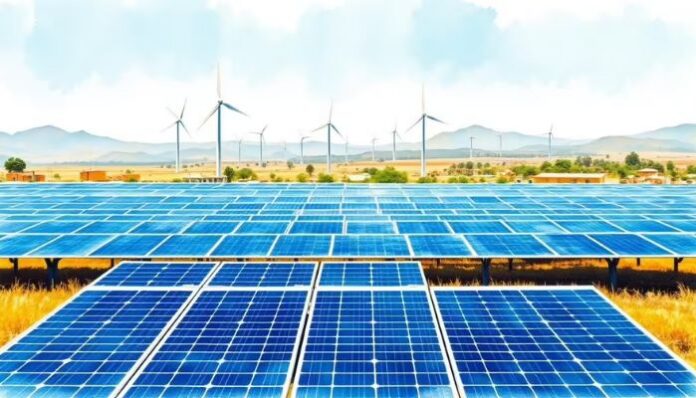
India recently managed to meet its highest-ever electricity demand without any shortage, and this time, it wasn’t just coal that kept things running. Solar power played a big role, showing how the country’s energy mix is slowly shifting towards cleaner sources.
Union Minister Pralhad Joshi said on Wednesday, 29th April, that nearly one-third of India’s all-time high power demand of 256.11 GW was met through renewable energy sources.
India Meets Record Demand Without a Flicker ☀️🇮🇳
— Pralhad Joshi (@JoshiPralhad) April 30, 2026
India achieved a significant milestone by meeting an all-time peak electricity demand of 256.1 GW in April without any shortage, reflecting the robustness and reliability of its power sector.#SolarEnergy played a critical role…
On 25th April, India recorded a peak power demand of 256.1 gigawatts (GW), the highest ever. Despite the surge, there was no power shortage, and the country even continued exporting electricity to its neighbours. While thermal power still made up the largest share at about 66%, solar energy contributed a significant 21%, marking a noticeable change in how electricity demand is being met.
𝐅𝐫𝐨𝐦 𝐏𝐨𝐰𝐞𝐫 𝐃𝐞𝐟𝐢𝐜𝐢𝐭 𝐭𝐨 𝐏𝐨𝐰𝐞𝐫 𝐒𝐮𝐫𝐩𝐥𝐮𝐬 ⚡
— BJP (@BJP4India) April 28, 2026
Once defined by shortages, India now meets its full power demand.
From a 16.6% deficit in 2007 to a massive 2012 blackout that plunged 60 crore people into darkness, the crisis was real.
Today, India delivers… pic.twitter.com/NU1JMG8e87
Solar steps up during peak hours
One of the most striking moments came earlier that day, around 12:30 pm, when solar energy generation touched nearly 81 GW. This was almost one-third of the total electricity being produced at that time. During peak demand hours, solar alone contributed about 57 GW, proving that it is no longer just a backup source but a major player in the system.
India successfully powered through its highest-ever peak demand of 256.1 GW on April 25, proving the robustness of our national grid.@MinOfPower highlighted that the demand has been met while simultaneously maintaining electricity exports to the neighbouring countries.
— All India Radio News (@airnewsalerts) April 28, 2026
The… pic.twitter.com/CfXR5P959Q
Data from GRID India shows that solar power is increasingly helping stabilise the grid, especially during daytime when demand spikes due to heat. With temperatures rising early this year, electricity use has also gone up sooner than expected.
Early summer pushes demand higher
Usually, India’s electricity demand peaks in June or July, but in 2026, the surge came as early as April. The main reason is the intense heat, which has increased the use of air conditioners, coolers, and fans across homes and offices.
Compared to April last year, peak demand has jumped from around 235 GW to 256 GW this year. Overall electricity consumption has also grown by nearly 9% in April, showing how quickly demand is rising.
The Ministry of Power has estimated that demand could go up to 271 GW in the coming months. This means the pressure on the power grid will remain high as summer continues.
Solar power is becoming central to India’s energy mix
Solar energy is now becoming one of the most important parts of India’s power system. As of March 2026, the country has crossed 150 GW of installed solar capacity, making it the fastest-growing source of power.
In the last financial year, solar energy generated over 173 billion units of electricity, contributing around 9.5% of total power generation. More importantly, non-fossil fuel sources now make up over half of India’s installed capacity, showing a long-term shift away from coal dependence.
Experts believe this growth is a result of strong government policies and falling costs of solar technology. Solar is especially useful during peak daytime demand, where it can directly reduce the burden on thermal power plants.
Government push behind Solar growth
India’s solar journey began with the National Solar Mission in 2010, but it has picked up speed in recent years. Several government schemes have helped expand solar use across the country.
The PM Surya Ghar scheme, for example, aims to install rooftop solar panels in one crore homes, offering free electricity benefits. So far, lakhs of households have already adopted rooftop systems.
Similarly, the PM-KUSUM scheme has helped farmers by promoting solar-powered pumps and decentralised plants. More than 21 lakh farmers have benefited from it.
The government is also focusing on manufacturing solar equipment within the country under the Production-Linked Incentive (PLI) scheme. Large solar parks and better infrastructure are also helping speed up project development.
India’s ability to meet record electricity demand without disruption shows that renewable energy, especially solar, is becoming a strong pillar of the power system. While coal still plays a major role, the growing contribution of solar indicates a steady shift towards cleaner and more sustainable energy.
As demand continues to rise, this balance between traditional and renewable sources will be key to ensuring an uninterrupted power supply. Step by step, with every solar panel installed, India is moving towards a future where clean energy plays a leading role.
