

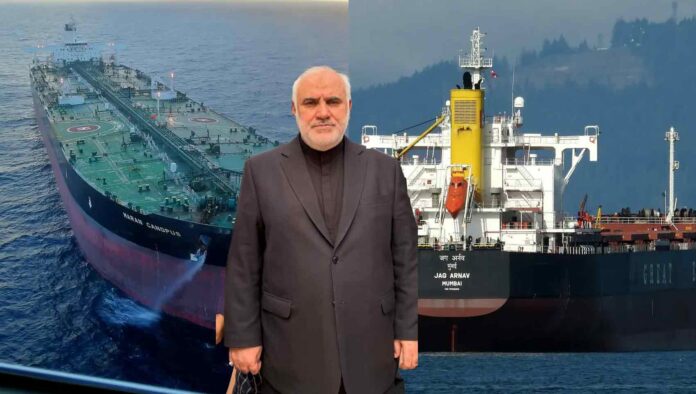
India today summoned Iran’s ambassador to lodge a strong protest after two Indian-flagged vessels came under fire in the Strait of Hormuz today, as Tehran tightened its military control over the strategic waterway. The Ministry of External Affairs (MEA) called in Ambassador Dr Mohammad Fathali for an urgent meeting with Foreign Secretary Vikram Misri this evening. In a strongly worded statement, the MEA expressed India’s “deep concern” at the shooting incident involving the two merchant ships and emphasised the safety of Indian seafarers and merchant shipping.
The Foreign Secretary recalled that Iran had previously facilitated the safe passage of several India-bound vessels and urged Tehran to “resume at the earliest the process of facilitating India-bound ships across the Strait”. The Iranian ambassador undertook to convey India’s views to his government.
The incident is the latest in a series of confrontations affecting Indian vessels. In a serious episode that prompted today’s diplomatic démarche, Iranian forces opened fire on two Indian-flagged vessels. One of them was the Very Large Crude Carrier (VLCC) Sanmar Herald (Indian-flagged, carrying nearly two million barrels of oil), which was reportedly targeted by IRGC gunboats as it attempted to transit the strait. Radio communications captured the crew pleading, “My name second on your list! You gave me clearance to go! You are firing now! Let me turn back!”
The vessel turned around without sustaining damage or injuries after Iranian forces refused to allow it to cross the strait. A second Indian-flagged vessel, identified as the bulk carrier Jag Arnav, was also involved in the incident, with both ships forced to abort their passage. No injuries have been reported, and the crews are understood to be safe.
Sanmar Herald is loaded with around 200,000 tonnes of crude, while Jag Arnav is carrying urea bound for India.
“Some ships trapped inside the Strait of Hormuz were trying to do the transit. There was some information that it was safe to do so. So, they were making the transit. And then there were warning shots fired, and the ships were ordered to go back because the Strait is closed,” a shipping industry official said.
Earlier today, Indian-crewed cargo ship Bhagya Laxmi and crude oil tanker Desh Suraksha were intercepted by IRGC gunboats and forced to make a U-turn after being denied permission to cross. The crew of both the vessels broadcast “Indian ship Indian crew” over their transponders, identifying as Indian ships, hoping that they would be allowed to go through. But as they were denied permission on the radio, they complied and headed back.
However, earlier in the day, Desh Garima, an oil supertanker owned by Shipping Corporation of India Ltd, managed to come out of the Strait safely, during the brief period the strait was opened by Iran.
The events came hours after Iran reimposed “strict military control” over the Strait of Hormuz, citing alleged US violations of a recent navigation understanding.
Yesterday, Iran declared the Strait of Hormuz open for all commercial traffic during the 10-day Israel-Lebanon ceasefire. But US President Donald Trump announced that the US naval blockade will continue despite the opening by Iran. Iran’s Parliament Speaker, Mohammed Bagher Ghalibaf, warned that the Strait of Hormuz, one of the world’s most critical oil corridors, will not remain open if the United States continues its naval blockade of Iranian ports. He made it clear that any movement through the strait would now depend strictly on Iranian authorisation and designated routes, signalling Tehran’s readiness to tighten control if pressure persists.
Following that, media reports said that Iran had reversed the brief reopening of the strait, with the IRGC Navy now actively enforcing transit permissions.
