

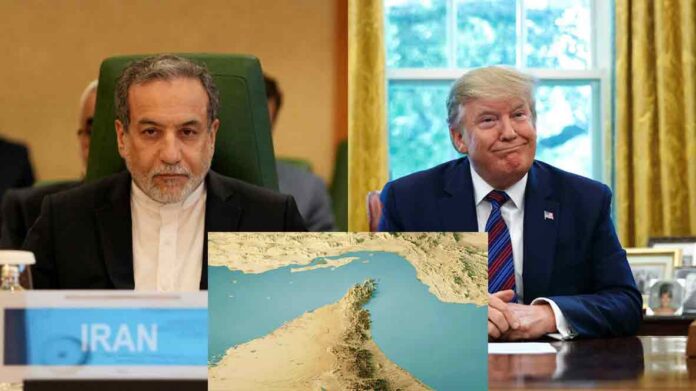
Iran on Friday declared the Strait of Hormuz completely open to commercial traffic during the ongoing 10-day ceasefire between Israel and Lebanon. Iran’s foreign minister Seyed Abbas Araghchi announced it on social media, saying that the strait, through which roughly a fifth of the world’s oil supply passes, will remain open for passage of all commercial vessels.
Araghchi wrote on X, “In line with the ceasefire in Lebanon, the passage for all commercial vessels through Strait of Hormuz is declared completely open for the remaining period of ceasefire, on the coordinated route as already announced by Ports and Maritime Organisation of the Islamic Rep. of Iran.”
In line with the ceasefire in Lebanon, the passage for all commercial vessels through Strait of Hormuz is declared completely open for the remaining period of ceasefire, on the coordinated route as already announced by Ports and Maritime Organisation of the Islamic Rep. of Iran.
— Seyed Abbas Araghchi (@araghchi) April 17, 2026
President Trump acknowledged the development on Truth Social, writing that the strait is “completely open and ready for business and full passage”. However, he added that the US naval blockade “will remain in full force and effect as it pertains to Iran”. He wrote, “the Strait of Hormuz is completely open and ready for business and full passage, but the naval blockade will remain in full force and effect as it pertains to Iran, only, until such time as our transaction with Iran is 100% complete. This process should go very quickly in that most of the points are already negotiated.”
The US imposed the blockade earlier this week after peace negotiations stalled, with American forces intercepting vessels entering or leaving Iranian ports and coastal areas. Trump has said that any vessel that transits the Strait by paying ‘illegal toll’ to Iran will be intercepted.
Washington has described the action as targeted pressure on Tehran’s economy while maintaining freedom of navigation for ships not connected to Iranian ports. Pentagon officials have claimed the measure has significantly disrupted Iranian seaborne trade.
Oil prices, which surged when the blockade was announced and Iran restricted traffic, dropped sharply on news of the reopening, easing immediate fears of prolonged disruption to global energy supplies.
Iranian sources emphasised that only non-military vessels may transit, following designated routes approved by the Islamic Revolutionary Guard Corps Navy and Iran’s Ports and Maritime Organisation. Some shipping industry voices, including the Norwegian Shipowners’ Association, cautioned that practical details, such as the presence of mines and exact implementation, still need clarification before full confidence returns.
The move comes amid a 10-day ceasefire involving Lebanon and follows weeks of heightened tensions after the collapse of peace talks in Islamabad. U.S. President Donald Trump on Thursday announced that Israel and Lebanon have reached an agreement for a 10-day ceasefire, scheduled to take effect on Tuesday at 5 p.m. Eastern Time.
In a post on his Truth Social platform, Trump declared the temporary halt to hostilities, describing it as a step toward achieving lasting peace between the two nations. Trump stated that Israel and Lebanon had agreed to the ceasefire following recent diplomatic engagements, including what he characterised as the first direct high-level discussions between leaders of the two countries in 34 years.
He added that added that he will be inviting Israeli Prime Minister Benjamin Netanyahu and President Joseph Aoun of Lebanon to the White House “for the first meaningful talks between Israel and Lebanon since 1983, a very long time ago.” He added, “Both sides want to see PEACE, and I believe that will happen, quickly!”
