

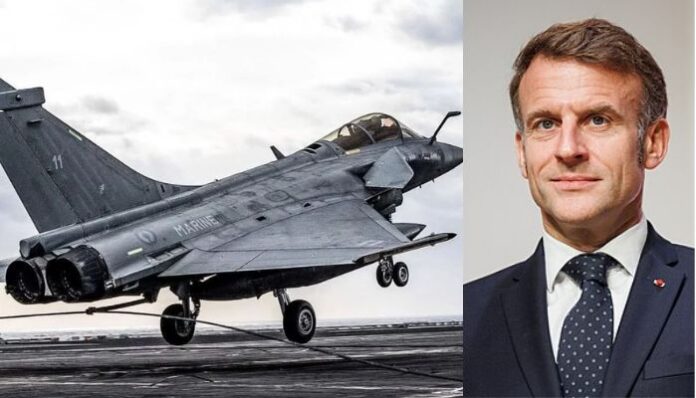
India is close to approving its largest defence purchase so far. The Defence Ministry likely to clear a ₹3.25 lakh crore deal for 114 French-made Rafale fighter jets for the Indian Air Force’s Multi-Role Fighter Aircraft (MRFA) programme.
According to media reports, the decision could come this week, just days before French President Emmanuel Macron arrives in New Delhi on Tuesday, 10th February.
Once cleared, the deal will mark a major step in India’s defence modernisation and will also support the government’s ‘Make in India’ push. A large number of these jets, around 100, are planned to be manufactured in India.
This will involve the transfer of advanced fighter jet technology and a long-term strategic partnership between Indian and French companies.
Strengthening India’s Rafale fleet
India already operates 36 Rafale ‘C’ variant aircraft. The last jet of the series was delivered to the Indian Air Force in December 2024. These fighters are deployed with No 17 Squadron, known as the Golden Arrows, at Ambala, and No 101 Squadron, called the Falcons, at Hasimara in West Bengal.
In addition, India has placed an order for 26 Rafale ‘M’ naval variants under a separate ₹63,000 crore agreement. This deal also covers four twin-seat trainer aircraft, along with maintenance, logistics support and personnel training under an MRO (maintenance, repair and overhaul) arrangement. Delivery of these naval jets is expected by 2030.
The Rafale ‘M’ aircraft will be deployed on board India’s aircraft carriers INS Vikrant and INS Vikramaditya, significantly boosting the Navy’s air power at sea.
Combat role and capabilities
The Rafale jets in Indian service have already been used in real operations. They took part in Operation Sindoor, India’s military response to the Pahalgam terror attack in May last year, and were also deployed during the standoff in Ladakh.
During Operation Sindoor, Rafales are believed to have fired SCALP air-launched cruise missiles, which can hit hardened targets more than 250 km away with high accuracy.
The aircraft is known for its strong air combat and strike abilities. It can carry Meteor long-range air-to-air missiles, Hammer stand-off weapons, and the Spectra electronic warfare system, along with advanced radar and targeting equipment. Rafales have also been used by other countries in conflicts such as the Iraq war and operations in Libya.
Technology transfer and manufacturing in India
Alongside the fighter jet purchase, India and France are also moving ahead with deeper industrial cooperation. In June last year, Dassault Aviation and Tata Advanced Systems Limited announced four major production and technology transfer agreements. These are expected to speed up the delivery of Rafale aircraft to the Indian military.
Under this plan, Tata Advanced Systems will set up a high-end manufacturing facility in Hyderabad. The unit will produce key structural parts of the Rafale, including the front section, central fuselage, complete rear section and the lateral shells of the rear fuselage.
The first fuselage sections are expected to roll out in 2028, with a target of producing two complete fuselages every month. Final assembly of the fighter jets will continue at Dassault’s facility in Merignac, near Bordeaux, in France.
While strengthening its Rafale fleet, India is also planning for the future. The Navy is preparing to induct indigenous fifth-generation fighter jets being developed by the Defence Research and Development Organisation (DRDO).
These twin-engine, deck-based fighters will be the naval version of the Advanced Medium Combat Aircraft (AMCA) programme for the Air Force, further reducing dependence on imports and boosting India’s self-reliance in defence manufacturing.
