

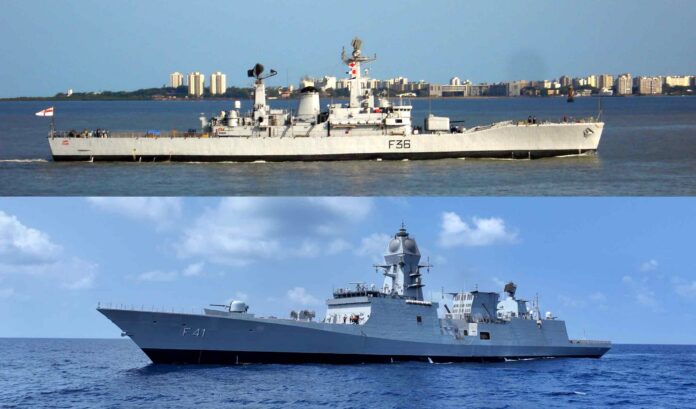
In a significant boost to India’s self-reliance in defence manufacturing, the Indian Navy received the indigenous stealth frigate INS Dunagiri on March 30, 2026, at Garden Reach Shipbuilders & Engineers (GRSE) in Kolkata. The warship, the fifth of the advanced Nilgiri-class (Project 17A), is set to be followed shortly by the commissioning of another vessel from the same class, INS Taragiri, on April 3, 2026.
INS Dunagiri represents the second Nilgiri-class ship built at GRSE and marks the fifth Project 17A frigate delivered to the Navy in the last 16 months. Its construction timeline was compressed to 80 months, down from 93 months for the lead ship INS Nilgiri, demonstrating improved efficiency in indigenous warship building. The ship was laid down on 24 January 2020, and it was launched on 15 July 2022.
The ship is a modern reincarnation of the earlier Leander-class INS Dunagiri, which served the Navy with distinction from May 5, 1977, to October 10, 2010, over 33 years. Officials described the new vessel as a “quantum leap” in naval design, featuring enhanced stealth, firepower, automation, and survivability. It embodies Aatmanirbharta (self-reliance) in warship design and construction, designed by the Warship Design Bureau and built under the oversight of the Warship Overseeing Team (Kolkata) using integrated construction methods.
Key Features of Nilgiri-Class Frigates
Project 17A frigates are versatile multi-mission platforms capable of addressing current and future maritime challenges. They displace approximately 6,670 tonnes, measure 149 metres in length, with a beam of 17.8 metres and draft of 5.22 metres. The ships feature a sleek design with significantly reduced radar cross-section for stealth operations.
Propulsion is provided by a Combined Diesel or Gas (CODOG) system, consisting of two gas turbines and two diesel engines driving controllable pitch propellers, paired with a state-of-the-art Integrated Platform Management System (IPMS). This configuration enables high-speed and high-endurance operations, with a top speed around 28–32 knots and a range of up to 5,500 nautical miles at economical speeds.
The advanced weapon and sensor suite includes BrahMos supersonic surface-to-surface missiles, MRSAM (Medium Range Surface-to-Air Missiles) complex with MFSTAR radar, 76mm Super Rapid Gun Mount (SRGM), close-in weapon systems (30mm and 12.7mm), and rockets and torpedoes for anti-submarine warfare.
These represent a substantial upgrade over the earlier Project 17 (Shivalik-class) frigates. The ships also integrate a modern Combat Management System for rapid threat response.
With an indigenisation content exceeding 75%, the Project 17A programme has engaged over 200 Micro, Small, and Medium Enterprises (MSMEs), generating direct employment for about 4,000 personnel and indirect jobs for more than 10,000.
INS Taragiri Commissioning
INS Taragiri (F41), the fourth potent platform of Project 17A and built by Mazagon Dock Shipbuilders Limited (MDL) in Mumbai, will be formally commissioned into the Indian Navy on Friday, April 3, 2026, at Visakhapatnam. The ceremony will be presided over by Defence Minister Shri Rajnath Singh.
The ship was laid down on 10 September 2020 and was launched on 11 September 2022. INS Taragiri was delivered to the Indian Navy on 28 November 2025.
Like its sister ships, Taragiri is a 6,670-tonne stealth frigate designed for multi-dimensional operations, including high-intensity combat, maritime security, and Humanitarian Assistance and Disaster Relief (HADR). It features the same advanced CODOG propulsion, reduced radar signature, and potent weapon suite, including supersonic surface-to-surface missiles, medium-range air defence missiles, and specialised anti-submarine systems, all integrated through a sophisticated Combat Management System.
The rapid progress in Project 17A underscores the Navy’s focus on self-reliance, with ships designed, built, and largely equipped by Indian industry. These frigates will significantly enhance the Navy’s blue-water capabilities in an increasingly complex maritime domain.
