

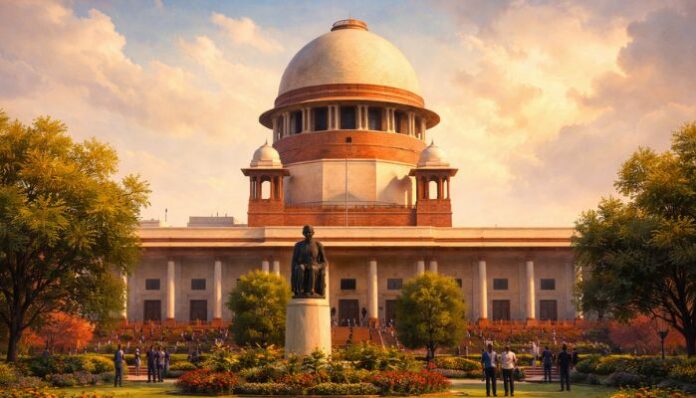
A bench comprising Chief Justice of India Surya Kant and Justice Joymalya Bagchi was hearing a petition filed by Dakxinkumar Bajrange, a DNT community leader, and others. The judges rejected the petition, observing that it was a policy decision and therefore was not justiciable. They added that the petitioner could file a representation before the concerned authorities.
“These are very calculated moves. These are not ordinary and innocent claims that suddenly appear before us. This is a very deep-rooted move to divide the society; these agencies are not from within India. If we hold an enquiry, we will find out from where they are routed,” CJI sternly remarked.
Appearing for the petitioners, Senior Advocate Siddharth Dave, argued that these communities were victims of historic justice and were criminalised by the British under the Criminal Tribes Act, 1871. Through the petition, they are seeking a separate classification in the upcoming census to be identified distinctly. Dave said that the enumeration form only contains categories SC, ST, and others. He sought a separate category of denotified tribes for such communities in the enumeration form, “so that at least there is a population number that comes.”
Dave contended that there were certain committee reports that recommended the separate enumeration of the DNT. He pointed out that the DNT communities were enumerated in the 1913 census. The top court, however, did not accept Dave’s argument and said that the plea was intended to create divisions in society. “India is a very unique country; instead of developing a casteless society, we want to create more and more classifications,” CJI Kant said.
“In our considered opinion, the classification/ sub-classification sought by the petitioners in the enumeration process essentially falls in the policy domain, for which the decision has to be taken by the competent authority in the Union of India. It is not a justiciable issue. We deem it appropriate to dispose of the writ petition, with liberty to the petitioners to pursue the matter before the competent authorities,” the Supreme Court said.
According to the petition, the DNT communities in India comprise about 10-12 crore people, who have never been separately counted in any census conducted after independence. The petitioner claimed that these communities have not been able to avail themselves of the benefits of welfare schemes because of the lack of data on their numbers. The petition stated that several commissions, including the Renke Commission (2008) and the Idate Commission (2017), highlighted the severe marginalisation of DNT communities and recommended their separate enumeration in the Census.
