

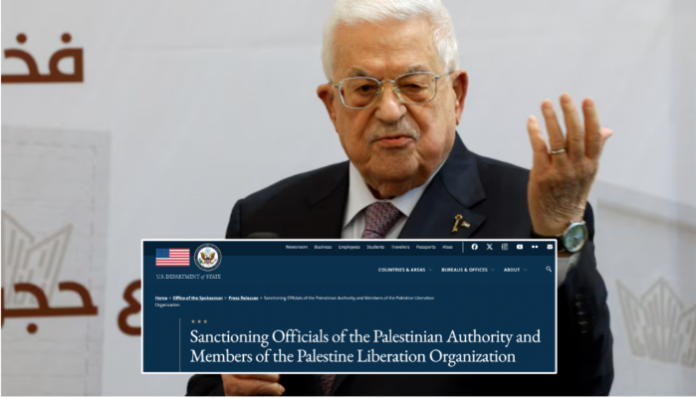
On 16th September (Wednesday), the Trump administration again decided to deny visas to a high-level Palestinian delegation, including Palestinian Authority (PA) President Mahmoud Abbas, for the annual meeting of world leaders at the United Nations for the second consecutive year.
According to the US Department of State, the Palestine Liberation Organisation (PLO) and the Palestinian Authority (PA) have once more failed to fulfil their promises as outlined in the Middle East Peace Commitments Act of 2002 (MEPCA) and the PLO Commitments Compliance Act of 1989 (PLOCCA).
The official statement highlighted, “This includes initiating and supporting actions at international organisations that undermine and contradict prior commitments in support of Security Council Resolutions 242 and 338, taking actions to internationalise the Israeli-Palestinian conflict, including through the International Criminal Court (ICC) and the International Court of Justice (ICJ), seeking to bypass negotiations through seeking unilateral recognition, and continuing to pay stipends to terrorists and to glorify acts of terrorism and terrorists in public pronouncements and school textbooks.”
It further conveyed that, as a result of their failure to reform, in violation of their commitments to the United States, and their continuous actions that jeopardise the possibility for peace, the United States has imposed sanctions that deny visas to PLO members and PA officials under section 604(a)(1) of the MEPCA.
The release added, “The Department has maintained the standing waiver for personnel notified to the PLO Observer Mission to the United Nations, as was the case in the Department’s prior determinations. It is in our national interest to impose consequences and hold the PLO and PA accountable for glorifying terrorism.”
The Palestinian Mission to the UN reportedly prepared a resolution in response to the latest development, which it will present to the General Assembly, allowing Mahmoud Abbas to address the body remotely as he did last year when the United States made a similar move against several Palestinian officials, including him, to block their entry before the prominent gathering in New York.
