

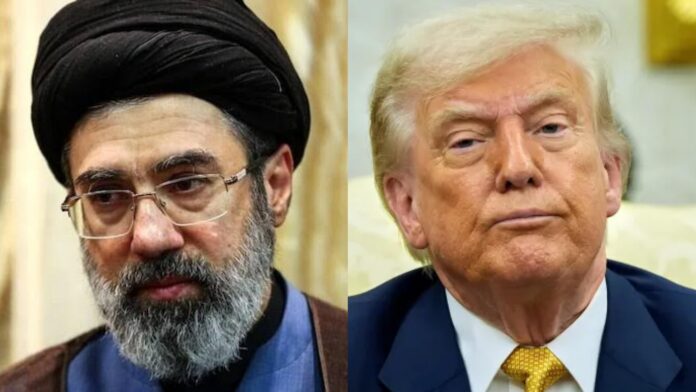
In a development that could mark a tentative shift in the ongoing standoff between Washington and Tehran, Iran’s newly elevated Supreme Leader, Mojtaba Khamenei, is reportedly open to negotiations with the United States, according to a claim broadcast by Al Arabiya, citing Israeli media sources.
The report, if substantiated, would indicate a potential diplomatic opening at a time when tensions between the two countries remain sharply elevated. It is also worth noting that Tehran had initially rebuffed claims made by Trump, expressly denying any engagement with the US.
The reported willingness to engage comes alongside remarks from US President Donald Trump, who suggested that recent backchannel discussions between American and Iranian representatives have yielded “major points of agreement.” Speaking to reporters on Monday, Trump indicated that talks had taken place a day earlier and were expected to continue, raising cautious optimism about the possibility of a negotiated settlement.
Trump further revealed that his Middle East envoy Steve Witkoff, along with his son-in-law and senior adviser Jared Kushner, were involved in the discussions. While he did not elaborate on the substance of the talks, the president struck a confident tone, stating that Washington was engaging with “the man who I believe is the most respected and the leader,” in an apparent reference to Iran’s top leadership. He added, somewhat ambiguously, that Iran “had some leaders left,” hinting at the internal strains within the Iranian establishment following recent escalations.
However, the narrative emerging from Tehran presents a starkly different picture. Iran’s state-aligned Fars News Agency quickly pushed back against the claims, quoting a source who categorically denied any form of communication, direct or indirect, with the United States. The denial underscores the deep opacity surrounding diplomatic channels between the two adversaries, where public messaging often diverges sharply from behind-the-scenes manoeuvring.
The contradiction between Washington’s assertions and Tehran’s denials is not unusual in US-Iran relations, where covert diplomacy and public posturing often operate in parallel. Analysts note that such discrepancies can either signal genuine confusion or serve as strategic signalling aimed at domestic and international audiences.
The timing of these reports is particularly significant. The region remains on edge amid ongoing hostilities, with recent military posturing and economic pressures intensifying the risk of a broader conflict. Against this backdrop, even tentative indications of dialogue, whether confirmed or denied, carry substantial geopolitical weight.
If Mojtaba Khamenei is indeed exploring diplomatic engagement, it would represent a notable recalibration within Iran’s leadership at a moment of heightened vulnerability. At the same time, the absence of confirmation from official Iranian channels suggests that any such move, if real, is being handled with extreme caution.
For now, the situation remains fluid, defined more by competing narratives than concrete breakthroughs. Whether these early signals evolve into a structured negotiation process or dissolve into another episode of diplomatic brinkmanship will likely depend on developments in the coming days.
