

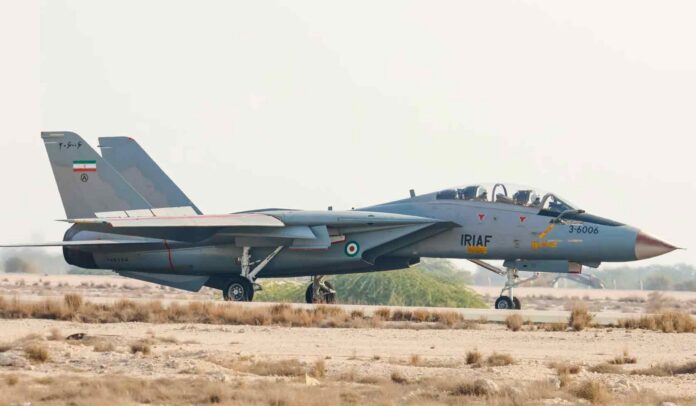
As part of the ongoing Operation Roaring Lion, the Israeli Defense Forces (IDF) on Sunday announced the destruction of several Iranian F-14 Tomcat fighter jets at Isfahan international airport, dealing a potentially fatal blow to Tehran’s aging air force backbone. The strikes, which also neutralised Iranian air defence systems, mark a significant deepening of Israel’s aerial dominance over Iranian skies, with military analysts suggesting the operation may have wiped out the entirety of Iran’s operational F-14 fleet.
The IDF’s precision airstrikes unfolded late Friday, targeting storage compounds housing the Cold War-era jets at the heavily fortified Isfahan airfield. The IDF said in a post on X, “In a broad wave of air force attacks directed by the Intelligence Directorate, compounds where the Iranian terrorist regime’s ‘F-14’ fighter jets were stored at the airport in Isfahan were attacked yesterday. Detection and defence systems that threatened the Air Force’s aircraft were also attacked.”
צה"ל תקף מטוסי קרב מסוג '14-F' בשדה תעופה באיספהאן
— צבא ההגנה לישראל (@idfonline) March 8, 2026
בגל תקיפה נרחב של חיל האוויר בהכוונת אמ"ן, הותקפו אתמול מתחמים בהם אוחסנו מטוסי קרב מסוג ׳F-14’ של משטר הטרור האיראני בשדה התעופה שבאיספהאן.
כמו כן, הותקפו מערכות גילוי והגנה שאיימו על מטוסי חיל האוויר.
תקיפה זו מצטרפת להשמדתם…
This follows a separate raid a day ago that obliterated 16 aircraft utilised by the Islamic Revolutionary Guard Corps’ (IRGC) Quds Force at Tehran’s Mehrabad International Airport, underscoring a coordinated campaign to dismantle Iran’s aerial threat. “The IDF will continue to deepen the damage to all of the Iranian terrorist regime’s assets and expand air superiority throughout Iran,” the statement added.
The 8th Tactical Fighter Base in Isfahan in central Iran is home to the 81st, 82nd and 83rd Tactical Fighter Squadrons of Iran. It is believed that the airbase hosted all remaining active F-14s in Iranian service.
The F-14 Tomcat, an icon of American aviation engineering, holds a storied place in both military history and pop culture, famously piloted by Tom Cruise’s Maverick in the 1986 blockbuster Top Gun, where its variable-sweep wings and Phoenix missile prowess turned it into a symbol of high-stakes dogfighting.
For Iran, however, these jets represent a relic of a bygone alliance with the United States of America. Acquired in the mid-1970s when Iran was ruled by Shah Mohammad Reza Pahlavi, Tehran purchased 80 Tomcats from the United States in a $2.5 billion deal aimed at countering Soviet MiG-25 incursions along its borders. Deliveries began in 1976, with Iranian pilots even receiving training in the USA before the 1979 Islamic Revolution severed ties and left the fleet embargoed from U.S. parts and upgrades. 79 jets were delivered before the Shah of Iran was deposed from power.
Over decades of sanctions, Iran cannibalised a large number of jets to keep around 30 of them operational.
Friday’s strikes at Isfahan, which was earlier hit by Israel to destroy Ghadr-class ballistic missiles, likely targeted the bulk of these remaining F-14 jets, experts say. With “several” F-14s confirmed destroyed, the IDF’s strikes could render Iran’s Tomcat squadron non-existent, stripping Tehran of its most capable interceptors. Iran had destroyed several F-14s of Iran during the strikes last year too.
Apart from the USA, Iran was the only operator of the Tomcat. The US retired the F-14 in 2006, which was replaced by F-18 Super Hornet.
