

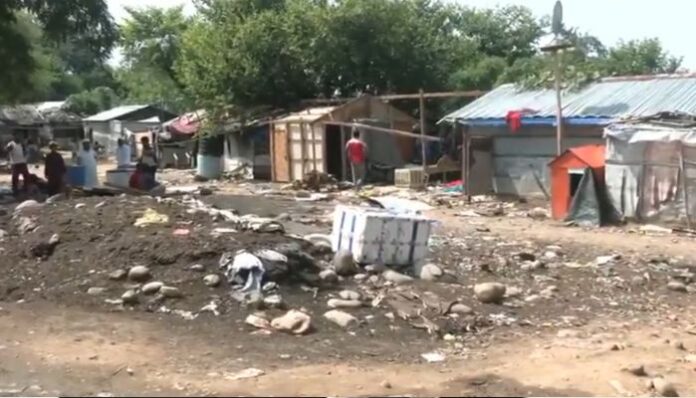
The Jammu district administration has intensified its action against illegal Rohingya settlements, with authorities now focusing not only on clearing existing structures but also on preventing families from establishing new ones elsewhere in the district. Notably, a delegation representing the Ministry of Home Affairs (MHA) conducted a recent inspection of these settlements situated in Jammu, during which they also evaluated the demographic transformation occurring there.
Afterwards, the latest action has been reported from areas including Narwal, Bathindi, Sunjwan and Chowadi, where more than 40 kanals of land have been cleared, and over 7,000 Rohingya infiltrators have been removed.
The administration has alerted police stations across Jammu and directed officials to keep watch on the movement of families leaving the settlements. Authorities have also warned that action could be taken against people found providing accommodation or shelter to Rohingya families. Neighbouring Samba district has also increased monitoring following the action in Jammu.
#WATCH | J&K: Rohingyas living in Rohingya Basti in Bathindi area of Jammu say that they have been told by their landlords to vacate the land they have been living on. A large number of Rohingyas have been living in this area on land owned by a local resident. These Rohingyas are… pic.twitter.com/bban7T9iLo
— ANI (@ANI) September 16, 2026
The latest crackdown has led several Rohingyas in Narwal and adjoining areas to dismantle their temporary homes, shops and other structures. Landowners were served notices by the administration and subsequently asked Rohingya families living on their plots to vacate, having unlawfully occupied them for around 20 years. The Rohingyas were seen dismantling their shops and shanties in the Kiryani Talab area of Narwal and adjoining areas on Wednesday, 16th September.
Alert issued for officials in other districts, states
Some Rohingyas spent the day packing their belongings and dismantling their homes before leaving others did it during the night. Meanwhile, many avoided giving specific details about where they plan to go next, but some families indicated that they might first approach relatives elsewhere in Jammu.
The Rohingyas added that they could also consider moving to other cities and states, including Punjab, Haryana, Hyderabad and Bengaluru. This prompted the administration to alert officials in other districts, including Udhampur, Kathua, Reasi, Poonch and Rajouri. Agencies in neighbouring states have also been alerted about possible movement. The stated focus is to ensure that these intruders do not create new settlements elsewhere without the authorities’ knowledge.
No illegal settlements will be allowed: BJP MLA
Amid the ongoing movement, BJP leader Bahu MLA Vikram Randhawa visited Rohingya settlements in Narwal to determine their future whereabouts and was pressed by the occupants to show leniency. However, he clarified that they would not be allowed to establish such new illegal settlements in the area.
Randhawa said their presence had become a security concern and that local people were facing problems. He also called for continued surveillance of their movement while speaking to Dainik Jagran.
Rohingyas have lived illegally in Jammu for nearly two decades
Rohingya families have been living illegally in parts of Jammu for many years. The first settlements in the Narwal area are reported to have emerged around 2006–08. The issue became more prominent in 2017 when posters calling for Rohingya and Bangladeshi infiltrators to leave Jammu appeared in different parts of the city.
The current action follows a visit by a government-appointed High-Level Committee on Demographic Changes to a Rohingya settlement in Narwal in August. Government data presented to the panel identified 7,656 Rohingyas across Jammu and Kashmir. Of these, 6,737 were identified across 10 districts of the Jammu region and 919 in the Kashmir Valley. The same data identified 504 Bangladeshi nationals across the Union Territory.
The data presented to the committee also showed 101 cases involving Rohingyas in Jammu, covering 179 men and 21 women. In the Kashmir Valley, 16 cases involving 41 women and four men were recorded. These figures are part of the government’s assessment and do not by themselves establish criminal activity by the wider Rohingya population.
Authorities have conducted verification drives against illicit Rohingya settlements in the past. In March 2021, a special verification exercise in Jammu identified more than 150 Rohingyas who were subsequently lodged at a holding centre. More than 250 Rohingyas have been staying at the holding centre at different points.
