

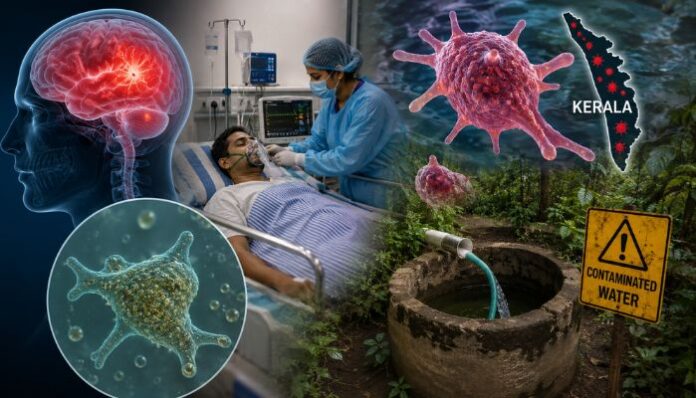
Kerala is witnessing a worrying rise in cases of amoebic meningoencephalitis, a rare but potentially deadly brain infection. According to data from the state health department, Kerala has reported 133 confirmed cases and 33 deaths from the infection in the first five months of 2026 alone.
The increase is significant because the state had reported only eight cases between 2016 and 2023. However, the situation changed dramatically in recent years. In 2024, Kerala recorded 36 cases and nine deaths. The numbers jumped further in 2025, when 201 cases and 47 deaths were reported across the state. The trend has continued this year, with over 130 cases already detected by mid-June.
Most recent cases linked to Acanthamoeba
Health officials say that most of the recently detected infections are Granulomatous Amoebic Encephalitis (GAE), which is caused by Acanthamoeba, a free-living amoeba commonly found in water, soil and even dust.
According to Kerala Director of Health Services Dr K J Reena, the increase in cases does not necessarily mean the infection is spreading rapidly. Instead, she says the state has significantly improved its testing and diagnosis systems.
“We are detecting more cases after all unidentified encephalitis cases are being subjected to all tests. Undetected encephalitis cases are very few in the state due to this rigorous testing and diagnosis,” Dr Reena said.
She explained that earlier, most cases involved Primary Amoebic Meningoencephalitis (PAM), caused by Naegleria fowleri. However, GAE cases are now more common.
“Now, the PAM cases have come down in Kerala, and most of the cases detected are GAE, caused by another free-living amoeba called Acanthamoeba, which is ubiquitous in water bodies, soil and even dust,” she said.
Water quality may be a major factor
Health experts believe Kerala’s environmental conditions may be contributing to the rise in cases. Dr Reena pointed out that the state’s tropical climate, water quality issues and vegetation-filled water bodies create conditions favourable for the growth of Acanthamoeba.
“Poor quality of water is a contributing factor for the increased presence of this amoeba. Our water bodies have vegetation, which is another conducive factor for the increased presence of Acanthamoeba. Most of the affected persons are aged ones with compromised immunity,” she said.
Dr Anoop Kumar A S, Director of Critical Care at Aster MIMS in North Kerala, also believes contaminated water may be playing a major role.
“Water quality is very poor in Kerala. High population density leads to contamination of water. Many households have their toilet pits close to open wells. Water bodies with high coliform bacterial counts are more likely to have a strong presence of Acanthamoeba,” he said.
He added that a detailed environmental study is needed to understand the problem better.
Better diagnosis helping save lives
Medical experts say Kerala’s aggressive testing strategy has helped identify cases that might otherwise have gone unnoticed.
“Western medical literature shows that most PAM cases were detected during postmortems. Many Western countries do not have regular screening for PAM/GAE. Whereas in Kerala, we are diagnosing the cases and saving lives,” Dr Anoop said.
In 2024, Kerala became the first state in India to introduce a dedicated treatment protocol and standard operating procedure for managing amoebic meningoencephalitis cases. Officials say this has helped improve early diagnosis and reduce mortality.
The state’s efforts also led to a medical achievement in 2024 when a 14-year-old boy became the first person in India to survive PAM. He was only the 11th known survivor of the disease worldwide.
Several studies have already highlighted concerns over water contamination in Kerala. According to one study conducted in 2018, 73% of tested wells in Thiruvananthapuram contained coliform bacteria, while another 2023 study in Ernakulam reported widespread E. coli contamination.
