

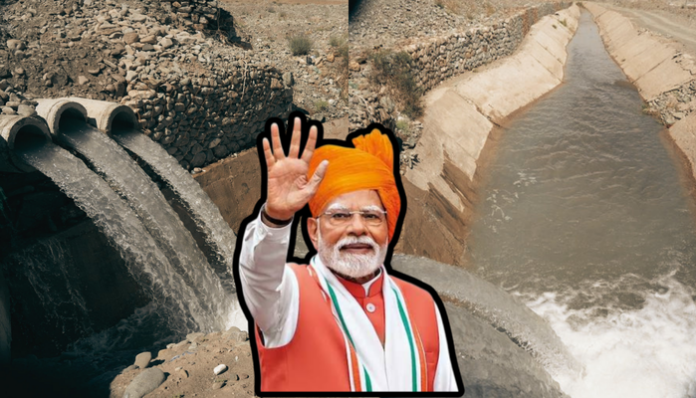
As part of the Centre’s initiative to ensure sustainable water and agricultural security, the Union Territory (UT) of Ladakh is utilising a massive 90 million litres of glacier water each day. The initiative, led by Lieutenant Governor Shri Vinai Kumar Saxena, is helping the UT channelise and utilise the glacial runoff using simple earthwork, without incurring any capital expenditure.
The initiative made use of abundant glacier and snowmelt resources of Ladakh to resolve the historic irrigation shortage for its vast swathe of cultivable land. It transformed the region’s agricultural productivity and realised the vision of a Green, Water-Secure, and Self-Sustaining Ladakh.
According to the Ladakh government, glacial-melt water from Stok village Nallah in Leh is now being directly channelised into the Igoo-Phey Irrigation Canal, catering to nearly 12 villages and augmenting irrigation of over 1000 acres of barren land that earlier remained parched due to paucity of water in the canal.
To execute the Centre’s plan, LG Saxena spearheaded a comprehensive, systematic campaign to identify such places where large quantities of glacier water are flowing down the Indus River. Stok village Nallah was among the first places to be identified by the Governor for diverting the glacier water into the existing canal. The Stok Nallah is fed by the Stok Kangri Glacier near Leh.
On 14th August, on the directions of LG Saxena, the Irrigation and Flood Control Department successfully diverted excess water from the glacier-fed main water channel of Nallah to the Igoo-Phey Canal by creating two trenches using a JCB.
Union Territory of Ladakh has started utilising 90 million litres of glacier water per day, for sustainable water and agricultural security in Ladakh.
— ANI (@ANI) August 20, 2026
Previously lost as untapped runoff into the River Indus, this volume of glacial-melt water from Stok village Nallah in Leh, is… pic.twitter.com/iguWufV6qG
Stok Nallah carries about 36.6 cusecs of water, making up to 90 million litres every day, which ultimately runs into the Indus River. Two diversions were created to channelise 26 cusecs into Igoo village (upstream) and 7 cusecs towards Phey village (downstream), from the Stok Nallah into the Igoo-Phey Canal. Plans to utilise the remaining 10 cusecs are underway.
“By successfully saving 90 million litres of glacier water daily and diverting this huge volume of water from the Stok Nallah into the Igoo Phey and Yokyur canals, we have proven that large-scale, sustainable water management is entirely feasible in our cold desert. This is a monumental step toward our vision of a Green, Water-Secure, and Self-Sustaining Ladakh. Our administration’s unwavering commitment is to harness every single drop for irrigation. This successful model is just a blueprint. We will expand these cost-effective interventions across Ladakh, transforming scattered glacier flows into a permanent lifeline for agricultural prosperity, revitalised rural economies, and long-term climate resilience for the people of Ladakh,” said LG Saxena.
Notably, the 43-km-long Igoo-Phey Canal was constructed between 1979 and 2005. During its construction, around 200m of its length lay underground to allow water from the Stok Nallah to continue flowing over it. However, due to the unexplored potential of the stream, the canal did not receive enough water. As a result, the water supply had to be rationed among villages, and it eventually became largely defunct.
After the diversion, the canal supply of water is expected to increase from roughly 50 cusecs to nearly 80 cusecs. This will translate into the 12 villages getting a regular and unrestricted water supply, which would allow farmers to cultivate more land, grow better crops and earn higher incomes. This will further create more rural employment and support the local economy. The Ladakh administration has been planning to replicate the model on other streams in Ladakh, including Matho Nallah, Tuchik Chenmo Nallah, Tuchik Chon Nallah and Stakna Nallah.
Apart from this, several villages of Ladakh are now receiving tap water supply under the Modi government’s Jal Jeevan Mission. Since the suspension of the Indus Water Treaty (IWT) between India and Pakistan, following the Pahalgam terror attack, the Modi government has accelerated the development of infrastructure to utilise water from the IWT rivers for fulfilling its domestic requirements.
