

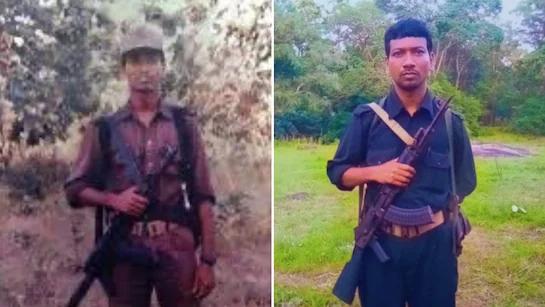
One of India’s most dreaded Maoist commanders, Madvi Hidma, long considered the shadowy architect of some of the deadliest attacks on security forces, has been killed in an encounter in Andhra Pradesh’s Alluri Sitharamaraju district.
The gun battle erupted early this morning in the Maredumilli forest, close to the tri-junction of Andhra Pradesh, Chhattisgarh, and Telangana, an area where Maoist units often shift base to evade security surveillance.
Officials confirmed that at least six Maoists have been killed so far, with the bodies spotted at the site as the operation continues. Andhra Pradesh DGP Harish Kumar Gupta said the exchange of fire lasted between 6 am and 7 am.
“In the encounter, six Maoists were neutralised, including a top leader. A large-scale combing operation is underway to sanitise the area,” he said.
The fall of a notorious Naxalite
Born in 1981 in Sukma, then part of Madhya Pradesh, Hidma climbed rapidly through the Maoist hierarchy to head a battalion of the People’s Liberation Guerrilla Army (PLGA). His ruthless efficiency and intimate knowledge of the Bastar jungles earned him a place on the CPI (Maoist) Central Committee, making him the youngest and the only tribal leader from Bastar on the organisation’s apex body.
Carrying a bounty of Rs 50 lakh, Hidma was known to move with heavily armed units and was elusive enough to repeatedly slip through coordinated operations. His wife, Raje alias Rajakka, is also believed to have been killed in today’s encounter.
A trail of brutal attacks
Hidma’s name has been associated with some of the most brutal Maoist attacks in recent memory, including the 2010 Dantewada massacre in which 76 CRPF personnel were killed, the 2013 Jhiram Ghati ambush that claimed 27 lives including several senior Congress leaders, and the 2021 Sukma–Bijapur attack where 22 security personnel were gunned down.
Security officials say these high-casualty strikes showcased Hidma’s operational expertise, his mastery over guerrilla warfare, and his ability to command large rebel units across the dense forests of Bastar.
A movement under severe pressure
Hidma’s death comes at a time when Maoist ranks are thinning due to sustained counter-insurgency operations and a surge in surrenders. PM Modi recently highlighted the rapid erosion of Maoist strength.“More than 300 Maoists surrendered within 24 hours,” PM Modi had said, calling Maoist violence a decades-long injustice to tribal youth.
“They blocked schools, hospitals, and roads. Today, the country is seeing the results of our efforts to bring them back to the mainstream.”
Among the significant recent surrenders is that of Mallojula Venugopal Rao alias Bhupathi, a long-time member of the Maoist leadership. After his surrender on October 14, Bhupathi appealed to his former comrades to abandon the path of violence. “Those fighting for power and land must realise that armed struggle has only isolated them from the people,” he said. “Active Maoists must give up violence and join the mainstream.”
A strategic breakpoint
Security agencies believe Hidma’s elimination will severely disrupt Maoist planning and recruitment in the region. With many top operatives now dead or surrendering, and state forces expanding their presence in Maoist strongholds, the insurgency appears to be facing one of its most critical setbacks in decades.
The ongoing operation in the Maredumilli forest continues as police search for more bodies, weapons, and evidence of the unit Hidma commanded. Authorities say the encounter marks a major step forward in dismantling the remaining Maoist network across central India.
