

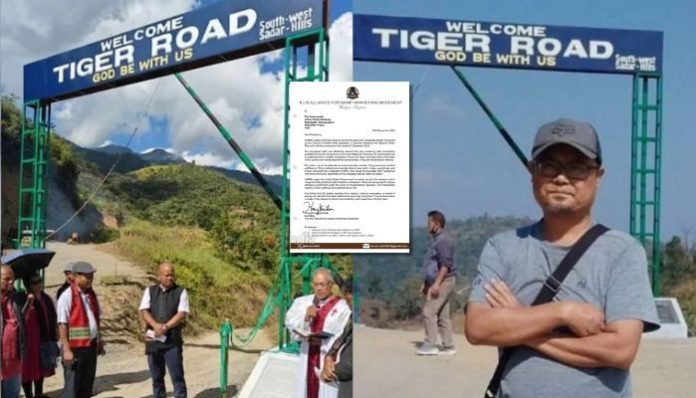
A Kuki-Zo outfit, Kuki Alliance for Nampi Awakening Movement (KANAM), active in Manipur, is on a letter-writing spree to target the National Green Tribunal (NGT). The Kuki Christian group has written letters to the US Embassy in New Delhi, UN High Commissioner for Human Rights Volker Türk, UN Environment Programme (UNEP), and the UN Permanent Forum on Indigenous Issues. By writing to the foreign entities, particularly the US Embassy, KANAM is essentially seeking America’s intervention in India’s internal affairs.
In its letter dated 30th December 2025, the Kuki Alliance for Nampi Awakening Movement or KANAM accused the NGT of “institutional violence,” “bureaucratic murder,” “collective punishment,” and “lethal indifference”. This scathing attack comes after the National Green Tribunal issued an interim order on 23rd December, stopping construction of an illegal “Ring Road”. The unauthorised road has been locally called the ‘German Road’ and at certain stretches as ‘Tiger Road’. The road is reported to have been named after Kuki militants.
“KANAM writes to formally place on record the grave and immediate danger now faced by the Kuki-Zo Christian tribal population in Manipur following the National Green Tribunal’s blanket construction ban dated 23 December 2025. The impugned order has effectively severed the only remaining safe connectivity available to Kuki-Zo hill areas at a time when National Highways are inaccessible due to sustained ethnic hostility, breakdown of law and order, and state failure. Hill roads in this context are not developmental conveniences. They are humanitarian lifelines. This action cannot be defended as environmental protection. It is governance by lethal indifference. When institutions knowingly obstruct evacuation routes, supply lines, and civilian movement for a targeted minority, they cross the boundary from negligence into moral criminality, regardless of the language used to justify the action,” the letter signed by KANAM Secretary Hmingthangkima Sailo reads.
KANAM memorandum to the Ambassador, United States Embassy.@USAmbIndia pic.twitter.com/b285jcXZge
— KANAM (@KanamDelhi) December 30, 2025
The letter adds, “KANAM urges the United States Government to closely monitor this situation and to recognise that judicial and administrative institutions in India are being used to impose collective punishment under the cover of environmental regulation. The foreseeable result is civilian suffering and potential loss of life. Any further Kuki-Zo deaths resulting from isolation, delayed evacuation, or denial of access will rest with the Indian state and its enforcing institutions. This communication is made in the interest of record, accountability, and prevention of further harm.”
Calling on the US to ‘monitor’ the situation about India’s domestic matters amounts to bypassing Indian remedies and seeking foreign interference.
Notably, the NGT’s order against the construction of the road named by Kuki militants came after the umbrella body of civil society organisations of Manipur’s Meitei community, COCOMI, filed an application demanding a halt to the illegal road’s construction. The COCOMI said that road construction work in forest areas cannot be permitted without a complete environmental and geological safety assessment.
The NGT was informed that construction work on the road passing through “forest and hilly areas” in Churachandpur, Kangpokpi, Noney, and Ukhrul districts is being carried out by the Kuki community, “as revealed through a memorandum dated February 5, 2025, submitted by the World Kuki-Zo Intellectual Council.”
“The applicant collected information from the authorities concerned, including the Directorate of Environment and Climate Change, the Rural Engineering Department, and the Forest Department, who have intimated that no official approval, no-objection certificate, or forest clearance has been issued for such construction. The applicant has further submitted that satellite imagery corroborates the unauthorised activity in ecologically sensitive zones,” the NGT stated.
