

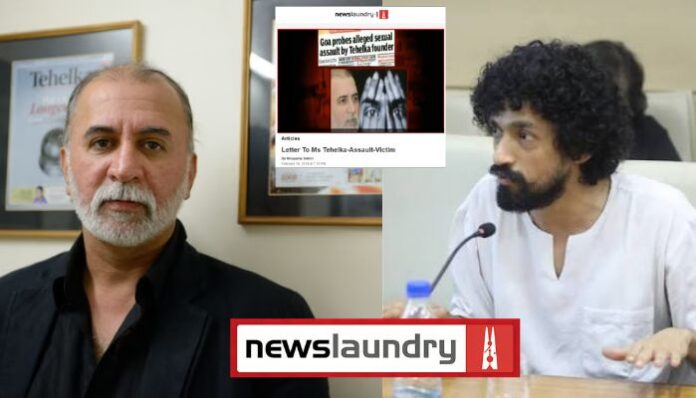
The conviction of former Tehelka editor-in-chief Tarun Tejpal in the 2013 sexual assault case has once again brought back questions about how sections of the media ecosystem treated the survivor when the allegations first surfaced. More than 12 years after the assault, the Bombay High Court at Goa overturned Tejpal’s 2021 acquittal and convicted him in the case, sentencing him to 10 years of rigorous imprisonment.
When Newslaundry and Abhinandan Sekhri came to defence of Tarun Tejpal
It is in this context that an old piece published by Newslaundry has come under renewed scrutiny. In February 2014, only months after the allegations against Tejpal emerged, Newslaundry published an open letter [archive] by Nirupama Sekhri, the sister of Newslaundry founder Abhinandan Sekhri, addressed to “Ms Tehelka-Assault-Victim”.
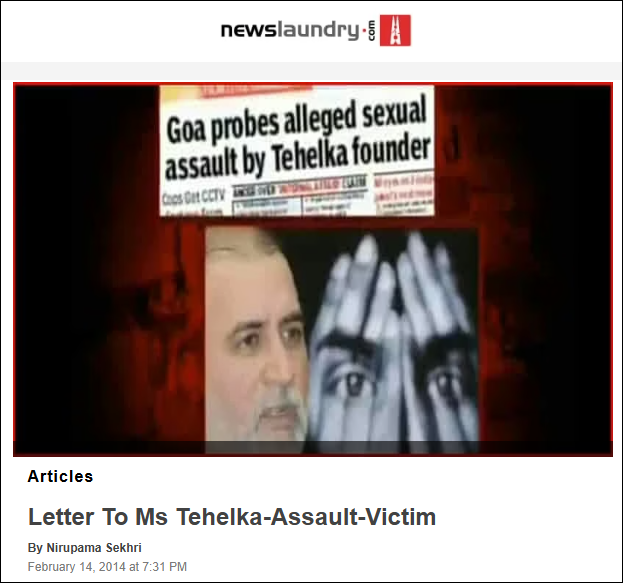
The tone of the letter was not one of sympathy towards the woman who had accused Tejpal. Instead, Sekhri questioned whether she should be considered a victim at all. “To begin with, I would like to establish quite clearly that I do not see you as a victim, unless it is of bubblegum feminism which I will speak in detail of later,” she wrote.
The letter went on to frame the controversy around what it described as “bubblegum feminism” and questioned the survivor’s actions before and after the alleged assault. It asked why she had entered the elevator with Tejpal and questioned the delay in making an official complaint. At one point, the letter said that Tejpal had become “the victim” of the media frenzy surrounding the case.
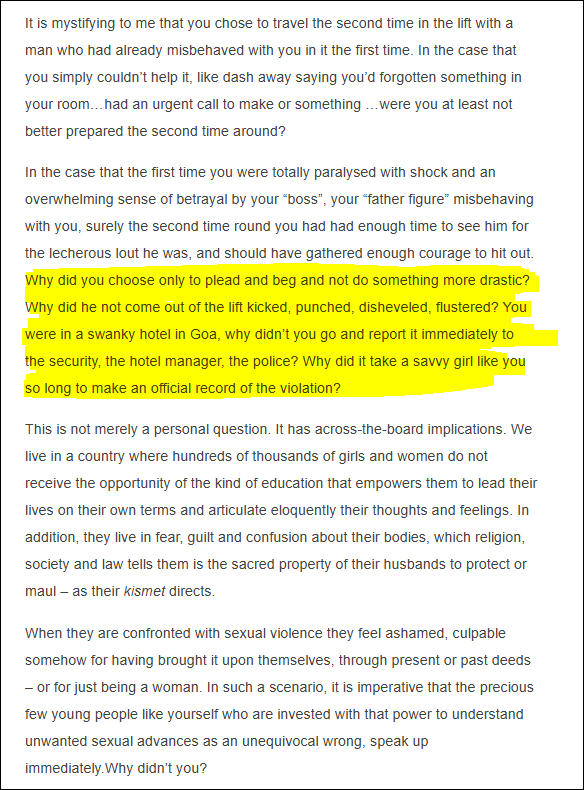
The questions raised in the piece reflected the kind of “perfect victim” expectations that have repeatedly been criticised in discussions around sexual violence. Why did she go with him? Why did she not immediately report it? Why did she not fight back? Why did she behave in a particular way after the incident? Such questions have long been criticised for shifting attention from the alleged conduct of the accused to the behaviour of the survivor.
Nirupama Sekhri’s letter also described the survivor as “irresponsible” and accused her of damaging Tejpal’s reputation. The piece therefore did not merely raise questions about the case; it placed a substantial part of the burden of explanation on the woman who had made the allegation. The original Newslaundry page itself confirms that the letter was published by Nirupama Sekhri on February 14, 2014.
The controversy did not end there. Abhinandan Sekhri himself amplified the article. In a 2014 post, he shared the link and wrote: “The counter perspective on the Tehelka case. For those asking, yup my sister. Letter to Ms Tehelka assault victim.” He also appeared in a 2014 interview with the former Tehelka editor. This made the issue more than simply an opinion piece written by an individual contributor; Sekhri had publicly associated himself with the article and its framing.
A letter that remained online for 12 years
This article, which resorts to victim-blaming, scarred the rape survivor for 12 years. Newslaundry never bothered to apologise to her.
For twelve long years, this article remained live on Newslaundry, serving as a persistent public record that demeaned the survivor’s experience. Throughout more than a decade of legal proceedings, as the survivor fought a gruelling battle for justice across multiple courtrooms, Newslaundry never reached out or offered a formal apology to her for hosting and promoting content that attacked her integrity.
It was only after the Bombay High Court’s landmark conviction of Tarun Tejpal, and the intense public outcry that followed regarding the media’s past conduct, that Newslaundry finally took action. Following the renewed controversy, Newslaundry removed Nirupama Sekhri’s original article and replaced it with an editor’s clarification. The publication acknowledged that the piece was originally published in 2014 and said it had since “reflected deeply on workplace sexual harassment, consent, trauma, and the responsibility of those in positions of power.”
The clarification further said that, in light of “legal developments, evolving public understanding, the #MeToo movement, and the experiences of countless survivors who have come forward”, Newslaundry no longer believed the piece met the values guiding its journalism. The publication therefore decided to take it down.
Newslaundry also said it was leaving the note at the original URL so that the article’s existence and its removal would remain part of its public record.
But the timing of the decision has itself become a point of criticism. The question being asked is simple: if the article was so clearly inconsistent with the publication’s present-day values, why did it take the conviction of Tejpal and a fresh wave of public criticism for the article to finally disappear?
In fact, the question we must ask is this – at what point was shaming a rape victim culturally acceptable? At what point was it the societal “understanding” that a rape victim should be shamed publicly. Did Newslaundry 12 years ago believe that rape was the fault of the woman? Did Newslaundry 12 years ago believe that rape was acceptable? What “evolving understanding” was required for Newslaundry to understand that victim shaming was, is and will continue to be wrong?
Abhinandan Sekhri’s so called apology
On Saturday, August 8th, Abhinandan Sekhri posted a message on his X account acknowledging the decision to remove the 2014 post:
“I have taken down my 2014 tweet. I don’t think there’s anything to say other than I take full responsibility for the piece that was published. It was wrong and should not have been online for this long on newslaundry, if at all. This is on me and me alone. It took a judgement to take this call, which should not have been the case. I apologise to all the people who support newslaundry and my fantastic team. I’ll try and do better.”
I have taken down my 2014 tweet. I don’t think there’s anything to say other than I take full responsibility for the piece that was published. It was wrong and should not have been online for this long on newslaundry, if at all. This is on me and me alone. It took a judgement to… https://t.co/QaQxRjcr9L
— Abhinandan Sekhri (@AbhinandanSekhr) August 8, 2026
The post was presented as an acknowledgement of responsibility. But in the same sequence, Sekhri also posted another message aimed at critics. “And as for the prime time studio turnips (this is only for you) who made the most of this with your hollow lectures & outpouring of pent up angst for us calling out your hate, bile and venom that you serve as news. We will continue to call you out. Enjoy your weekend. Read a book, play a sport – do better.”
However, any sense of genuine remorse was quickly undercut by a second tweet posted shortly thereafter. Rather than maintaining a tone of solemn accountability, Abhinandan Sekhri shifted into a defensive and combative stance aimed at his media critics, “And as for the prime time studio turnips (this is only for you) who made the most of this with your hollow lectures & outpouring of pent up angst for us calling out your hate, bile and venom that you serve as news. We will continue to call you out. Enjoy your weekend. Read a book, play a sport – do better.”
And as for the prime time studio turnips (this is only for you) who made the most of this with your hollow lectures & outpouring of pent up angst for us calling out your hate, bile and venom that you serve as news. We will continue to call you out. Enjoy your weekend. Read a…
— Abhinandan Sekhri (@AbhinandanSekhr) August 8, 2026
This casual dismissal highlighted a sharp contrast between the formal words of reflection and the immediate urge to settle scores with rival journalists. By brushing off criticism as mere outrage from “prime time studio turnips,” the gravity of the decade-long victim-blaming was brushed aside in favour of social media bravado.
Was it an apology or forced accountability and social media tokenism
For over 36 hours after the conviction of Tarun Tejpal, the article and Sekhri’s tweet remained available without any modification. Only after the issue gained wider public attention did Newslaundry remove the article and Sekhri delete his old tweet. That timeline has led that the apology was not spontaneous accountability but a response to public backlash.
Calling the response a genuine apology is therefore difficult because the apology did not come when the article was first questioned, nor when the publication’s own understanding of sexual harassment changed after the #MeToo movement. It came after the Bombay High Court overturned Tejpal’s acquittal and the old article suddenly became a major subject of public discussion.
At the very least, the episode raises questions about institutional accountability. An apology is not simply an admission that something was “wrong”. It also requires recognising who was harmed, what exactly was wrong, and why the mistake was allowed to continue for so long.
In this case, the wording of Sekhri’s post focused heavily on taking responsibility for the publication decision and apologising to “all the people who support newslaundry and my fantastic team”. It did not centre the woman who had been targeted by the 2014 article. That omission is significant because the original piece itself had placed the survivor under scrutiny.
The phrase that Newslaundry has “reflected deeply” and that the piece no longer represents its values also invites another question: when did that reflection actually begin? If the publication had already recognised the problems surrounding consent, trauma and workplace power, why was the article allowed to remain online until the present controversy?
The response was social media posturing rather than a meaningful apology, and, at best, tokenism. Whether one agrees with that assessment or not, the chronology is difficult to ignore: Tejpal was convicted, the old article resurfaced, public criticism followed, and only then did Newslaundry remove it and Sekhri delete his old tweet.
The larger issue goes beyond Newslaundry or one old article. The Tejpal case has once again shown how powerful men accused of sexual misconduct can remain at the centre of public sympathy, while the survivor’s behaviour is examined in extraordinary detail. The Bombay High Court’s decision has rejected several of the stereotypes that shaped the earlier trial court approach.
The Tarun Tejpal case
The case dates back to November 2013. Before November 2013, Tarun Tejpal was regarded as one of the most prominent figures in spreading propaganda under the name of journalism. At that time, Tejpal was not an unknown journalist. He was a prominent figure in far-left journalism and the founder-editor of Tehelka.
In November 2013, a young woman working with Tehelka accused him of sexually assaulting her inside an elevator at the Grand Hyatt in Bambolim, Goa, during the magazine’s THiNK event; the allegations concerned incidents on 7th and 8th November. Tejpal subsequently stepped down as Tehelka’s editor-in-chief, saying he wanted to “recuse” himself from the organisation. He was arrested on 30th November, 2013, and was later released on bail in 2014.
The legal battle then continued for years. The Goa Crime Branch filed a chargesheet, and Tejpal faced charges including rape, sexual harassment, assault with intent to disrobe, wrongful restraint and wrongful confinement. Among the provisions invoked were Section 376(2)(f), dealing with rape by a person in a position of trust or authority, and Section 376(2)(k), dealing with rape by a person in a position of control or dominance.
In May 2021, a Goa sessions court acquitted Tejpal of all charges. The judgment attracted widespread criticism, particularly for its treatment of the survivor’s behaviour. The court examined her conduct, including her reactions and communications after the assault, while assessing whether they matched what it considered “normative behaviour” for a sexual assault survivor. The Bombay High Court later criticised this approach, with the lower court’s reasoning having been described as resembling a “manual for rape victims.”
The Bombay High Court has now reversed that acquittal. The court found Tejpal guilty and sentenced him to 10 years’ rigorous imprisonment. The verdict has once again put the spotlight not only on the legal history of the case but also on the treatment the survivor received in the public discourse surrounding it.


