

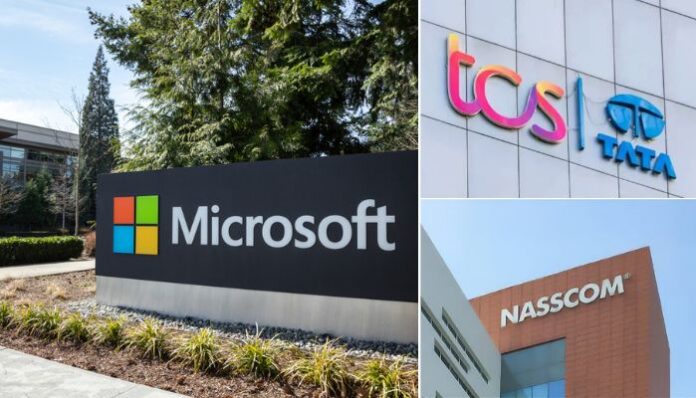
Following the US government’s suspension of several major technology companies from filing new applications under the Permanent Labour Certification (PERM) programme, Microsoft, Tata Consultancy Services (TCS) and the National Association of Software and Service Companies (NASSCOM) have responded to the decision, which affects a key step in the green card process for foreign workers.
Microsoft says most H-1B applications were for existing employees
Microsoft has said that most of its H-1B applications were filed for employees already working at the company, rather than for new hires. In a blog post on Thursday, October 8, the company said around 80% of the nearly 6,000 H-1B applications it filed in the last fiscal year were meant to extend or change the status of existing employees.
"Vast majority of Microsoft employees in the United States are Americans", says Microsoft after US govt claimed that the company has been replacing US workers with foreign workers (Indians) https://t.co/HPTb1rhVX4
— Sidhant Sibal (@sidhant) October 9, 2026
The remaining applications were for people already living legally in the US, the company said, adding that these workers account for only 1% of its US workforce.
“Microsoft only files H-1B petitions for those who meet the rigorous standards of this visa category,” the company said.
It also said its H-1B wages were among the highest across such filings and that employees were paid the same as others doing similar work.
According to data from Levels. fyi, Microsoft ranked fourth among H-1B sponsors this year, with 21,706 petitions and a median base salary of $180,710. The company had also announced in July that it would cut 4,800 jobs, around 2.1% of its global workforce.
The US government suspended Microsoft’s access to the PERM programme following an investigation led by Vice President JD Vance. The administration accused the company of laying off American workers while hiring foreign employees through visa programmes. Microsoft has rejected the broader criticism of its hiring practices, saying most of its US employees are Americans.
TCS says suspension will not affect hiring plans or client work
Tata Consultancy Services (TCS) said it does not expect the suspension to affect its workforce plans in the US or its client engagements.
TATA statement "Our PERM applications were in single digits in the last two years and hence we do not expect the suspension of the program to impact our workforce strategy and customer engagements" https://t.co/ZBoMrwN6Hy
— Sidhant Sibal (@sidhant) October 9, 2026
In a statement on Friday, TCS said, “We have noted the announcement by the US Government on the Permanent Labour Certification Program (PERM), and TCS will comply with any directive from the Department of Labour.”
The company said its US workforce strategy focuses on hiring local employees and includes a strong campus recruitment programme. It added that it had built a significant local workforce across 31 offices and delivery centres in the country.
“As we had announced earlier, we intend to hire an additional 15,000 people in the US over the next five years, to further augment our local workforce,” the statement said.
TCS also said its PERM applications had remained in single digits over the past two years. “Hence we do not expect the suspension of the program to impact our workforce strategy and customer engagements,” it added.
NASSCOM says immigration and skilled talent mobility are different issues
NASSCOM said the suspension affects a specific route to permanent residency and should not be confused with the broader movement of skilled professionals between countries.
India’s Industry body Nasscom issues statement on US suspending Indian IT firms Cognizant, TCS, Wipro, HCL from Green Card filings: https://t.co/GABKtoI1ft
— Sidhant Sibal (@sidhant) October 9, 2026
In its statement, the industry body said, “While the decision affects a specific immigration pathway, NASSCOM has consistently maintained that immigration and skilled talent mobility are two distinct issues and should not be viewed through the same lens.”
It said Indian technology companies had reduced their dependence on H-1B visas over the years while increasing local hiring and building a strong workforce in the US.
“The H-1B visa programme has historically played an important role in addressing short-term skill gaps in the US and it will continue to be used to address short term talent gap,” Nasscom said.
The organisation added that Indian IT companies work with most Fortune 500 companies in the US, helping them grow and innovate while creating local jobs. It also said the number of employees moving from H-1B visas to permanent residency through PERM was relatively limited.
Indian technology companies operate in more than 80 countries, NASSCOM said, adding that they were committed to following local laws and regulations. “We are confident that they will continue to adhere to applicable regulations in the US as well,” it said.
The response comes as Indian IT companies face tighter scrutiny of work visas and higher costs for H-1B applicants in the US, which remains the biggest market for India’s $300-billion technology industry.
Why US suspends PERM applications from major IT firms
The Trump administration announced the suspension on October 8, targeting Microsoft, Adobe, Cognizant, Infosys, Tata, Wipro, HCL and Capgemini. Vice President JD Vance and Labour Secretary Keith Sonderling said the Department of Labour would stop accepting new PERM applications from the affected companies and halt the processing of pending applications, citing concerns about the use of foreign-worker programmes. Vance accused Microsoft of laying off American employees while bringing in foreign workers.
PERM is an important step in the employer-sponsored green card process. It generally requires an employer to show that qualified, willing and available American workers cannot be found for a particular position and that hiring a foreign worker will not harm US workers. Unlike an H-1B visa, which allows a foreign professional to work in the country, PERM helps employers move eligible employees towards permanent residency. The suspension does not automatically cancel existing H-1B visas, but it could delay green card applications and create uncertainty for employees awaiting permanent residency.
