

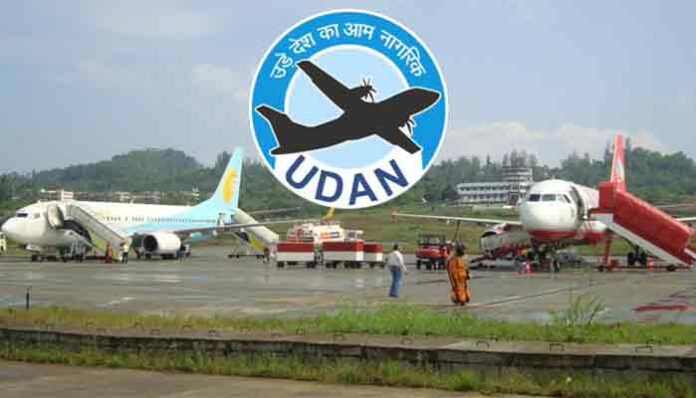
The Union Cabinet, chaired by Prime Minister Narendra Modi, has approved the launch of the Regional Connectivity Scheme – Modified UDAN, the second version of the UDAN (Ude Desh ka Aam Naagrik) scheme aimed at strengthening air links across India’s underserved regions. The scheme will run for ten years from the financial year 2026-27 to 2035-36 and carries a total outlay of ₹28,840 crore, fully supported by the central government’s budgetary provisions.
Under the modified programme, the government plans to develop 100 new airports by upgrading existing unserved airstrips, with a dedicated capital expenditure of ₹12,159 crore spread over the next eight years. The scheme proposes upgrading existing infrastructure rather than building new greenfield airports. This infrastructure push is intended to expand regional aviation capacity in line with the long-term vision of Viksit Bharat 2047 and to create a more competitive national aviation ecosystem.
In addition, support will be provided for the operation and maintenance of around 441 regional aerodromes for an initial three-year period, with annual caps of ₹3.06 crore per airport and ₹0.90 crore per heliport or water aerodrome, at an estimated cost of ₹2,577 crore.
To improve connectivity in challenging terrain, the scheme includes the development of 200 modern helipads, particularly in hilly, remote, island and aspirational districts, at a total projected cost of ₹3,661 crore over eight years. These facilities are expected to enhance last-mile access and strengthen emergency medical and disaster response capabilities. Airline operators will continue to receive viability gap funding for awarded routes, with an allocation of ₹10,043 crore over the decade to ensure longer-term route sustainability and more affordable fares for passengers.
In a further boost to domestic manufacturing under the Atmanirbhar Bharat initiative, the government will procure two HAL Dhruv helicopters for Pawan Hans and two HAL Dornier aircraft for Alliance Air to address the shortage of suitable small aircraft and rotorcraft for operations in difficult areas.
The original UDAN scheme, launched in October 2016, has already made significant progress by operationalising 663 routes across 95 airports, heliports and water aerodromes. As of the end of February 2026, more than 341,000 flights had been completed, carrying over 16.2 million passengers and extending reliable air services to remote, hilly and island regions while stimulating tourism, trade and healthcare access. Officials expect the modified version to build on this foundation, improving the financial viability of regional airports and operators, promoting indigenous aerospace capabilities and making air travel more accessible to ordinary citizens.
The initiative is projected to deliver broad economic benefits, including stronger growth in Tier-2 and Tier-3 cities, better emergency response systems and tangible progress towards India’s goal of becoming a developed nation by 2047.
