

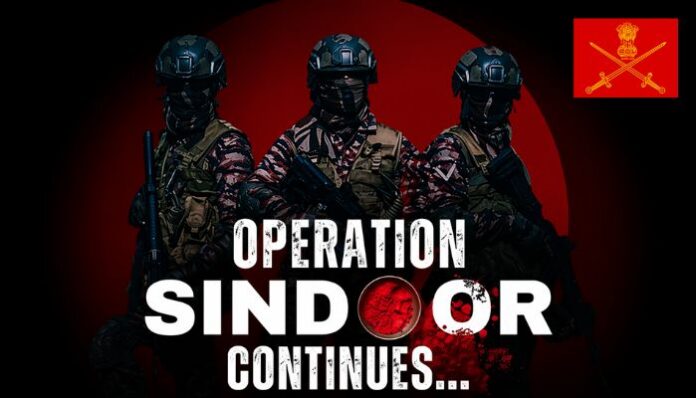
On 22nd April, the Indian Army shared a post on social media platforms reminding the enemies of India that ‘Operation Sindoor’ is still in motion. It has been one year since 26 innocent Hindus were brutally murdered by Pakistan-sponsored terrorists. Indian Army’s post is a reminder of how security forces neutralised key perpetrators of the attack in a coordinated counter terrorist operation in Jammu and Kashmir. The operation, codenamed Operation Mahadev, ensured that the terrorist could not flee to Pakistan.
For acts against #India, the response is assured.
— ADG PI – INDIAN ARMY (@adgpi) April 22, 2026
Justice will be served. Always.#SindoorAnniversary #JusticeEndures #NationFirst pic.twitter.com/w6PRIpp0bM
On 28th July 2025, Union Home Minister Amit Shah announced the success of the operation in the Parliament. He confirmed that the joint operation of the Indian Army, CRPF and Jammu and Kashmir Police successfully eliminated India’s enemies before they could escape to Pakistan.
Mastermind and associates eliminated
The three terrorists who were killed in the encounter were identified as Hashim Musa alias Abu Suleman, Hamza Afghani, alias Afghan, and Zibran. They were classified as ‘A’ category terrorists linked to Lashkar-e-Taiba. According to security forces, Suleman was the mastermind behind the Pahalgam attack. He was also involved in several terrorist activities, including the Gagangir incident. Afgan and Zibran were also directly linked to the murders of civilians in the Baisaran Valley during the Pahalgam attack.
Operation Mahadev in the Lidwas forests
The encounter that eliminated them took place in the dense Lidwas forest area near Harwan on the outskirts of Srinagar. According to HM Shah, a high-level security meeting was held a day after the Pahalgam attack, where it was decided that the terrorist must not be allowed to escape the country.
Immediately, security agencies began coordinating efforts to track the terrorists. The first breakthrough occurred on 22nd May 2025, when the Intelligence Bureau received human intelligence inputs indicating the presence of terrorists in the Dachigam region.
In the next few weeks, the Army and Intelligence agencies deployed specialised equipment to capture ultra signals in the region. Personnel from the Army, IB and CRPF conducted ground operations in difficult terrain and extreme weather conditions to track the movement of the terrorists.
On 22nd July, they intercepted a confirmed signal from one of the terrorists, which established their presence. Joint teams led by 4 Para, along with CRPF and Jammu and Kashmir Police, surrounded the terrorists and eliminated them in a coordinated operation.
Identities confirmed through multiple pieces of evidence
The identification of the terrorists was backed by both human and forensic evidence. The National Investigation Agency (NIA) had earlier arrested four local individuals who had provided shelter to the terrorists after the Pahalgam attack.
When the bodies were brought to Srinagar, these individuals identified them as the terrorists involved in the Pahalgam terrorist attack.
Further forensic confirmation came through ballistic analysis. The rifles recovered from the terrorists were sent to Chandigarh, where test firing was conducted. The shells recovered from the Pahalgam attack site were matched with the test-fired shells, conclusively establishing that the same weapons were used in the attack.
‘Operation Sindoor continues’
The post by the Indian Army serves as a reminder that operations against the nation’s enemies are ongoing. The elimination of the three terrorists before they could escape across the border is a clear signal that the Indian armed forces are pursuing perpetrators relentlessly. Operation Sindoor, which was started to eliminate India’s enemies, never stopped.
Operation Mahadev was a coordinated success of intelligence gathering, sustained ground effort and inter-agency cooperation, which ensured justice for the victims of the Pahalgam attack.
