

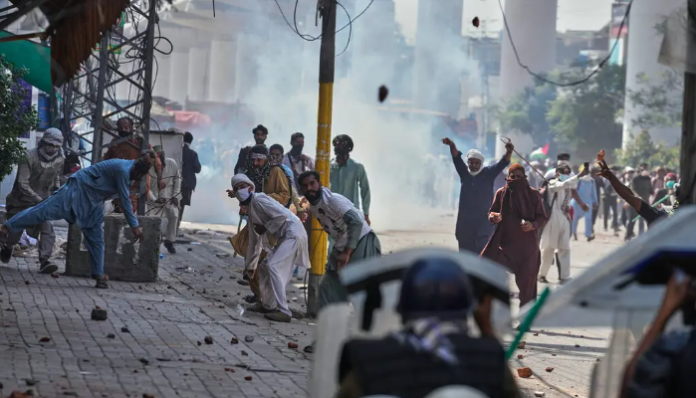
On 23rd October Pakistan banned a hardline Islamist group whose members had recently clashed with the police during protests over war in Gaza, resulting in the deaths of at least five persons and multiple injuries. The Tehreek-e-Labbaik Pakistan (TLP) party, founded in 2016, was outlawed after the unrest began on 9th October on the outskirts of Lahore.
Prime Minister Shehbaz Sharif’s office declared that the cabinet took the decision “unanimously” which was legitimate due to the group’s “violent and terrorist activities.” The Punjab provincial government recommended the proposal in accordance with the nation’s Anti-Terrorism Act (ATA). Officials stated that the group has incited violence and instability across the country on numerous occasions.
“In the past, security personnel and innocent bystanders have been killed in violent protests and rallies by the TLP,” the official statement mentioned. According to the prime minister’s office, the party had broken promises made in 2021 under Imran Khan government, when it was exempted from a prior ban six months later, on the premise that it would cease to engage in violence.
The prohibition, according to Prime Minister’s Political Affairs Advisor Rana Sanaullah, is intended to curtail the organization’s violent tendencies rather than its religious beliefs. The problem, he claimed, is when “their protests turn violent and cause loss of life.” He added, “No one has any issue with their religious views.”
Sanaullah used the 2017 Faizabad agitation, a significant anti-government blockade that left Islamabad immobilised for weeks, as an illustration of how the TLP has often utilised violence to subvert official authority. In a statement, the outfit announced that it opposed the verdict and described it as “unconstitutional, vindictive, illegal and dictatorial.”
The Sunni Muslim organisation was established after the 2011 funeral of Mumtaz Qadri who was a Pakistani Elite Police commando. He was a member of the squad of personal bodyguards assigned to protect Salman Taseer, Governor of Punjab. However, Qadri ended up killing him over his criticism against the country’s barbaric blasphemy laws and demand for a fair trial regarding a Christian accused named Asia Bibi.
Blasphemy is punishable by death in Pakistan. Human rights groups say the blasphemy laws are often misused to settle personal scores. Many people have been lynched after accusations of insulting Islam or its prophet. TLP’s founder late Khadim Hussain Rizvi was able to transform the group into a popular movement because many Pakistanis viewed Qadri as a hero.
It then continued to use the laws to unleash bloodshed, pressure the authorities and the government, intimidate others as well as incite violent religious fervour.
After entering politics in 2016, TLP garnered over two million votes in the 2018 elections, making it the fourth largest party. It regularly organised large protests most of which were in relation to extreme religious and political positions from the Prophet Muhammad’s caricatures in the French satirical magazine Charlie Hebdo to Israel and Gaza.
The party declared preparations to march to the US Embassy in Islamabad in solidarity with the people of Gaza and oppose ceasefire between Israel-Hamas which sparked the skirmishes near Lahore. According to the police, protesters threw petrol bombs, used spiked batons and fired at officers who retaliated. Many people were hurt, including at least one police officer, three TLP members and a bystander.
The location of TLP leader Saad Rizvi who headed the protest and his younger brother are still unknown. The two men are reportedly in hiding. Authorities in Punjab have closed the group’s headquarters and mosques as well as sealed its property and frozen at least 95 bank accounts.
