

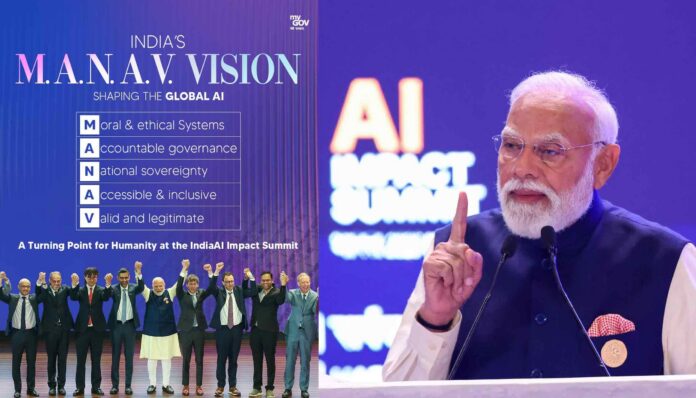
Prime Minister Narendra Modi today presented India’s “M.A.N.A.V.” vision for artificial intelligence during his inaugural address at the India AI Impact Summit 2026, emphasising a human-first approach to the rapidly evolving technology.
The summit, held from February 16-20 at Bharat Mandapam in New Delhi, brings together global leaders, tech experts, policymakers, and industry representatives to discuss AI’s societal impact. During his inaugural address at the India AI Impact Summit on February 19, PM Narendra Modi outlined a nuanced approach to AI, not as an autonomous force driven solely by data and algorithms, but as an extension of human aspirations, ethics, and dignity.
He encapsulated this human-centric vision in the acronym M.A.N.A.V., presenting a roadmap where technological advancement progresses in harmony with societal values: Moral and Ethical Systems, Accountable Governance, National Sovereignty, Accessible and Inclusive AI, and Valid and Legitimate Systems.
M.A.N.A.V.: A Roadmap Rooted in Humanity
PM Modi explained that “MANAV” — the Hindi word for “human” — doubles as a powerful acronym encapsulating five core principles guiding India’s AI strategy:
- M – Moral and Ethical Systems: AI development must prioritise fairness, transparency, and human oversight, with ethical guidelines embedded from the start. This includes integrating AI literacy through the National Education Policy 2020 and initiatives like a nationwide AI responsibility campaign that achieved a Guinness World Record with over 250,000 pledges in 24 hours.
- A – Accountable Governance: Transparent rules, robust oversight, and mechanisms for trust, equity, and fairness are essential. This is supported by India’s AI Governance Guidelines and the flagship IndiaAI Mission, which has an outlay exceeding ₹10,300 crore dedicated to compute resources, datasets, skilling, innovation, and safe AI practices.
- N – National Sovereignty: India asserts the right to protect its data, algorithms, and infrastructure. Key efforts include the India Semiconductor Mission, trusted data governance frameworks, and secure digital public infrastructure to promote self-reliance while engaging globally.
- A – Accessible and Inclusive AI: Technology should act as a “multiplier” for all, not a monopoly for a few. Democratisation is advanced through Digital Public Infrastructure, the MeghRaj GI Cloud, IndiaAI Compute Portal (providing access to GPUs/TPUs), IndiaAI Kosh (for datasets and models), AI Data Labs Network, and the National Supercomputing Mission.
- V – Valid and Legitimate Systems: AI must be lawful, verifiable, and transparent to counter risks such as deepfakes and bias. Regulations include the Information Technology (Intermediary Guidelines and Digital Media Ethics Code) Amendment Rules, 2026, alongside the Safe and Trusted AI pillar of the IndiaAI Mission, focusing on privacy, auditing, bias mitigation, and risk assessment.
PM Modi stressed that with one-sixth of the world’s population, the largest youth demographic, and a vibrant tech talent pool, India bears a special responsibility in shaping global AI norms. He positioned the M.A.N.A.V. vision as a guiding framework not just for India but for humanity’s welfare in the AI-driven 21st century, calling for AI to empower the Global South and promote shared progress.
The announcement aligns with ongoing national programs, including the IndiaAI Mission’s pillars for infrastructure, innovation, and governance. PM Modi highlighted India’s commitment to “develop in India, develop for the world,” balancing openness with sovereignty.
