

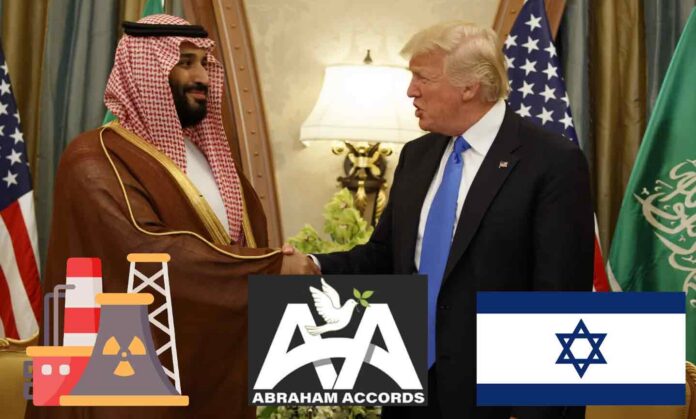
US President Donald Trump has stated that Saudi Arabia must recognise Israel as a condition for advancing a landmark civilian nuclear cooperation agreement between Washington and Riyadh. The remarks come shortly after the Trump administration formally signed the deal, which aims to support Saudi Arabia’s development of nuclear energy for peaceful purposes. Notably, the deal progressed after Trump delinked the condition of recognition of Israel as a condition last year.
In a post on his Truth Social, Trump said that while the deal has been approved, it is ‘totally subject to Saudi Arabia joining the very respected and successful Abraham Accords.’ The US president also added that there will be no enrichment of material, and it pertains to only non-military use.
He posted, “The Civil Nuclear Deal (There will be no enrichment of material!) being made between the United States Department of Energy and Saudi Arabia, which pertains only to non-military use such as the ones that Iran and UAE (and others) already have, will be approved, but is totally subject to Saudi Arabia joining the very respected and successful Abraham Accords. The United States is not opposed to Civil (Non-Enriched) Nuclear Facilities.”
The Abraham Accords are a series of bilateral normalisation agreements signed in 2020 under the first Trump administration that established full diplomatic relations between Israel and several Arab states, beginning with the United Arab Emirates and Bahrain, and later expanded to include Morocco and Sudan. Named after the biblical patriarch Abraham revered in Judaism, Christianity and Islam, the accords marked a significant departure from the long-standing Arab consensus that required a resolution of the Israeli-Palestinian conflict before any formal ties with Israel.
They opened the door to direct flights, trade, tourism, technology and security cooperation, and have been widely viewed as a major diplomatic breakthrough that reshaped regional alignments in the Middle East. Trump administration is attempting to get other Arab states to recognise Israel by entering the Abraham Accords.
The civil nuclear agreement with Saudi Arabia, signed on Wednesday, is a 30-year framework that would allow American companies, notably Westinghouse, preferential access to contracts for building nuclear reactors in the kingdom. It includes provisions for a joint study on the economics of nuclear fuel production, after which Saudi Arabia could potentially enrich uranium on its own soil. US has emphasised safeguards and non-proliferation measures, though critics note that the terms fall short of the stricter “gold standard” applied in earlier deals, such as the one with the United Arab Emirates, which required the recipient to forgo domestic enrichment and accept more intrusive international inspections.
The proposed deal was in talks for several years. Under the previous Biden administration, civilian nuclear cooperation with Saudi Arabia was envisaged as one element of a broader diplomatic package. That package sought to secure Saudi diplomatic recognition of Israel in exchange for US security guarantees, advanced weaponry including F-35 fighter jets, and nuclear technology assistance.
However, progress on the deal stalled after the 7 October 2023 Hamas attacks on Israel and the ensuing regional conflicts. Upon returning to office, President Trump detached the nuclear component from any requirement for Saudi recognition of Israel, allowing negotiations to proceed independently. Discussions intensified following Crown Prince Mohammed bin Salman’s visit to the White House last November, and the final terms were worked out through the spring and summer of this year amid the ongoing war involving the United States, Israel and Iran. But now the president has again linked the deal with recognition of Israel.
Saudi Arabia has long sought nuclear technology as part of its effort to diversify its energy mix beyond oil. Crown Prince Mohammed has publicly stated that the kingdom would pursue nuclear weapons without hesitation if Iran were to acquire them. The deal is therefore viewed as a means of strengthening US-Saudi ties and countering Iranian influence, while generating substantial commercial opportunities for American firms. Opponents, including some lawmakers from both parties in the US Congress and Israeli officials, warn that permitting enrichment capability could enable the kingdom to develop weapons material in future and encourage other regional powers, such as Turkey, to follow suit.
President Trump’s latest comments insisting on Saudi recognition of Israel appear to reintroduce a political condition that had been set aside during the final negotiations. Whether this signals a firm linkage for full implementation or a rhetorical stance remains to be clarified as the deal moves through congressional scrutiny. The agreement will now be submitted to the US Congress for a 90-day review under the Atomic Energy Act.
For now, the signing marks a significant shift in American nuclear policy towards a key Gulf ally and underscores the complex interplay of energy ambitions, security concerns and regional diplomacy in the Middle East.
