

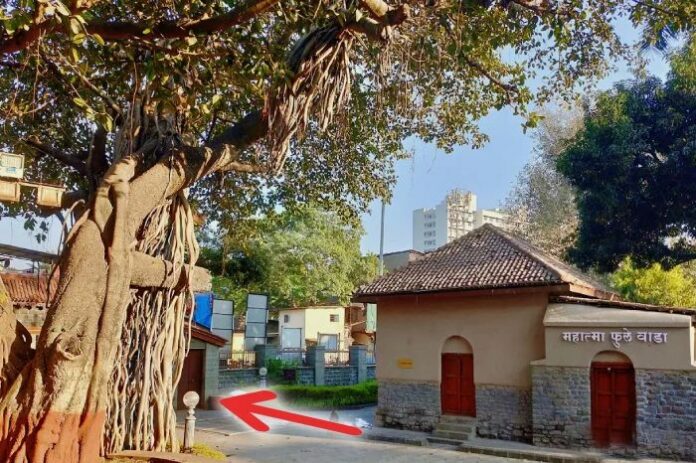
In a significant development in the Mahatma Phule Wada Vat Purnima controversy, the Maharashtra Archaeology Department has issued a fresh communication stating that the pre-existing traditions and customary practices at the protected monument should continue, effectively clearing the way for devotees to perform the traditional Vat Purnima worship at the site.
The development has come days after Hindu organisations raised objections to the earlier move to stop the ritual and submitted a memorandum demanding permission for the rituals to continue.
The fresh letter, dated 23 June 2026, was issued by the Assistant Director (Archaeology), Pune Division, and addressed to the Senior Police Inspector, Khadak Police Station, Pune. Referring to instructions received from the Director of Archaeology and Museums, Mumbai, the letter states that the traditions and customs that existed at Mahatma Phule Wada before it was declared a state-protected monument should be maintained. It further asks the local police to ensure that on Vat Purnima, the long-standing custom at the site continues while law and order are maintained.
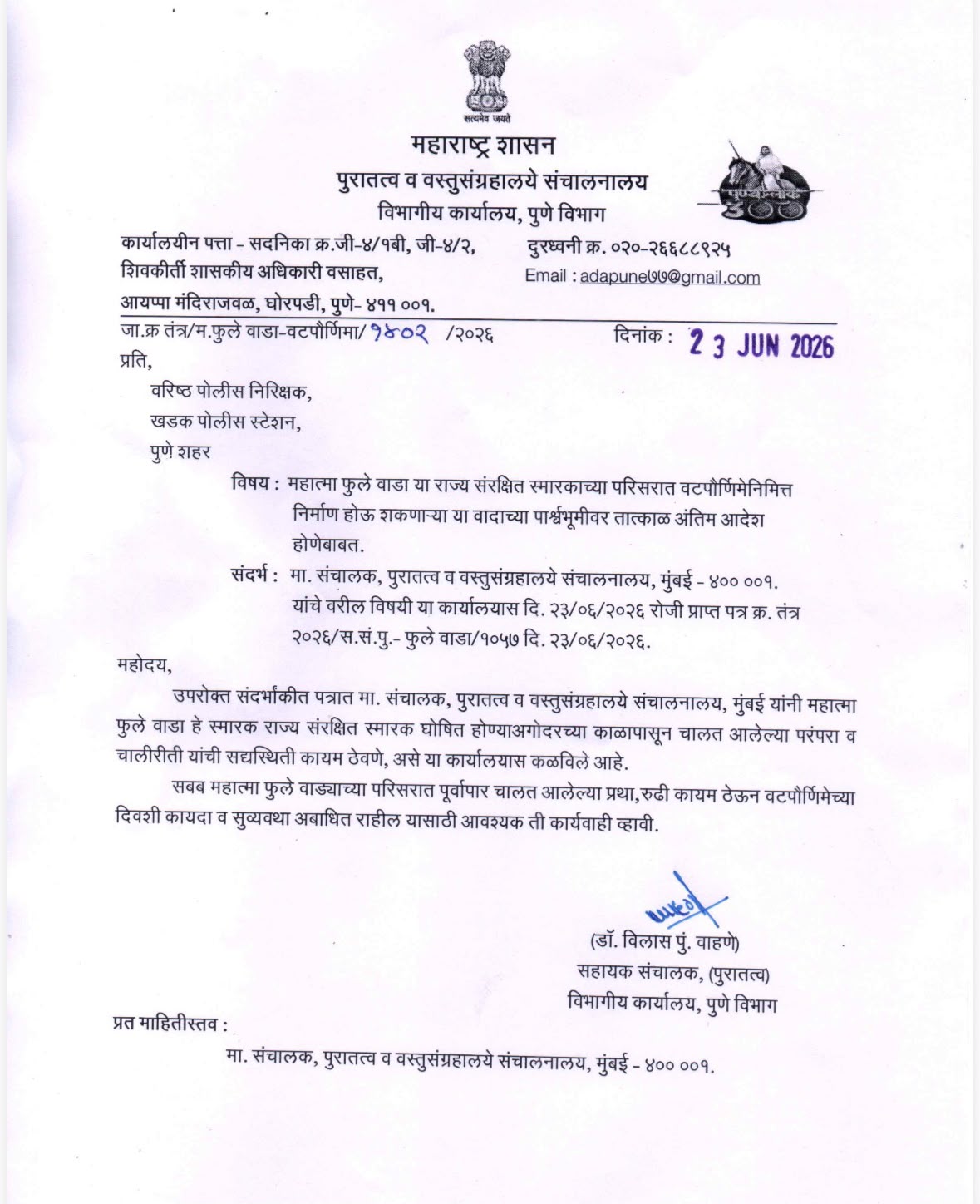
The new communication marks a major shift from the department’s earlier 2 June order, which had sought police deployment to ensure that no religious programme was held at Mahatma Phule Wada on Vat Purnima. That earlier order had triggered a controversy after it cited Mahatma Phule’s opposition to ritualism and was seen as an attempt to stop married Hindu women from performing the traditional banyan tree worship within the monument premises.
Reversal comes after Hindu groups submit a memorandum
The reversal comes days after a Hindu Jagruti Samiti submitted a memorandum demanding that devotees be allowed to perform the traditional worship at Mahatma Phule Wada. The memorandum was submitted to Shri Hemant Gosavi and sought immediate intervention to ensure that the long-standing Hindu custom was not blocked under the pretext of Phule’s ideological legacy.
The row had snowballed after Hindu groups, local devotees and women who traditionally observe Vat Purnima objected to the earlier order and argued that the ritual had been peacefully performed at the site for years. They maintained that there was no evidence of damage to the monument and that stopping the worship amounted to unnecessary interference in a traditional Hindu observance.
A 12-page legal objection petition was also filed against the 2 June order, contending that the move was based not on conservation concerns or any proven threat to the monument, but on an ideological reading of Mahatma Phule’s legacy. The petition argued that the Archaeology Department had acted on a private representation without hearing the affected women, without prior notice, and without any archaeological or structural evidence showing that the ritual caused damage to the monument.
Fadnavis govt seen as responding to Hindu concerns
The fresh notice is being seen as another instance of the Devendra Fadnavis-led Maharashtra government taking cognisance of Hindu concerns after objections were raised by Hindu organisations and temple-linked groups. Rather than framing the latest development merely as a departmental reversal, it is being viewed in political terms as a sign that the state government is willing to course-correct when Hindu groups flag concerns over religious traditions and temple-related matters.
Reacting to the development, National Spokesperson of Hindu Jagruti Samiti, Ramesh Shinde, welcomed the move as the Maharashtra government took cognisance of Hindu concerns and allowed the continuation of the traditional Vat Purnima worship at Mahatma Phule Wada. He said the fresh communication showed that sustained objections by Hindu organisations and devotees had been taken seriously, and described the move as another instance of the Fadnavis government responding to issues concerning Hindu religious traditions.
Notably, this is the second such instance this month in which the Maharashtra government has stepped back or softened its position after strong objections from Hindu activists and religious bodies.
Earlier, the Maharashtra govt put the Devasthan land law on hold after opposition from Hindu groups
On 6 June 2026, the Maharashtra government had put the proposed “Maharashtra Devasthan Inam Abolition Draft 2026” on hold after facing sharp opposition from Hindu activists, temple organisations, trustees and Hindu groups across the state. The draft law had been placed in the public domain on 7 May, with the government inviting objections and suggestions till 5 June. The state had said the proposed legislation was aimed at protecting Devasthan lands, removing encroachments and providing legal protection to temple properties.
However, the draft triggered concern among several temple bodies, including the Maharashtra Mandir Mahasangh, Ashtavinayak Temple Committee, Vishva Hindu Parishad and temple trustees from across Maharashtra. They argued that some provisions could adversely affect temple control over Devasthan lands by conferring rights on existing occupants, cultivators, priests, managers and others associated with such lands.
While interacting with the media in Nagpur, Revenue Minister Chandrashekhar Bawankule announced that the draft had been put on hold for the time being and that hearings on objections would continue till 15 August. He said the proposed law had led to misunderstandings and that a consultation process was needed to remove confusion. At the same time, he maintained that the government’s objective was to protect temple lands and make them encroachment-free.
Temple bodies had welcomed the move as a major victory for their united opposition. Sunil Ghanwat, national organiser of the Maharashtra Mandir Mahasangh, had described the decision as “temple-friendly” and called it a major success of the collective efforts of temple trustees and Hindu organisations across the state.
Second instance of course correction after concerns raised by Hindus
Against that backdrop, the fresh Mahatma Phule Wada communication is being read by Hindu organisations as yet another example of the Maharashtra government responding to organised Hindu concerns.
In the Devasthan Inam law matter, the state put the draft on hold after objections from temple bodies and Hindu activists. In the Mahatma Phule Wada row, the Archaeology Department has now issued a fresh notice stating that pre-existing customs at the monument should continue, after Hindu groups and devotees opposed the earlier attempt to stop Vat Purnima worship.
