

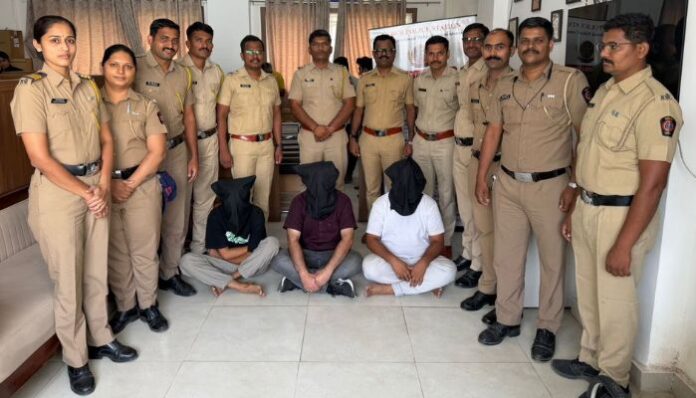
What began as a story of rescue from a notorious cyber scam compound in Myanmar eventually turned into a major cybercrime investigation in India. Three men from Navi Mumbai, Jalandhar and Darjeeling, who were forced into cyber slavery inside a scam compound near the Thailand border, are now behind bars for running online fraud operations after returning to India.
According to police officials in Maharashtra, the three men met each other while working inside the infamous KK Park cyber scam compound in Myanmar’s Myawaddy region. They were rescued in January during a large international operation and brought back to India. However, investigators say that instead of leaving the cyber fraud world behind, they used the skills they learned there to start their own scam network in India.
According to a report by the Indian Express, officials found that the accused were even planning to set up a large cybercrime operation from a farmhouse near Mumbai before they were arrested by the Pimpri Chinchwad police in March.
“They are still behind bars, in judicial custody. We arrested two more persons linked to them who were providing local support,” an officer involved in the investigation said.
Share trading scam exposed the network
The investigation started after a businessman and his parents from Pimpri Chinchwad were cheated of ₹2.1 crore in an online share trading scam in the first week of February.
Police said the victims were contacted by two people pretending to be stock market experts named “Sarath Kumar Malik” and “Shalini Kulkarni”. The fraudsters convinced the family to invest money through a fake share trading app.
While tracking the money trail, investigators found that a large part of the stolen amount had been transferred to the bank account of a private company based in Navi Mumbai.
Towards the end of March, police arrested Sushil Bhagwan Juwatkar, a 42-year-old real estate businessman from Nerul West in Navi Mumbai. Soon after, police also arrested Pankaj Raj Kapur from Jalandhar and Nischal Tankbir Bareyali from Darjeeling, who had shifted to Nerul to work with Juwatkar.
Police said searches at their office revealed a well-organised cyber fraud setup.
“We found that the suspects were operating from a space in Nerul linked to a company registered by Juwatkar. Searches at the premises revealed an elaborate cybercrime operation. We recovered complete kits, passbooks, cheque books, debit cards and linked SIMs, of nearly two dozen bank accounts used as mule accounts,” an officer said.
Police also seized mobile phones, point-of-sale machines and multiple company seals from the location.
According to investigators, these bank accounts were linked to at least 120 cyber fraud cases across the country and had transactions ranging from ₹2 crore to ₹18 crore.
From fake jobs offers to Myanmar scam centres
During questioning, investigators uncovered a much bigger story behind the accused.
Police found that all three men had travelled to Thailand in August 2025 after seeing social media advertisements promising high-paying jobs in Bangkok. But after reaching Thailand, they were taken to the KK Park cyber scam compound in Myanmar.
The compound, located near the Myanmar-Thailand border, has become infamous for large-scale cyber fraud operations involving trafficked workers from different countries.
“The compound is infamous for organised cyber crime operations that exploit thousands of trafficked youths lured with fake overseas job offers,” a police officer said.
According to investigators, the trio was forced to carry out various online scams targeting Indian citizens. These included fake share trading scams, task scams, romance scams and digital arrest frauds.
Police said the men worked in huge call centre-style setups inside the compound and were paid small amounts while being kept under pressure and strict control. It was during this period that the three became friends and exchanged contact details.
The Office of the United Nations High Commissioner for Human Rights (OHCHR) has earlier described such scam centres in Myanmar, Cambodia and Laos as a large criminal ecosystem built around human trafficking and forced online fraud.
Rescue operation, new criminal plans
The three accused were rescued earlier this year during a major joint operation involving Myanmar authorities and international agencies. Thousands of people trapped in similar scam compounds were rescued and sent back to their home countries between December and January.
However, police said the trio soon regrouped after returning to India and started running cyber scams again from Navi Mumbai.
“After returning to India, the trio regrouped in Nerul and started executing online scams in collaboration with some suspects linked to the racket run from KK Park,” another officer said.
Investigators found that the accused had already started preparing for a much larger operation. Police said they had purchased domain names to create fake business websites and were planning to shift their activities to a farmhouse near Mumbai, possibly in the Karjat area.
“They had even started working on the layout of the space they were about to purchase from the proceeds of crime when we caught them,” the officer added.
Pimpri Chinchwad Police Commissioner Vinoy Kumar Choubey said the case highlights how international cyber fraud networks are not only exploiting Indian youth but are also creating trained cyber criminals inside the country.
“Our investigation shows how organised cyber fraud networks are on one hand exploiting a large number of Indian youth but on the other hand also creating a pool of trained operatives who can later replicate such criminal models within the country,” Choubey said.
