

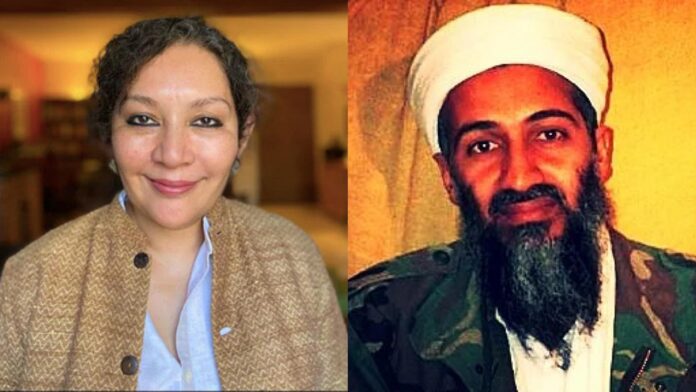
‘Journalist’ Saba Naqvi recently invoked Al Qaeda terrorist Osama Bin Laden and referred to the Saudi monarch as the ‘custodians of the two holy mosques in Mecca and Medina’ over Trump’s insulting remarks for Saudi crown prince Mohammed bin Salman, or MBS, as he is popularly called.
“How can the Saudi monarch just swallow this insult?” Naqvi posted in a long tweet on X, invoking Al Qaeda terrorist Osama Bin Laden and stating the Saudi monarchy is the custodian of the two holy mosques.
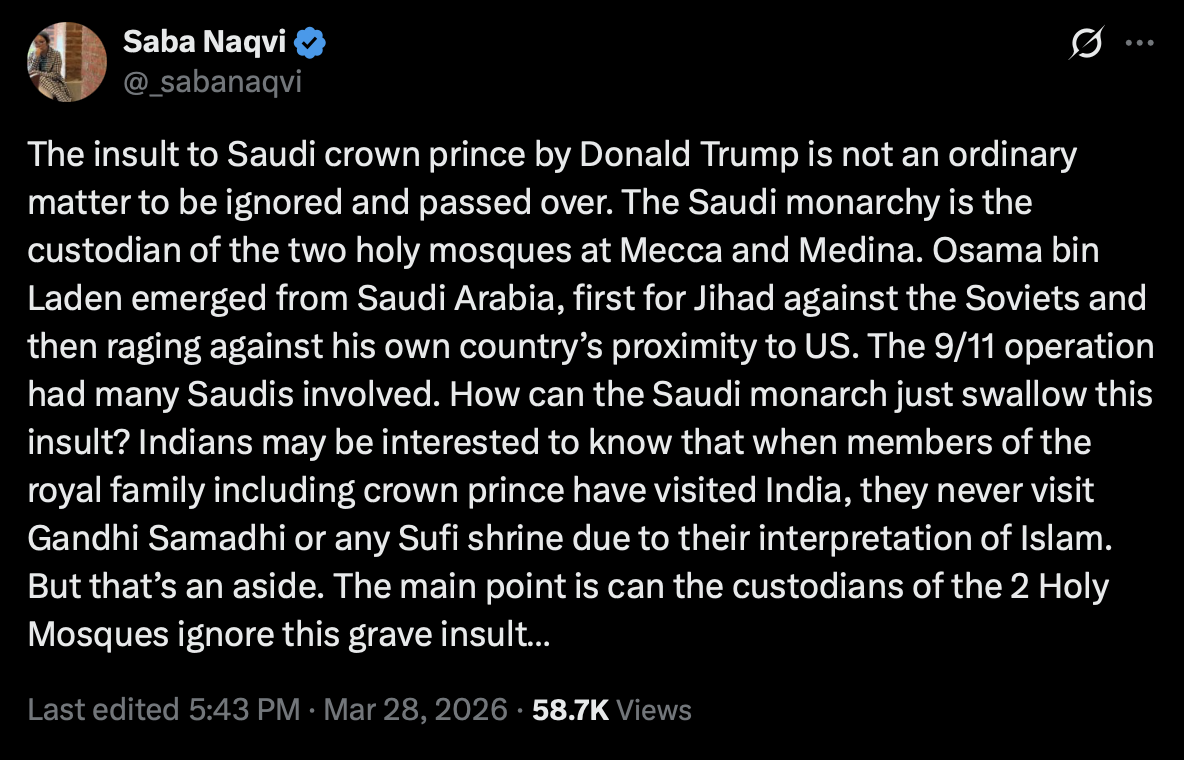
“The insult to the Saudi crown prince by Donald Trump is not an ordinary matter to be ignored and passed over. The Saudi monarchy is the custodian of the two holy mosques at Mecca and Medina. Osama bin Laden emerged from Saudi Arabia, first for Jihad against the Soviets and then raging against his own country’s proximity to the US. The 9/11 operation had many Saudis involved,” she tweeted.
Citing the Saudi royal family’s visit to India, Saba further added, “Indians may be interested to know that when members of the royal family, including the crown prince, have visited India, they never visit the Gandhi Samadhi or any Sufi shrine due to their interpretation of Islam. But that’s an aside. The main point is, can the custodians of the 2 Holy Mosques ignore this grave insult…”
Naqvi’s tweet comes hours after Donald Trump’s controversial remarks. Addressing the Future Investment Initiative conference in Florida, Trump recounted an alleged exchange with the Saudi Crown Prince, claiming that MBS had not anticipated a strong American resurgence under his leadership.
“He didn’t think this was going to happen… he didn’t expect to be in a position where he’d be kissing my a**… he assumed it would be another weak American president. But now he has to be nice to me,” Trump remarked.
Naqvi’s choice of words is far from incidental. By invoking Osama Bin Laden, a figure globally synonymous with the 9/11 attacks, and pairing it with references to Saudi Arabia as the “custodians of the two holy mosques,” she appears to be constructing a layered insinuation rather than making a direct accusation.
This rhetorical framing subtly gestures toward the historical undercurrents of Islamist extremism that once emanated from within the broader ideological ecosystem tied to Saudi influence, without explicitly stating it. In doing so, Naqvi seems to be hinting at the uncomfortable parallels and unanswered questions that continue to linger around the geopolitical and ideological backdrop of 9/11. Such phrasing allows her to provoke thought, and perhaps suspicion, about whether similar fault lines or ideological currents could again manifest in ways that threaten Western nations, particularly the United States, while maintaining plausible deniability.
