


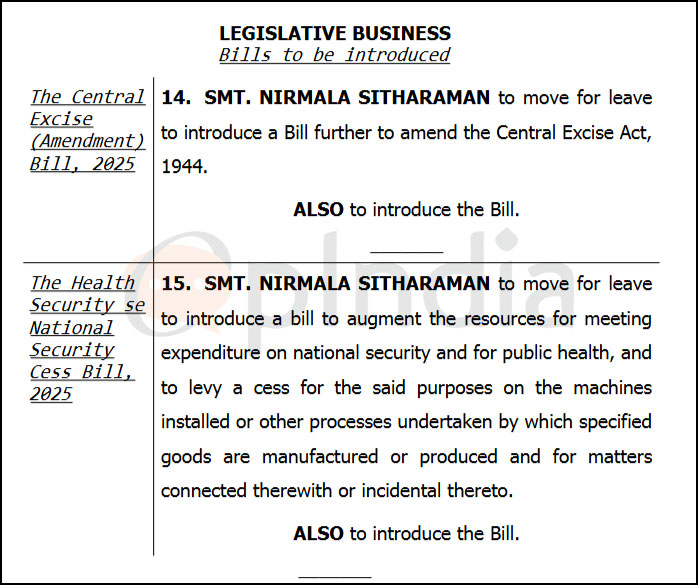
On 1st December, Finance Minister Nirmala Sitharaman will introduce a Bill in Lok Sabha creating a new cess for public health and national security. The proposal comes at a crucial moment as the GST compensation cess on tobacco products is expected to lapse once the Centre finishes repaying loans raised to compensate states during the pandemic.
Centre seeks to preserve current tobacco tax burden
According to the Lok Sabha’s list of business, the new cess will be levied on machines or processes that are used to manufacture specific goods, though the precise categories remain undisclosed. Media reports indicate that the move is designed to maintain the overall tax incidence on cigarettes, gutkha, pan masala and other tobacco products after the existing GST compensation cess is discontinued.
The decision to introduce the Bill came after the GST Council’s meeting in September where a resolution was passed to eliminate compensation cess on all goods except tobacco and gradually shift to a largely two-rate structure. The Council left it to the finance minister to decide the timing for tobacco’s transition to the newly created 40% GST slab, reserved for ultra luxury and so-called ‘sin’ goods.
Parallel amendments to ensure synchronisation
As of now, tobacco attracts both GST and central excise which makes a parallel amendment to the Central Excise Act necessary. According to officials quoted by the media, a new statutory mechanism is needed to preserve revenue and support the government’s deterrence-based policy on tobacco taxation.
The Mint quoted an unnamed source involved in drafting the Bill who confirmed that the amendment is required as the tobacco-related compensation cess is set to expire once the loan obligations are cleared.
Hence, the new public health and national security cess is aimed at filling the fiscal gap and ensuring the tax burden on tobacco products remains unchanged. It is in line with the government’s policy to discourage consumption through high taxes and strict labelling norms.
Transition expected before March 2026
The GST compensation cess was originally intended to offset states’ revenue losses following the introduction of GST in 2017. Although the five-year window ended in 2022, the cess was extended till March 2026 to service the Rs 2.69 trillion debt incurred to support states during the pandemic. The loan repayment is expected to conclude before that date.
Tobacco products currently fall under the 28% GST slab with heavy compensation cess rates reaching as high as 290% for certain mixtures. Once the transition is triggered, they will move to the 40% GST slab, with the remaining revenue gap likely met through the new cess and additional excise duties.
