

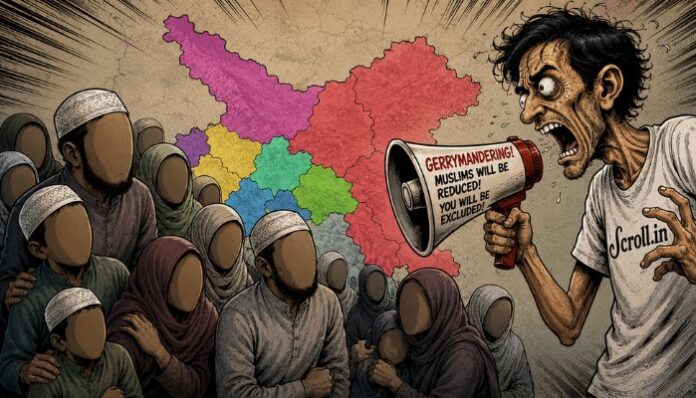
On 12th May, Scroll published an article authored by Safwat Zargar where it tried to portray the creation of five new districts in Ladakh as an exercise in “gerrymandering” and pushed “fears of exclusion”.
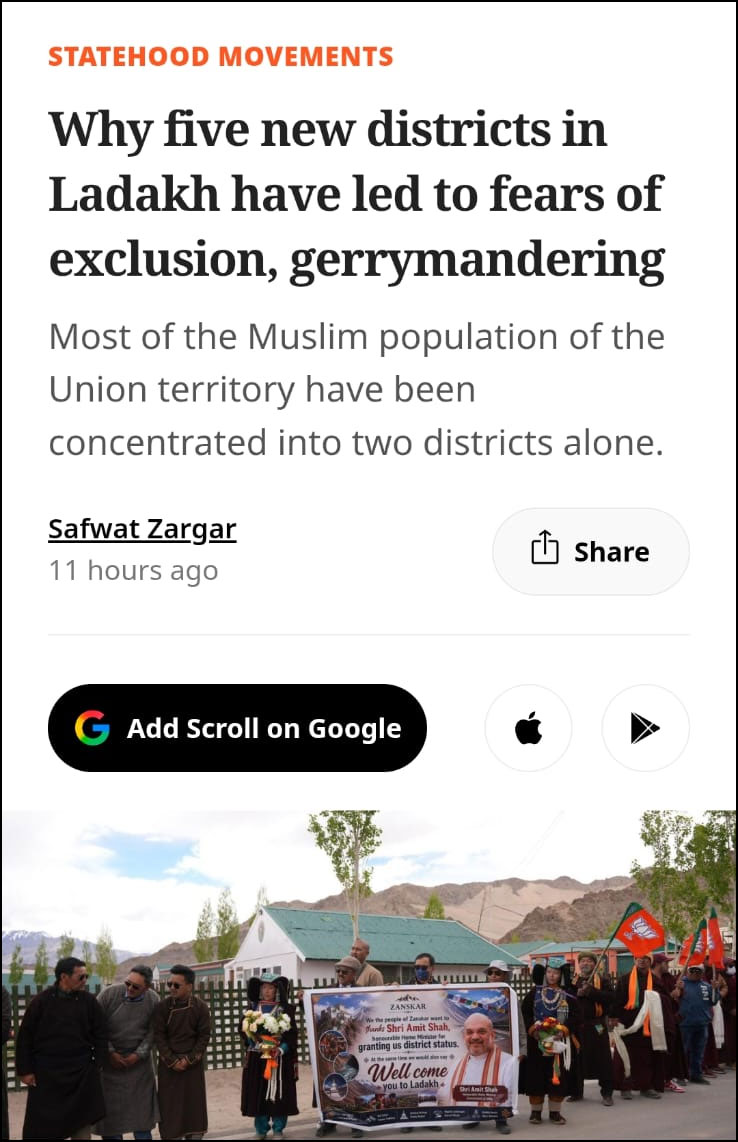
As Scroll made its point in a “convincing way”, at least from its point of view, there is one problem with the claims it has made. Ladakh’s new districts are not electoral constituencies but administrative units.
In its attempt to build a communal narrative, Scroll quoted self-styled activist Sajjad Kargili, who claimed that “if the Centre had followed the principle of proportion, four out of seven districts would have been Muslim-majority”. The report further pushed apprehensions that future delimitation “may skew constituencies”.
The whole article was based on the foundation of “may”, “could”, “possibility”, “fear” and speculation. What Scroll carefully avoided telling its readers is that gerrymandering applies to electoral boundaries, not administrative districts. No parliamentary seat has been altered. No voting ward has been redrawn. No electoral constituency has been changed.
Still, the publication pushed the agenda of “gerrymandering”, a term that specifically refers to the manipulation of electoral boundaries for political gain.
The geography of Ladakh does not work on communal arithmetic
There are five new districts that have been carved out in the UT, Nubra, Sham and Changthang in Leh, and Zanskar and Drass in Kargil. These regions were not “created” overnight to engineer demographic changes. Their religious and geographic character existed long before the notification by the Central Government.
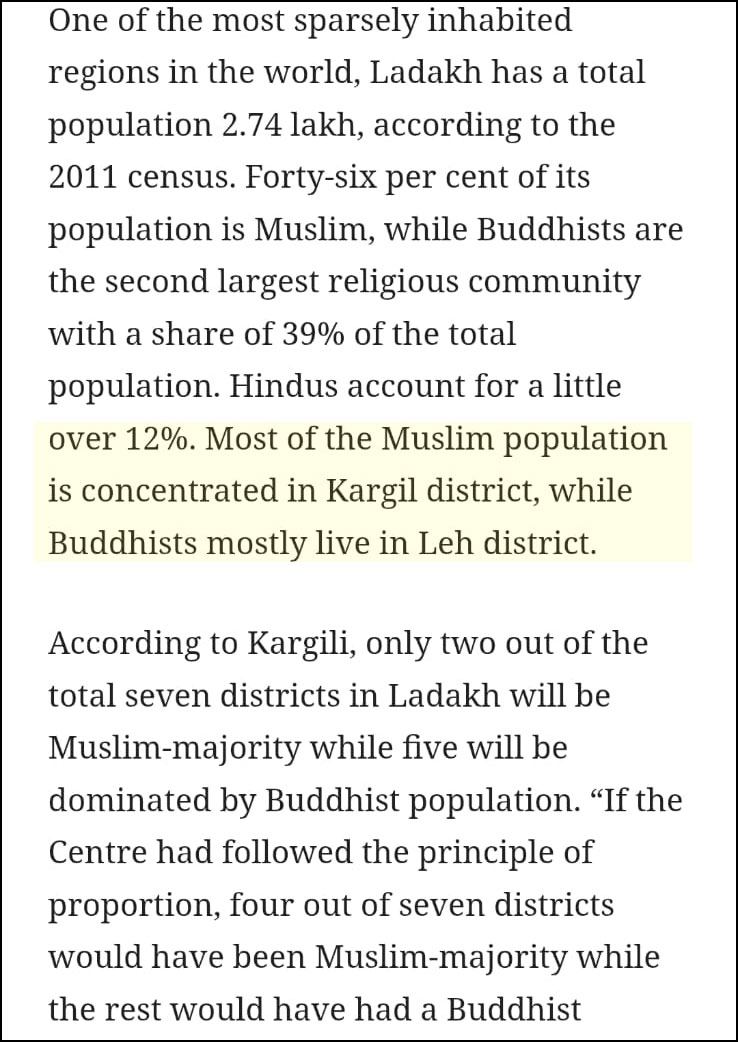
Interestingly, Scroll itself wrote that “most of the Muslim population is concentrated in Kargil district, while Buddhists mostly live in Leh district”. Yet, it attempted to present existing demographic realities as some new conspiracy hatched by the PM Modi government at the Centre.
Administrative districts are created for governance, terrain management, connectivity and local administration, not to satisfy religious proportionality formulas.
Ladakh is among India’s most sparsely populated and geographically difficult regions. Remote areas such as Zanskar, Nubra and Changthang have for years demanded separate district status for better governance, infrastructure and access to administration. Even Drass, which is Muslim-majority, received district status.
Scroll reduced all of this into simplistic communal mathematics about how many villages belong to which religion.
Scroll conveniently blurs delimitation and district creation
The irony is that actual gerrymandering involves electoral delimitation. The term applies to redrawing voting constituencies and not administrative districts. Scroll appeared to have knowingly merged the two to create political suspicion around a governance exercise.
The publication quoted fears that district-level jobs and future funds may become “skewed”, but barely engaged with the actual rationale behind decentralisation in a massive high-altitude Union Territory.
The report published by Scroll appeared designed to reinforce a familiar narrative that every administrative move by the central government must somehow be interpreted through the lens of communal victimhood and political conspiracy.
