

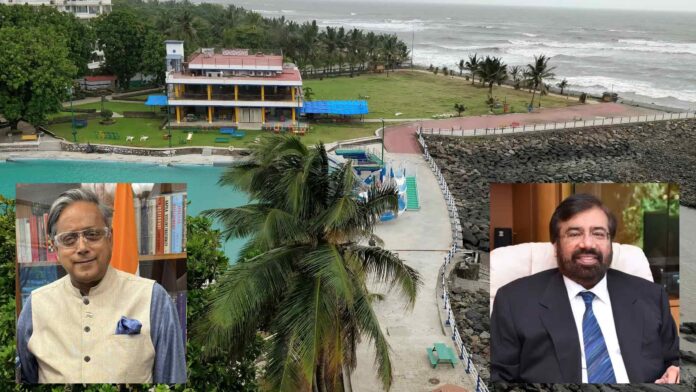
A decades-old experience shared by Congress MP Shashi Tharoor has once again brought Mumbai’s elite Breach Candy Club under public scrutiny over allegations of racism and colonial-era discrimination. The controversy erupted after the proposed takeover of the premises of Delhi’s colonial-era Delhi Gymkhana Club by the Centre reignited debate over colonial hangovers, elitism and exclusionary practices in India’s old clubs.
Shashi Tharoor recalls being thrown out of Breach Candy Club
An old blog post written by Shashi Tharoor has now gone viral on social media. In the post, Tharoor recalled how he was thrown out of the exclusive Mumbai club during the 1960s because Indians were not allowed there at the time.
“I myself was thrown out of Breach Candy Club in Bombay in the mid ’60s when an American classmate hoped he could ignore the whites and take an Indian friend along. That was India 20 years after Independence,” Tharoor had written. The incident has sparked fresh outrage online, with many questioning how such rules linked to colonial-era discrimination can continue in modern India.
According to the media reports, the club’s constitution still allows only European residents holding European passports to become members of its Trust Committee. This means Indians cannot be part of the top governing body of the club.
Reacting to the controversy again on social media, Tharoor strongly criticised the rule and questioned how such a provision could still exist on government-owned land. “There is absolutely no acceptable justification for a racist provision to survive on government land. To say the club’s constitution requires it is ridiculous. What about our country’s constitution?” Tharoor wrote on X.
There is absolutely no acceptable justification for a racist provision to survive on government land. To say the club’s constitution requires it is ridiculous. What about our country’s constitution? https://t.co/MtsWmH0rVI
— Shashi Tharoor (@ShashiTharoor) May 27, 2026
Harsh Goenka also questions colonial-era rules
Industrialist Harsh Goenka also criticised the Breach Candy Club in a social media post on Tuesday, 26th May, while raising questions about elitism and outdated colonial practices in elite Indian clubs. Goenka pointed out the irony of Mumbai projecting itself as a progressive and inclusive city while one of its most famous clubs still follows rules that exclude Indians from leadership roles.
“Mumbai never tires of talking about inclusivity and progress. Yet a few decades ago, Indians were not allowed membership at Breach Candy Club, Mumbai. Astonishingly, even today, no Indian can be on its Trust Committee; only a European living in Mumbai is allowed,” Goenka wrote on X.
Mumbai never tires of talking about inclusivity and progress. Yet a few decades ago, Indians were not allowed membership at Breach Candy Club, Mumbai. Astonishingly, even today, no Indian can be on its Trust Committee- only a European living in Mumbai is allowed.
— Harsh Goenka (@hvgoenka) May 26, 2026
The irony? The…
He also highlighted that the land on which the club stands belongs to the Maharashtra government, further intensifying the debate around the club’s rules and governance structure.
What is Breach Candy Club?
Breach Candy Club is among Mumbai’s oldest and most prestigious private clubs and has traditionally been linked to the city’s wealthy business families, diplomats and social elite. Along with the Willingdon Club and Bombay Gymkhana, it is often considered part of Mumbai’s famous “Big 3” elite clubs. Founded in 1878 during British rule, the Breach Candy Club originally functioned as a European-only social club in Bombay. Indians were reportedly not allowed membership until the 1960s. Even after Indians were later allowed to join as members, certain rules related to the club’s administration reportedly remained unchanged.
Historical records describe the club as a socially exclusive space during the British colonial period and the years immediately after Independence, where European expatriates and influential foreign business families regularly gathered. Over the years, the club became known for its sports facilities, swimming pools, restaurants and seaside leisure spaces, while also serving as an important networking centre for Mumbai’s powerful business and social circles.
