

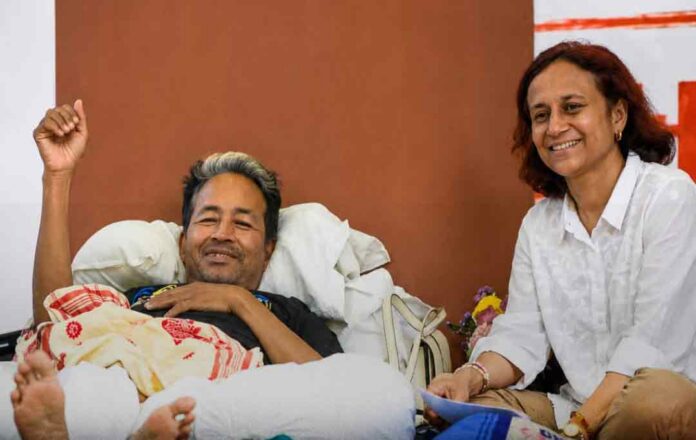
Sonam Wangchuk’s wife, Gitanjali J. Angmo, has approached the Delhi High Court, alleging that her husband is being kept at Safdarjung Hospital against his will under the guise of “medical intervention” to stop him from returning to his indefinite hunger strike at Jantar Mantar.
The petition, filed on Saturday, 18th July, has sought an urgent hearing on Sunday, 19th July, asking the court to order Wangchuk’s immediate discharge and allow him to be shifted to a hospital or medical facility of the family’s choice. Angmo has also sought unrestricted access to Wangchuk for his lawyers, family members and doctors, while requesting that no medicines, fluids or medical treatment be given without his informed consent.
According to the plea, Wangchuk was taken away from the protest site by Delhi Police around 7 am on 18th July and shifted to Safdarjung Hospital without his consent or prior notice to his family. The petition argues that there was no arrest order, preventive detention order or criminal case against him and claims his continued stay in the hospital is effectively an illegal confinement.
“His confinement is being carried out under the pretext of medical intervention to prevent his return to a peaceful protest,” the petition stated.
Gitanjali J. Angmo has also written to Safdarjung Hospital seeking his transfer to a medical facility of the family’s choice, saying their trust has been “shaken” by a lack of transparency. She alleges that the hospital administration and police are neither sharing medical reports nor allowing phones inside the room where Wangchuk is being kept. She also claims his lawyer and personal doctors are not being allowed to meet him.
Hospital shift followed High Court order and medical advice
Wangchuk has been on an indefinite hunger strike since 28th June, in support of students protesting alleged irregularities in competitive examinations.
His hospitalisation came after the Delhi High Court, in an order passed on 16th July by Chief Justice Devendra Kumar Upadhyaya and Justice Tejas Karia, directed authorities to monitor his health every day and ensure that any medical intervention considered necessary by doctors was provided.
Following his shift, Delhi Police clarified that the decision was taken in compliance with the High Court’s directions and on expert medical advice. “As per orders of the Hon’ble High Court and on expert medical advice due to the deteriorating health condition of Sh. Sonam Wangchuk, he has been shifted to the hospital for essential medical care,” the official X handle of DCP New Delhi said.
Police further said doctors found Wangchuk weak and showing signs of dehydration after 21 days of fasting and advised hospitalisation. Deputy Commissioner of Police Sachin Sharma also said the exercise was carried out peacefully with maximum restraint and denied allegations of any lathi-charge or detention of protesters.
While Angmo and members of the Cockroach Janata Party (CJP) have argued that the High Court ordered only daily health monitoring and not hospitalisation, the court order also states that any medical intervention considered necessary by doctors should be provided. Police maintain that the decision to shift Wangchuk to the hospital was based on this part of the order after doctors advised further medical care in hospital.
Family questions medical findings
According to hospital records, Wangchuk was conscious when admitted, and his pulse, blood pressure and oxygen levels were stable. However, doctors found signs of compensated acidosis, a drop in his potassium level to around 2.9 mEq/L and rising urinary ketones, warning that his condition could become life-threatening. The hospital also recorded that Wangchuk refused intravenous fluids, oral rehydration and medication.
Angmo has questioned these findings, pointing out that a test conducted a day earlier showed his potassium level at 4.3 mmol/L. She alleged that the hospital delayed providing a blood sample for independent testing and claimed that an external laboratory later recorded his potassium level at 3.6 mEq/L, which falls within the normal range.
“No treatment is underway right now. Only observation and tests are being conducted, and we are actually going to get the tests done at an external lab,” Angmo said, adding that the High Court’s order “never mandated hospitalisation.”
