

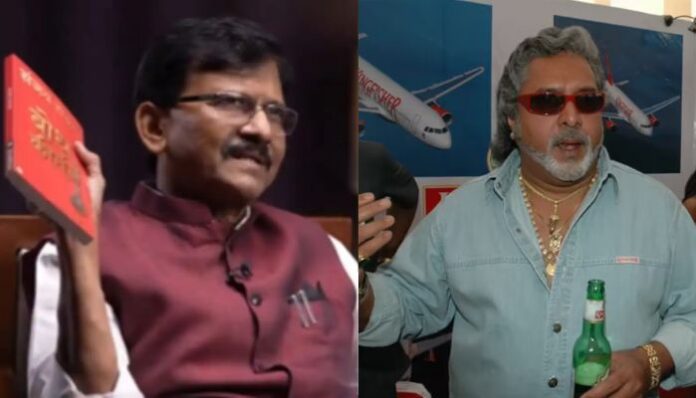
Shiv Sena (UBT) leader Sanjay Raut has stirred a fresh controversy with his new book, Bodh Kirtan, set to be officially released on Saturday, 31st October, in the presence of the Thackeray brothers. In the book, which captures his personal experiences, parliamentary encounters, and literary reflections, Raut comes out strongly in defense of fugitive industrialist Vijay Mallya. Raut claims that the former Rajya Sabha MP never had any intention of cheating anyone and was essentially forced to flee India after his airline business collapsed. Interestingly, alongside his defense of Mallya, Raut also reserves praise for Prime Minister Narendra Modi’s non-political speeches.
Describing his relationship with the businessman, Raut shares that he knew Mallya closely through their time together in Parliament and the Central Hall. He characterises him as cheerful, generous, and even “more patriotic than many parliamentary leaders”. Raut argues that Mallya’s extravagant lifestyle created undue misconceptions about him, though such a persona may have simply been necessary for his line of business.
‘Mallya needed relief, not a Waiver’
In a chapter dedicated to the former liquor baron, Raut directly challenges the widespread narrative labeling the two-term Rajya Sabha MP as a “fugitive”. He writes that when Kingfisher Airlines collapsed and its debt piled up, banks should have offered a helping hand to keep the business afloat.
Taking a swipe at the ruling government, Raut claims that the PM Modi-led government has quietly written off massive loans for numerous big industrialists over the past decade. In contrast, he claims, Mallya wasn’t asking for a full debt waiver, he simply needed institutional relief and financial breathing room to recover. Mallya fled India in March 2016 following the collapse of his airline, and a Mumbai court subsequently declared him a fugitive economic offender in 2019.
The serious legal charges against Vijay Mallya
While Raut paints a sympathetic picture, Vijay Mallya remains at the center of massive legal battles and criminal proceedings in India. The former billionaire is accused of defaulting on bank loans totaling over ₹9,000 crore linked to his now-defunct Kingfisher Airlines. After fleeing to the United Kingdom in March 2016, he became the first person in India to be declared a fugitive economic offender under a plea filed by the Enforcement Directorate.
Despite losing his legal battle against extradition to India in May 2020, Mallya has managed to avoid returning to face trial, continuing to remain out on bail in the UK while a confidential legal process, involving an application for political asylum, unfolds.
Furthermore, a London court declared him bankrupt in July 2021. To recover public funds, Indian authorities have aggressively pursued his assets; Finance Minister Nirmala Sitharaman previously informed Parliament that banks recovered approximately ₹13,109 crore by selling off seized assets of financial defaulters like Mallya, Nirav Modi, and Mehul Choksi under the Prevention of Money Laundering Act (PMLA).
Supreme Court’s contempt ruling and strict warnings
In July 2022, the Supreme Court of India handed Mallya a four-month jail sentence alongside a fine of Rs 2,000 in a long-standing 2017 contempt of court case. The apex court had found him guilty on two counts: hiding crucial financial details regarding a USD 40 million transfer to his children, and acting in “flagrant violation” of Karnataka High Court orders.
The Supreme Court bench, led by Justice UU Lalit, ordered him to deposit back the USD 40 million along with accrued interest within four weeks, warning that failure to comply would trigger the attachment of his properties. The court highlighted that Mallya had consistently shown a complete lack of remorse throughout the legal proceedings, ignoring notices to appear before it either in person or through his lawyers. Emphasising that Indian courts could no longer wait indefinitely for his extradition from the UK, the apex court moved forward with sentencing to “uphold the majesty of law.”
