

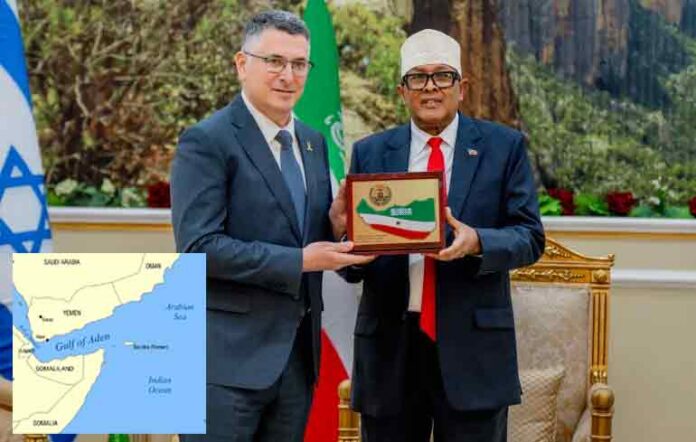
In a significant escalation of ties following Israel’s landmark recognition of Somaliland last December, the self-declared Republic of Somaliland has formally invited Israel to establish a strategic presence at its Berbera port and airport. The invitation, posted today on X by Somaliland’s official government account, emphasises Berbera’s critical geopolitical value as a gateway to the Bab el-Mandeb Strait and Red Sea.
The tweet by @RepOfSomaliland said, “Israel, you are invited to establish your presence at the Republic of Somaliland’s Berbera, gateway to the Bab el-Mandeb and the Red Sea.” It highlights Berbera Airport’s status as home to Africa’s longest runway and the port as one of the world’s most strategic deep-water facilities. It said that the strategic corridor handles 15% of global trade, 30% of global container traffic, and 10% of seaborne petroleum, calling for “security ties and mutual prosperity.”
Israel 🇮🇱, you are invited to establish your presence at the Republic of Somaliland’s Berbera, gateway to the Bab el-Mandeb and the Red Sea.
— REPUBLIC OF SOMALILAND (@RepOfSomaliland) March 12, 2026
– Berbera Airport: longest runway in Africa
– Berbera Port: one of the world’s most strategic deep-water ports
A strategic corridor… pic.twitter.com/G1gNCnEcc9
This offer comes directly after Israel’s December 2025 decision to become the first United Nations member state to formally recognise Somaliland as an independent and sovereign nation, a move sealed in a joint declaration signed by Israeli Prime Minister Benjamin Netanyahu, Foreign Minister Gideon Saar, and Somaliland’s president.
What is Somaliland?
Somaliland is a self-declared independent republic in the Horn of Africa, occupying the northwestern territory of what is internationally recognised as Somalia. It broke away and declared independence in May 1991 after the overthrow of Somali dictator Siad Barre, whose regime had waged a brutal civil war against the region. Since then, Somaliland has functioned as a de facto sovereign state with its own democratically elected government, currency (the Somaliland shilling), passport, military, and institutions.
Somaliland, with its capital in Hargeisa, has maintained relative stability and held multiple peaceful transitions of power, in stark contrast to the instability plaguing much of Somalia. Despite these achievements, Somaliland remained unrecognised by any UN member state for 34 years until Israel’s historic step in December 2025.
It occupies the northwestern region of Somalia, bordering Djibouti to the northwest, Ethiopia to the south and west, and the rest of Somalia to the east. The most important aspect of its location, however, is not the land borders, it is the 850-kilometre-long coastline in the Gulf of Aden, the waterway that connects the Red Sea to the Arabian Sea, and watches over a large chunk of global trade passinge over a sea-route that has been contested, and fought over for centuries.
The former British Somaliland Protectorate gained independence in 1960 and became the State of Somaliland on June 26, 1960. Just days later, on July 1, 1960, it voluntarily joined the former Italian Somaliland to form the Somali Republic, but the union did not last long. The Somalis of the Northern areas were alienated and marginalised under the political dominance of southern groups. After Somalia’s disastrous 1977–1978 Ogaden War with Ethiopia, under the dictatorship of Siad Barre, the tension peaked. Barre bombarded the northern territories, destroyed Hargeisa and killed thousands of people.
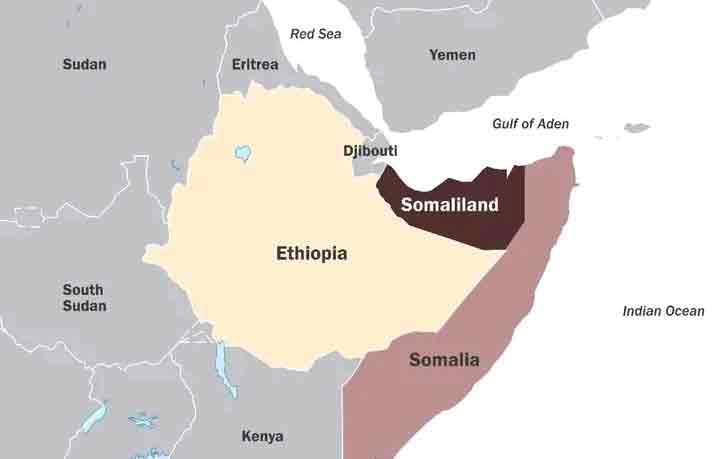
In response, the Somali National Movement (SNM) launched a guerrilla war against Barre’s regime. During the fall of Barre regime in 1991, the SNM already controlled the northwestern lands. At the Grand Conference of Northern Clans in Burao in 1991, SNM leaders revoked the 1960 union and declared an independent Somaliland, recognising the borders of the former British Protectorate as the new independent nation of Somaliland.
Despite having no UN recognition as a country, Somaliland has been a country in terms of governance and jurisprudence. It blends modern democracy with traditional clan-based rule to form a functional, peaceful governing system, with peaceful transfers of power, a sharp contrast to Somalia, which is a fragile land destroyed by civil wars. Somaliland holds regular multi-party elections and is ranked as ‘partly free’ by Freedom House.
Somaliland has a relatively stable and lawful governance, with low instances of piracy and terrorism. It has its own police and military and maintains territorial integrity in the region.
Somalia continues to view it as an integral part of its territory, and the African Union, Arab League, and several regional powers have condemned the Israeli recognition as a threat to Somali sovereignty.
Israeli Plans for a Base in Somaliland
Bloomberg and other outlets reported this week that Israel is actively exploring the construction of a military base — possibly covert — in Somaliland to gather intelligence and conduct operations against Yemen’s Iran-backed Houthi rebels. Two Somaliland officials confirmed the government would permit such activities. It was reported that discussions have gained urgency amid Israel’s broader conflict with Iran.
Israeli security officials surveyed Somaliland’s coastline in June 2025, focusing on sites including an elevated area roughly 100 km west of Berbera, a location that offers proximity to Yemen, just 260 km across the Gulf of Aden. Berbera’s existing UAE-operated port and military airstrip, along with its 5-km runway capable of handling heavy aircraft, make it an ideal forward operating location.
Somaliland’s Minister of the Presidency Khadar Hussein Abdi said that the partnership is advancing rapidly, potentially including Israeli training and defence systems for Somaliland in exchange.
The strategic goals for Israel include setting up a base closer to Houthi strongholds, monitor Red Sea shipping lanes, and respond more swiftly to attacks that have disrupted 15% of global trade. Houthi leader Abdel Malek al-Houthi has already warned that any Israeli presence in Somaliland would be treated as a “military target,” raising fears of retaliatory missile or drone strikes, risks that could also endanger Berbera’s commercial operations and expose the port to Iranian or Houthi threats. Al-Shabaab, the Somalia-based al-Qaeda affiliate, has similarly vowed opposition.
Somalia has denounced the entire process as an “unlawful step” undermining its territorial integrity, while Turkey, Egypt, and the Arab League have voiced strong criticism. Pro-Israel voices, however, hail the move as a pragmatic alliance between two stable, democratic partners in a volatile region. Somaliland officials are actively supporting the deal, saying that the partnership is essential for security and economic development of the nation.
A planned presidential visit and formal trade agreement between the two sides are expected later this month, according to earlier reports.
The invitation marks a dramatic shift in Middle East–Horn of Africa relations, turning Somaliland’s long-isolated Berbera into a potential base for Israeli operations against one of Tehran’s most active proxies.
