

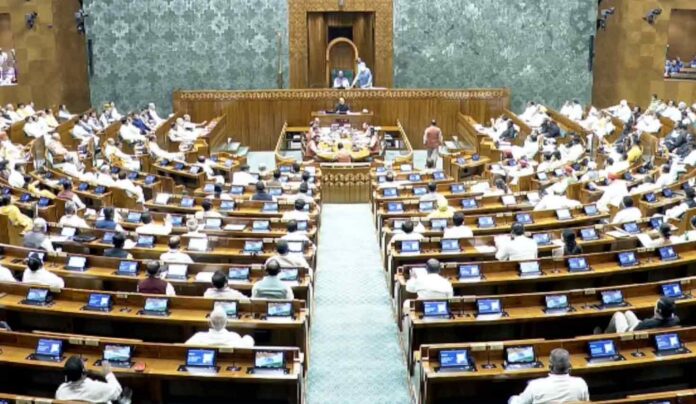
The three-day special sitting of Parliament began on Thursday morning as the government introduced three major bills aimed at paving the way for the implementation of 33 per cent reservation for women in the Lower House and state assemblies ahead of the 2029 general elections.
Lok Sabha Speaker Om Birla presided over the proceedings as the House took up the Constitution (One Hundred and Thirty-First Amendment) Bill, 2026, the Delimitation Bill, 2026, and the Union Territories Laws (Amendment) Bill, 2026. Opposition members pressed for a division rather than a voice vote on the introduction of the legislation.
Following the demand, division took place using the Automatic Vote Recorder system. A total of 333 members participated, resulting in 251 votes in favour (AYES) and 185 against (NOES), with no abstentions. The bills were subsequently introduced with a clear majority of the house
Law Minister Arjun Ram Meghwal moved the Constitution (One Hundred and Thirty-First Amendment) Bill, 2026, and the Delimitation Bill, 2026, while Union Home Minister Amit Shah introduced the Union Territories Laws (Amendment) Bill, 2026. Earlier on 14th April, the Centre circulated draft Bills among MPs, related to the Nari Shakti Vandan Adhiniyam- implementation of the women’s reservation law, and a fresh delimitation exercise including increasing the number of Lok Sabha constituencies.
The Constitution (One Hundred and Thirty-First Amendment) Bill, 2026 seeks to amend the Constitution, including Articles 81 and 82, to increase the strength of the Lok Sabha from the current 543 seats to approximately 850. This expansion is intended to accommodate the one-third reservation for women without reducing the existing representation of other groups. As per the government, 50% seats will be increased in every state and UT, preserving the current proportion of seats of the states and the UTs in the parliament. Of the 850 seats, around 283 will be reserved for women.
The Delimitation Bill, 2026 provides for the constitution of a new Delimitation Commission to redraw parliamentary and assembly constituencies on the basis of the latest population data. It forms a key part of the process to operationalise the women’s reservation law, which was passed in 2023 but requires fresh delimitation to take effect.
The Union Territories Laws (Amendment) Bill, 2026 makes corresponding changes to laws governing Union Territories to align their electoral frameworks with the proposed delimitation exercise and expanded seat allocation.
The special session, which runs from 16 to 18 April, has been convened specifically to debate and pass these measures. The government has allocated 12 hours for discussion, with voting on the passage of the bills scheduled for 4 pm on Friday, 17 April. Prime Minister Narendra Modi had earlier appealed to opposition parties to support the legislation unanimously, describing it as fulfilling the aspirations of women across the country.
Opposition parties, including the INDIA bloc, have expressed reservations about the timing and basis of the delimitation process, with some members moving motions against the introduction of the bills. The government maintains that the package will enable the long-pending women’s reservation to be implemented effectively from the next general elections.
