


On 11th May (Monday), a case under the Scheduled Castes and Scheduled Tribes (Prevention of Atrocities) Act was dismissed by the Supreme Court. The complainant, who belonged to the Scheduled Caste category, charged that he was subjected to caste-based abuses within the four walls of a home. Both the accused and the complainant are family members. The parties were already at odds over their late father’s property.
A bench of Justice Prashant Kumar Mishra and Justice NV Anjaria invoked multiple judgements to point out that “to make out the offence under Section 3(1)(r) and/or Section 3(1)(s) of the SC/ST Act, the occurrence of the incident and the act and conduct of hurling of castebased abuses must take place at a place within public view. It must be a place within the public gaze. Even happens to be a private place, then in such eventuality a public eye must have access to be able to notice what happens there or what is taking place that will only make the place within public view.“
The order mentioned that the accusations regarding the purported misbehaviour did not mention any particular incident or day and they are too unrelated to be of any use to prove a crime under the SC/ST Act’s Section 3(1)(r) or Section 3(1)(s).
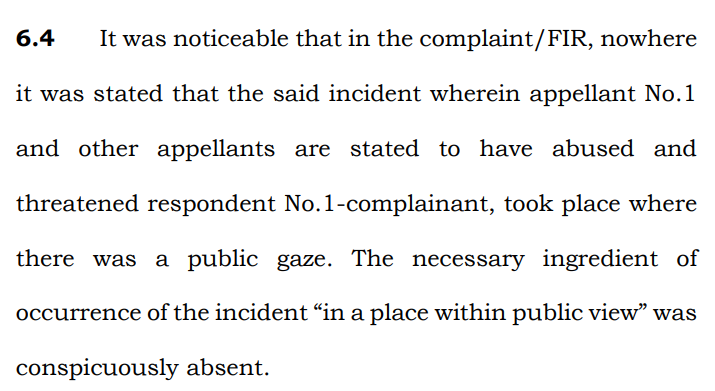
“It was noticeable that in the complaint/FIR, nowhere it was stated that the said incident wherein appellant No.1 and other appellants are stated to have abused and threatened respondent No.1-complainant, took place where there was a public gaze. The necessary ingredient of occurrence of the incident in a place within public view was conspicuously absent,” the court further observed.
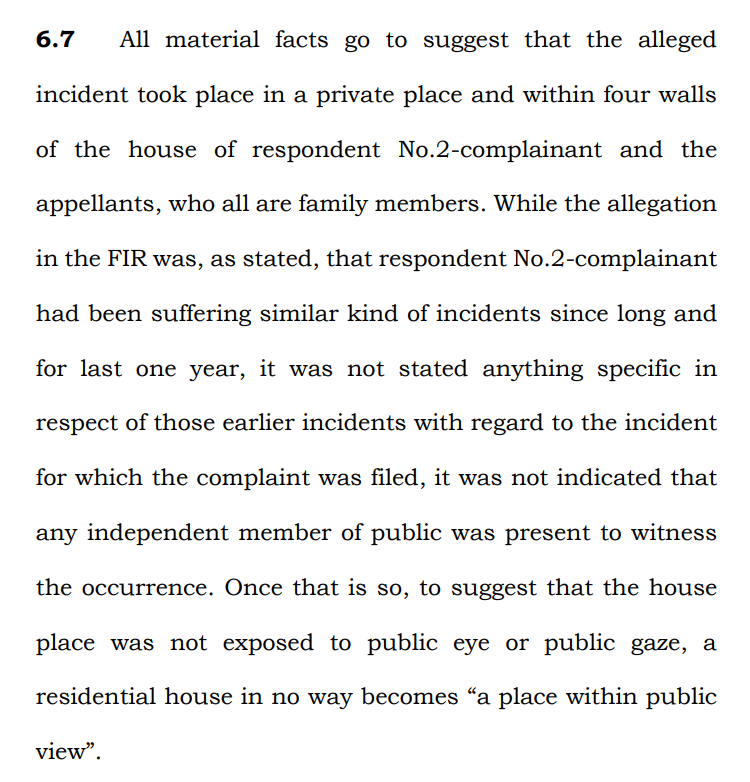
It highlighted that all relevant information refers to the instance originating inside the four walls of the house of the respondent No. 2-complainant and the appellants as they are all family members. According to the FIR, respondent No. 2-complainant had been experiencing similar situations for the past year. However, nothing particular was revealed about those earlier events in relation to the incident for which the complaint was submitted, and no neutral member of the public was present to observe the event.
“Once that is so, to suggest that the house place was not exposed to public eye or public gaze, a residential house in no way becomes a place within public view,” the bench outlined. It continued to cite several verdicts delivered by different courts to assert that the case cannot progress in the evident absence of the requisite elements required to form the offence.
The court pronounced, “Thus, it is trite principle that the FIR becomes liable in law to be quashed when it, in its bare reading, does not disclose the necessary ingredients to constitute the offence alleged therein. The basic constituents of the offence alleged in the FIR must stem and stand disclosed from the contents of the FIR.”
It added that the FIR must manifest and expose the fundamental components of the violation or infractions claimed in order for it to be sustainable in law as a good and acceptable record to proceed criminal against any accused identified therein or any person to be made accused on its basis.
Furthermore, it was discovered that the two witnesses listed in the FIR were the complainant’s friends and that their testimony did not prove they had seen the purported occurrence.
“For an offence to be made out under Sections 3(1)(r) and 3(1)(s) of the SC/ST Act, as is the question in the instant case, the requirement that the occurrence has to be in a place within public view is not satisfied, is missing and absent,” the bench reiterated.
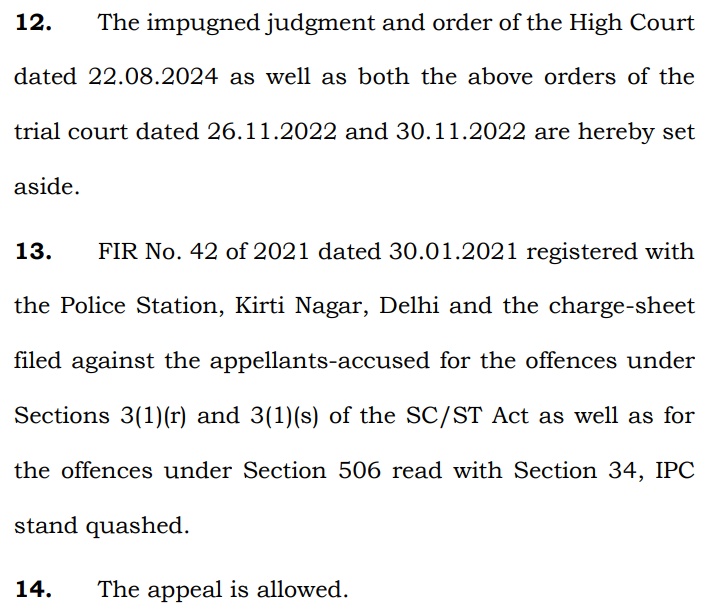
“The impugned judgment and order of the High Court dated 22.08.2024 as well as both the above orders of the trial court dated 26.11.2022 and 30.11.2022 are hereby set aside,” the judges declared in light of the facts of the matter.
Additionally, they rejected the criminal intimidation accusation under Section 506 IPC, ruling that the contents of the FIR did not show any purpose to cause “alarm,” a vital element of the offence. The court informed that “the charge-sheet filed against the appellants-accused for the offences under Sections 3(1)(r) and 3(1)(s) of the SC/ST Act as well as for the offences under Section 506 read with Section 34, IPC stand quashed,” and allowed the appeal.
Background of the issue
The case commenced with a First Information Report (FIR), accusing that the complainant and his wife were attacked with casteist insults such as “dirty drain,” “chura,” “chamar,” and “harijan” by the accused who apparently tried to forcefully open the former’s house lock. It was registered at Delhi’s Kirti Nagar Police Station on 30th January 2021. This incident took place on 28th January.
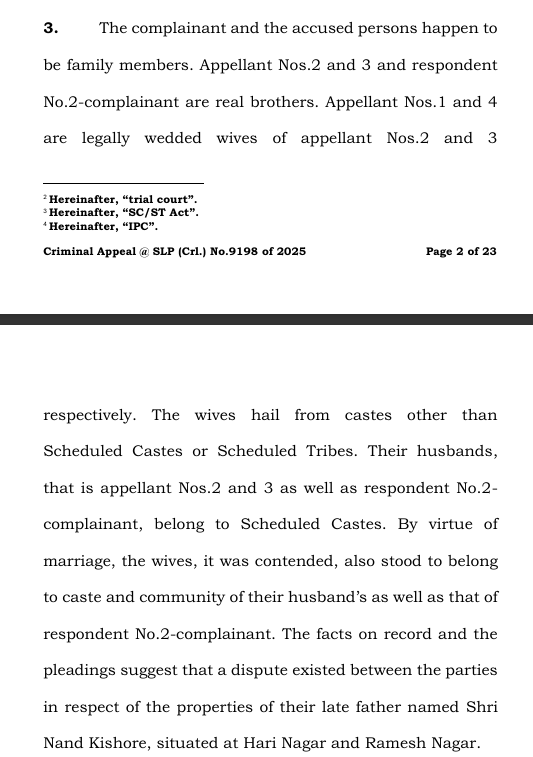
While the accused’s spouses belonged to non-SC/ST communities, the complainant and two of the accused were real brothers from a Scheduled Caste community. The order read, “By virtue of marriage, the wives, it was contended, also stood to belong to caste and community of their husband’s as well as that of respondent No.2-complainant. The facts on record and the pleadings suggest that a dispute existed between the parties in respect of the properties of their late father named Shri Nand Kishore, situated at Hari Nagar and Ramesh Nagar.“
One of the accused was charged under Sections 3(1)(r) and 3(1)(s) of the SC/ST Act by the trial court, while the rest were charged under Section 506 read with Section 34 of the IPC. Later, the Delhi High Court declined to intervene with the charge-framing order.
The appellants argued that neither the allegations in the complaint revealed the elements of an offence under Section 506 read with Section 34, IPC, nor the offences under Sections 3(1)(r) and 3(1)(s) of the SC/ST Act were made out from the statements and contents of the FIR, particularly when the crime under the SC/ST Act was not shown to have been committed at “a place within public view,” which was an essential requirement to constitute such offences.
